
Chinese Herbs for Anxiety: Your Gentle Path to Calm
Explore Chinese herbs for anxiety with a gentle, supportive guide. Learn about TCM, common formulas, safety, and how to pair herbs with affirmations for calm.
Your chest feels tight. Your thoughts keep looping. You try deep breathing, then tea, then a scroll through your phone for answers that all seem to say different things. Part of you wants something gentle. Part of you wants something that makes sense.
That's where many people first become curious about Chinese herbs for anxiety. Not because they want a trendy fix, but because they want to feel more like themselves again.
Traditional Chinese Medicine, often called TCM, offers a different lens. It doesn't separate the mind from the body quite so sharply. It asks how your sleep, digestion, emotions, energy, and stress all interact. It treats anxiety less like a single label and more like a message from an overwhelmed internal system that needs support.
That can feel relieving.
Instead of asking, “What herb is for anxiety?” TCM asks, “What kind of anxiety are you experiencing?” Is it tension and frustration? Restlessness at night? Mental overthinking that drains your energy? Feeling wired but also depleted? Those distinctions matter in Chinese herbal medicine.
There's also room here for modern self-awareness. Herbs may support the body's stress response, while daily mindset practices can help soften the thought patterns that keep anxiety cycling. One works from the inside out. The other works from the mind inward. Together, they can create a steadier foundation for calm.
A Quiet Invitation to Inner Calm
You wake up already bracing for the day. Before your feet hit the floor, your mind has started its usual round of what-ifs. What if I mess up that conversation? What if something's wrong with my body? What if I never feel settled again?
By noon, your shoulders are tight, your stomach feels off, and even small decisions seem strangely heavy. You may still be functioning. You may even look fine to everyone around you. But inside, everything feels noisy.
That inner noise is often what sends people searching for Chinese herbs for anxiety. They're not always looking for sedation. Many are looking for a way to feel regulated, steady, and safe in their own body again.
Anxiety can feel mental, physical, and emotional all at once
Anxiety rarely stays in one lane. It can show up as racing thoughts, but also as shallow breathing, poor sleep, irritability, digestive discomfort, muscle tension, or sudden emotional sensitivity. That mix is one reason TCM has stayed meaningful to so many people over time. It doesn't treat the mind as separate from the rest of you.
In this tradition, emotional distress can be connected to patterns of imbalance in the body. The goal isn't to silence symptoms by force. The goal is to restore smoother internal balance so calm feels more available.
You don't need to “win” against anxiety to begin healing. You need a safe way to listen to what it's asking of you.
An ancient system with a gentle point of view
Chinese herbal medicine comes from a long lineage of observation. Practitioners looked closely at how stress changes sleep, appetite, mood, menstruation, digestion, and energy. Over time, they developed formulas meant to fit patterns, not just labels.
One of the best-known formulas, Xiao Yao San, has been recorded since an 11th-century compendium of prescriptions, giving it a continuous lineage of roughly 900 years, and modern reviews have described it as one of the most established Chinese herbal approaches discussed in global literature on anxiety and mood support (historical and clinical overview).
That kind of history doesn't mean every herb is right for every person. It does mean this is a mature healing tradition, not a random collection of calming plants.
For many people, the most confidence-building approach is both practical and compassionate. Support the body. Understand your pattern. Build calm a little at a time. Let your healing be thoughtful rather than frantic.
How TCM Understands Anxiety
TCM sees your internal state a bit like a garden. For a garden to thrive, the soil needs nourishment, water needs to move, sunlight has to be balanced, and the whole ecosystem must stay in relationship. Anxiety, in this view, can happen when something in that internal garden becomes stuck, depleted, overheated, or unsettled.
The language may sound unfamiliar at first, but the ideas are often surprisingly intuitive.
Qi, Blood, and Shen in simple terms
Qi is often described as your vital energy. Think of it as movement. It helps things circulate, transform, and respond. When Qi flows smoothly, you tend to feel more adaptable. When it gets stuck, you may feel tense, irritable, sighing, tight in the chest, or emotionally bottled up.
Blood in TCM isn't just the fluid in your veins. It also represents nourishment and grounding. When this aspect is insufficient, a person may feel restless, unanchored, or mentally overactive in a thin, depleted sort of way.
Shen refers to the spirit or consciousness. In plain language, it reflects mental clarity, emotional steadiness, and that feeling of being settled within yourself. When Shen is disturbed, sleep may become light, thoughts may race, and your mind can feel unable to land.
Why one person's anxiety doesn't look like another's
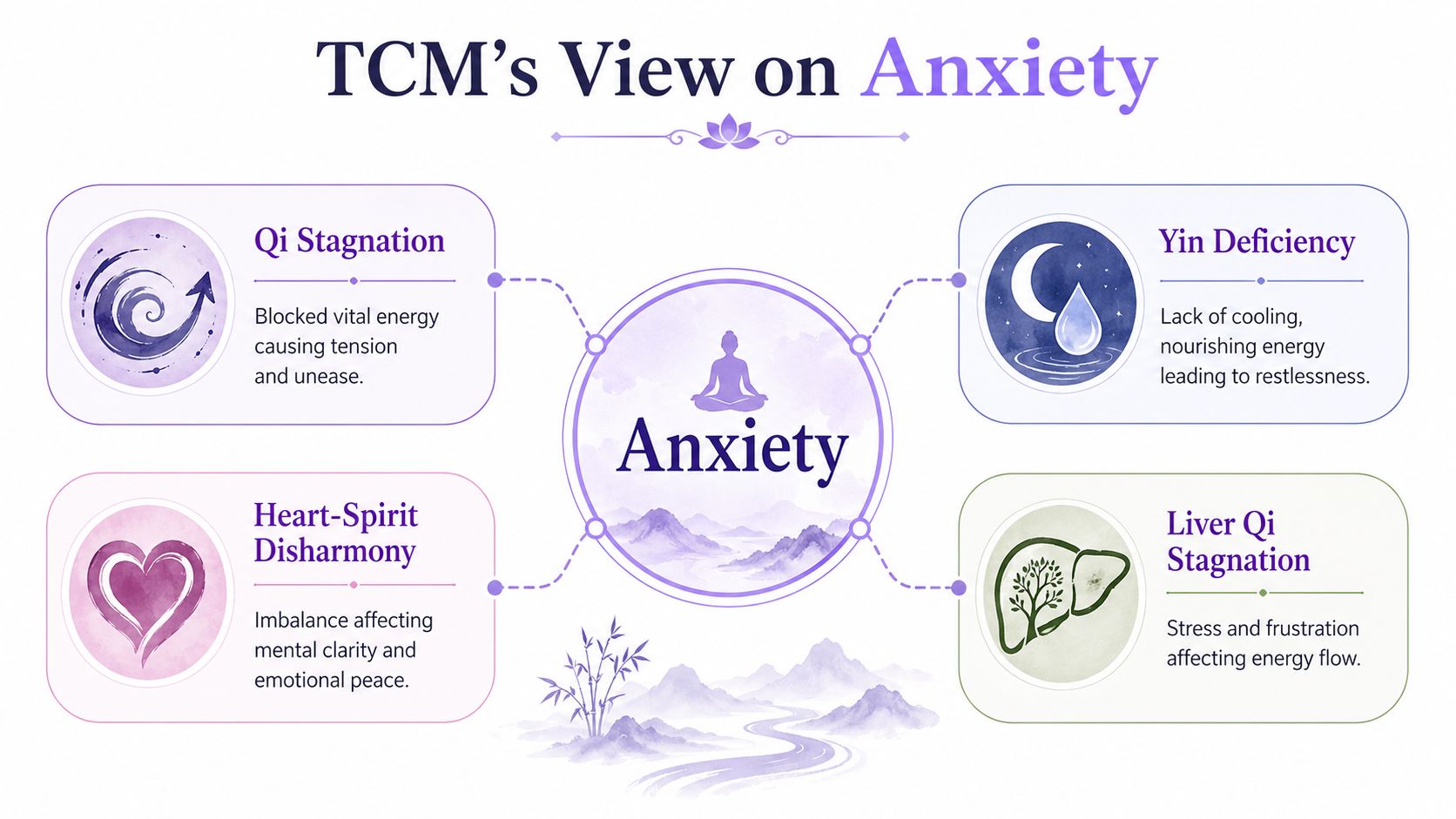
TCM treatment becomes more individualized. Two people can both say, “I feel anxious,” while their patterns are completely different.
A practitioner may look for signs such as:
- Liver Qi stagnation. Stress feels pent up. You're irritable, emotionally tight, and prone to frustration or mood swings.
- Heart-Spirit disharmony. You feel restless, easily startled, or unable to settle into sleep or stillness.
- Yin deficiency. Anxiety feels hot, wired, dry, and agitated, often worse at night.
- Spleen-related worry. Your mind keeps chewing on the same thoughts, and overthinking leaves you drained.
A 2024 review of Traditional Chinese Medicine for anxiety noted that formulas such as Chaihu Shugan Powder and Xiaoyao Powder are used to target distinct TCM patterns like liver Qi stagnation, and that these formulas may modulate anxiety-related neurobiology by increasing brain 5-HT synthesis and release. The same review also noted that ginseng may reduce anxiety by downregulating the HPA axis, lowering stress hormones like cortisol (review details).
That's one of the most helpful bridges between ancient and modern thinking. TCM patterning isn't just poetic language. It's a way of matching treatment to the shape anxiety takes in a real person.
The body systems TCM pays attention to
In TCM, the Liver helps Qi move smoothly, especially around emotion and stress. When that movement gets constrained, people often feel wound up and stuck. The Spleen relates to digestion, nourishment, and repetitive thinking. When it's strained, worry can spiral and energy may dip.
That connection is one reason some people also explore resources on the gut-brain relationship and supplements for mood and digestion. For many readers, it helps to see that anxiety isn't only about thoughts. It can also involve digestion, stress hormones, and the body's broader regulation systems.
Practical rule: If an herbal recommendation doesn't seem to match your actual pattern of symptoms, it may not be the right fit, even if it's popular.
Meet the Calming Herbs and Formulas
Some Chinese herbal formulas feel like gentle organizers. Some feel more like nourishers. Others are there to settle a system that has become too stirred up. This is why Chinese herbs for anxiety are usually discussed as formulas, not isolated herbs. The blend is the medicine.
A formula is built like a small team. One ingredient leads. Others support, direct, soften, or balance the action.
Xiao Yao San as the classic stress-soothing formula
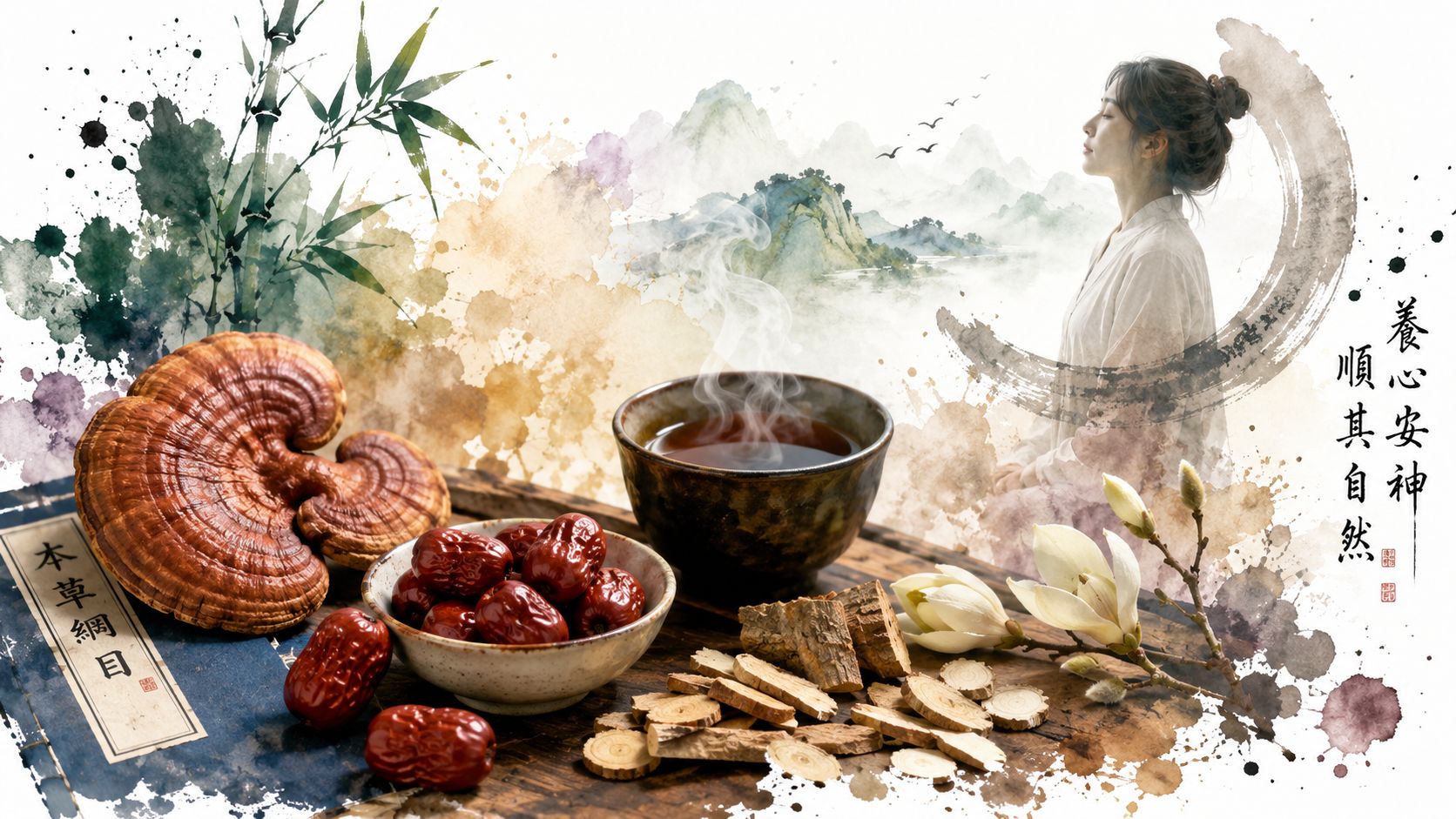
Xiao Yao San is one of the best-known formulas in this area. It's often associated with patterns where stress, irritability, emotional tension, and fatigue travel together. In everyday language, it's often used when someone feels constrained and depleted at the same time.
Modern research has paid unusual attention to this formula. A 2023 systematic review and meta-analysis found that adding Xiao Yao San to anxiolytic treatment improved efficacy versus anxiolytics alone with a risk ratio of 1.19 and lowered adverse events with a risk ratio of 0.44. The same review also reported that Xiao Yao San used alone outperformed anxiolytics alone on treatment efficacy with a risk ratio of 5.41 (meta-analysis findings).
That doesn't mean everyone should start taking it on their own. It does show why this formula keeps appearing in both traditional discussions and modern anxiety research.
Other formulas you may hear about
Some formulas are mentioned often in conversations about emotional regulation, sleep, and stress sensitivity. Their names can sound technical, but their roles are easier to understand when translated into felt experience.
| Formula Name | Traditional Use | Best For Feelings Of... |
|---|---|---|
| Xiao Yao San | Soothes Liver Qi and supports internal balance | Irritability, emotional tension, stress with fatigue |
| Chaihu Shugan Powder | Moves constrained Liver Qi | Frustration, chest tightness, mood stuckness |
| Gan Mai Da Zao Tang | Gently nourishes and calms emotional sensitivity | Feeling tender, overwhelmed, weepy, easily unsettled |
| Suan Zao Ren Tang | Nourishes and calms restlessness, often around sleep | Tired but unable to relax, nighttime agitation |
| Tian Wang Bu Xin Dan | Nourishes deeper depletion and calms the spirit | Restlessness with dryness, poor sleep, feeling ungrounded |
A table like this can help, but it's still only a sketch. The same formula can be appropriate for one anxious person and completely wrong for another.
What “soothing the Liver” or “nourishing the Heart” can feel like
When TCM says a formula soothes the Liver, it usually points to easing internal constriction. A person may feel less emotionally jammed, less reactive, and more able to exhale. When a formula nourishes the Heart, that often refers to supporting sleep, calm, and a settled sense of presence.
Those phrases aren't random metaphors. They describe what a treatment is trying to shift in lived experience.
For readers curious about how herbal traditions are also influencing modern wellness culture, it's interesting to explore future beverage trends and notice how calming botanicals are increasingly showing up in teas and functional drinks. That doesn't replace proper herbal care, but it does show how ancient plant wisdom keeps finding new forms.
A short visual overview can help make these formulas more memorable.
Some formulas calm because they reduce internal friction. Others calm because they replenish what stress has worn down.
Why formulas matter more than trends
It's tempting to search for a single “best” herb. TCM usually resists that idea. Anxiety can come from tension, deficiency, overstimulation, poor sleep, or a mix of several patterns. A formula gives practitioners more precision.
That precision is part of the wisdom here. Rather than forcing every anxious experience into the same box, Chinese herbal medicine asks a kinder question. What does your system need in order to feel safe enough to soften?
Finding Your Guide to TCM Wellness
If you're exploring Chinese herbs for anxiety, one of the most caring choices you can make is not to self-prescribe based on a social media post or a product label. TCM works best when someone looks at your full pattern, not just your most uncomfortable symptom.
Two people can both have anxiety, poor sleep, and chest tightness. One may need a formula that moves tension. Another may need support for depletion. If they swap formulas, both could miss the mark.
Why professional guidance matters
Recent scientific and regulatory discussion around traditional medicines has emphasized the need for better standardization, pharmacovigilance, and clearer guidance for integrative use, especially because consumer information often skips practical questions about contamination, product variability, and interactions with medications such as SSRIs, benzodiazepines, or sleep aids (safety and interaction discussion).
That's the quiet part many wellness articles leave out. “Natural” doesn't automatically mean simple, gentle, or risk-free.
What to look for in a practitioner
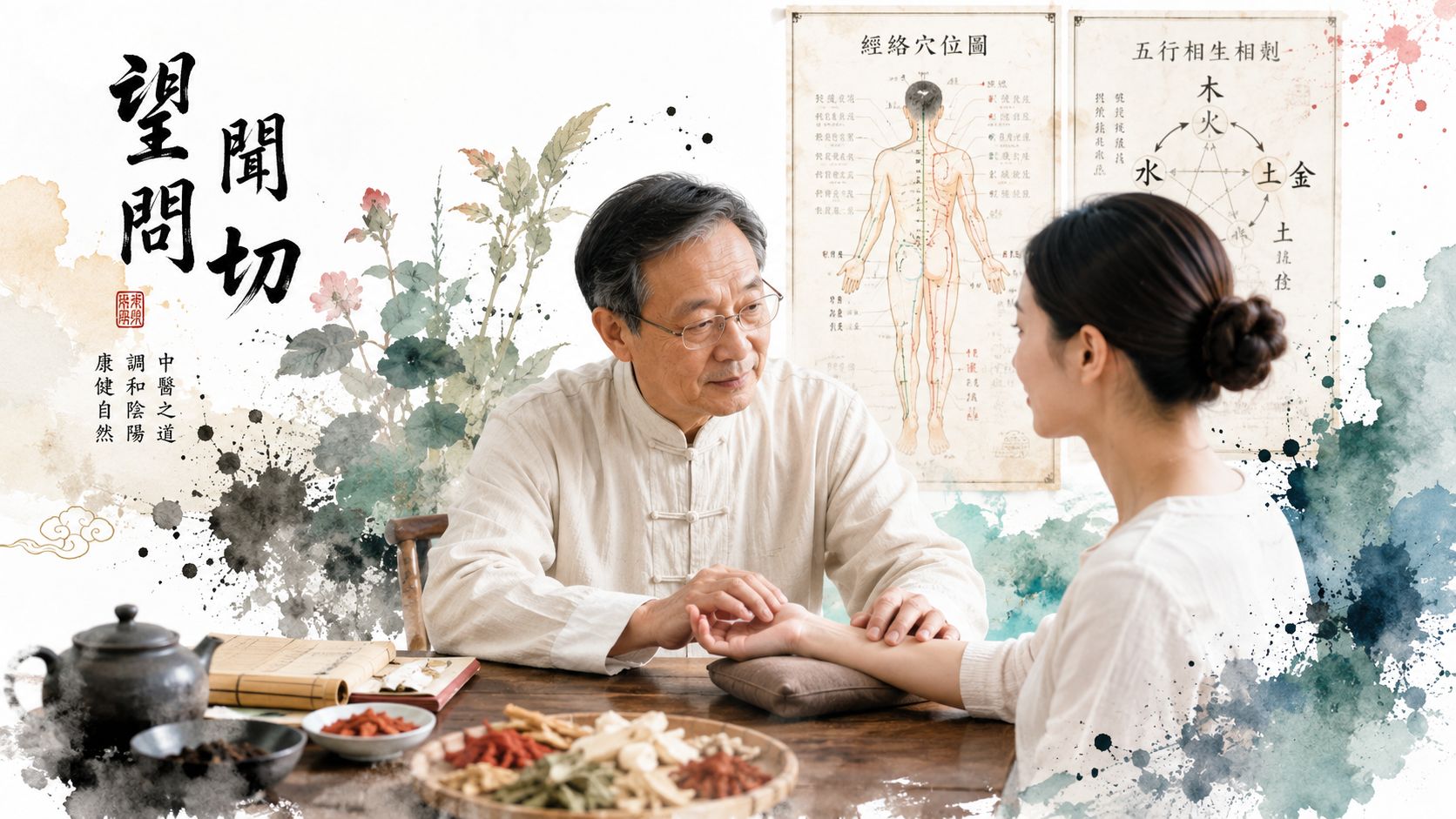
A good TCM practitioner should make you feel informed, not pressured. They should ask about your sleep, digestion, menstrual cycle if relevant, medications, mood, stress history, and physical symptoms. They may also use pulse and tongue assessment as part of their evaluation.
Here are a few smart questions to bring to a first appointment:
- How do you determine which formula fits my pattern?
- Do you screen for herb and medication interactions?
- How do you choose brands or suppliers for quality control?
- What changes would tell us the formula is helping or not helping?
- When should I also follow up with my physician or therapist?
If anxiety is affecting your daily functioning, you might also appreciate supportive digital tools alongside clinical care. Some readers find it useful to pair practitioner guidance with evidence-informed self-help resources like these apps to help with anxiety.
Red flags to avoid
Be cautious if someone promises a cure, dismisses your prescriptions, or offers the same formula to everyone with anxiety. Also step back if a practitioner discourages medical evaluation for symptoms that could point to another health issue.
The right practitioner won't make you feel helpless. They'll help you understand your body more clearly and make safer decisions.
Working with someone qualified isn't an extra hurdle. It's part of the treatment itself. Being seen accurately is often the first calming step.
Weaving Herbs and Habits into Your Daily Life
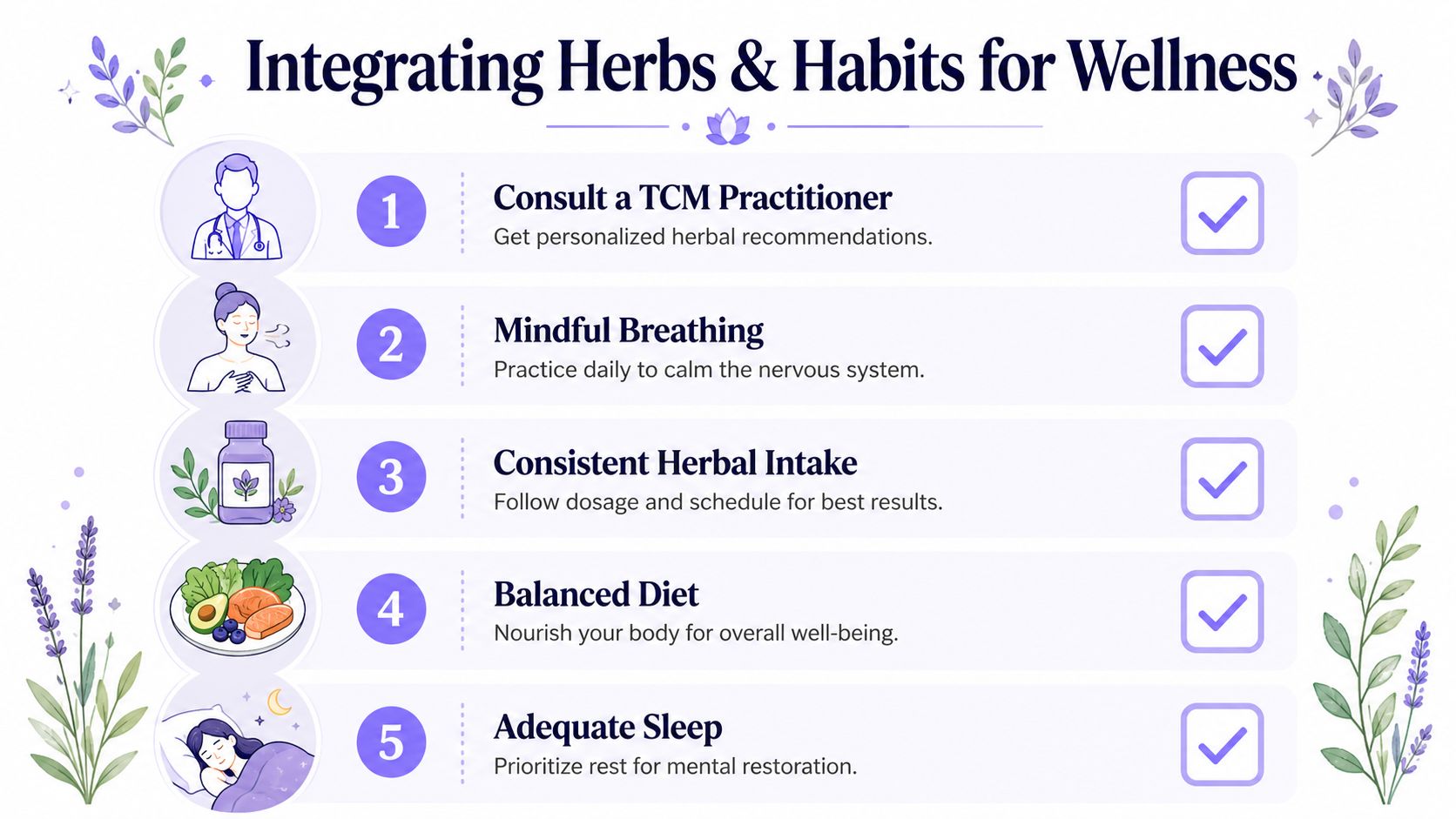
Herbs can help create the conditions for calm. Habits help you recognize, reinforce, and return to that calm. Without that second piece, it's easy to feel better briefly and then slide back into the same inner alarms.
This is where ritual matters.
When you take an herbal formula with intention, or sip a practitioner-recommended tea without multitasking, you're doing more than consuming something. You're telling your nervous system, “I'm here. I'm listening. I'm supporting myself on purpose.”
Turn support into a repeatable ritual
A calming ritual doesn't need to be elaborate. It needs to be consistent enough that your body starts to recognize it.
Try a sequence like this:
- Pause before taking your herbs and notice your breath without trying to fix it.
- Name your current state in a gentle way. “I feel activated.” “I feel scattered.” “I feel tired and on edge.”
- Take the formula as directed by your practitioner.
- Add one steadying action such as a hand on the chest, a few slow exhales, or sitting in silence for a minute.
- Close with a sentence you want your mind to learn.
That final step matters. Thoughts shape experience. When anxiety has been loud for a long time, many people develop automatic inner messages like “I'm not safe,” “I can't handle this,” or “Something bad is about to happen.” A calming body practice creates space. A compassionate phrase helps fill that space with something new.
Affirmations that pair well with calming practices
Affirmations work best when they feel believable enough to repeat and strong enough to guide attention. They aren't magic words. They're training cues for the mind.
You might try:
- I am safe in this moment.
- My body is learning how to soften.
- I can feel discomfort without becoming it.
- Peace is something I can practice.
- I return to myself one breath at a time.
If anxious thinking tends to race at night or spiral during the day, it may also help to learn a few concrete grounding methods. This guide on how to calm anxious thoughts offers practical ways to interrupt mental momentum and return to the present.
Why this partnership can feel so powerful
Herbs and affirming mental practices support different layers of the same experience. Herbal care may help regulate the body systems involved in stress, tension, and restlessness. Repeated mindset practices help shape what your attention returns to when fear starts talking.
A gentle reminder: Calm isn't only a feeling you wait for. It's a pattern you practice.
Over time, these small moments can become anchors. A cup of tea. A practitioner-guided formula. A hand on the heart. A sentence that meets panic with steadiness instead of argument. Healing often grows through repetition more than intensity.
Your Path Forward with Safety and Confidence
Chinese herbs for anxiety can be meaningful, especially when they're used with care, matched to your pattern, and supported by wise daily habits. The deeper invitation isn't to collect more remedies. It's to build a relationship with your own nervous system that feels informed, respectful, and steady.
That means staying practical.
Talk with a qualified practitioner before trying herbal formulas on your own. Talk with your physician or prescribing clinician if you take medications, especially SSRIs, benzodiazepines, or sleep aids, because herb-drug interactions and product quality matter. Pay attention to sourcing, manufacturing quality, and how your body responds over time.
It also helps to keep perspective. Herbal medicine can be one layer of support, not the whole structure. Some people benefit most when they combine TCM with therapy, stress regulation, sleep care, movement, and a broader functional medicine approach to anxiety that looks at the whole person.
If your anxiety shows up physically, don't ignore that. Symptoms like tight breathing, chest pressure, or body alarm can feel frightening, and sometimes they need medical evaluation. This piece on whether stress can cause chest tightness can help you think more clearly about that overlap, but it shouldn't replace proper care.
The kindest path is usually the least extreme one. Get support. Ask questions. Choose quality. Let your healing be guided, not rushed.
You don't need to have everything figured out today. You only need the next honest step.
If you want a simple way to support calmer thought patterns each day, I Become offers a gentle affirmation practice for iPhone users. You can read, speak, listen to, or write personalized affirmations, and use widgets and daily prompts to make self-support feel natural instead of forced. Download it from the App Store if you'd like a steady companion for building more calm, confidence, and inner safety.
Found this helpful? Share it with someone who might benefit.