
Can Stress Cause Chest Tightness? Your Guide to Relief
Can stress cause chest tightness? Yes. Learn why anxiety creates this feeling, how to know when it's an emergency, and actionable steps for relief.
Yes, stress can absolutely cause chest tightness, and it's more common than many people realize. Approximately 50% of people with generalized anxiety disorder report chest discomfort, chest pain shows up in 20% to 70% of panic attacks, and about 18% to 25% of people who go to emergency units with chest pain are diagnosed with panic disorder rather than a heart problem.
You may have felt it this morning. A sudden squeeze in your chest while reading emails. A heavy, pressing sensation after a tense conversation. A sharp wave of fear that makes you wonder, “Is this stress, or is something seriously wrong?”
That fear is understandable. Chest sensations get your attention fast. They should.
But they aren't always a sign that something catastrophic is happening. Sometimes your body is reacting exactly the way stressed human bodies react. The problem is that the sensation feels so intense that your mind can go straight to worst-case scenarios.
Understanding helps. When you know what stress does inside the body, the feeling becomes less mysterious. And when the feeling becomes less mysterious, it often becomes less powerful.
That Squeezing Feeling Is It Really Just Stress
A lot of people know this moment well. You're sitting still, but your body acts like it's in danger. Your chest feels tight. Your breathing gets weird. Your thoughts race. Part of you wants reassurance, and another part is already spiraling.
Stress-related chest tightness often shows up in ordinary moments. It can happen during a deadline, after conflict, while carrying silent worry, or even after days of pushing yourself without rest. The body doesn't always wait for a dramatic crisis. Sometimes it responds to a steady buildup.
What makes this so unsettling is the confusion. Stress is “emotional,” so people expect it to stay in the mind. But stress is physical too. It changes breathing, muscle tension, heart rate, and your sense of safety.
Chest tightness from stress is real physical discomfort, not “just in your head.”
That distinction matters. If you've ever felt embarrassed for being affected by stress this way, let that belief soften. Your body is not overreacting to annoy you. It's trying to protect you, even if the alarm is misfiring.
Why it feels so convincing
Chest tightness feels convincing because the chest is where we notice life most clearly. Breath happens there. Heartbeat happens there. Tension collects there. When stress lands in that area, it can feel personal and frightening.
A simple way to think about it is this:
- Your body senses threat: Even if the threat is emotional, your nervous system may treat it like immediate danger.
- Your chest responds fast: Muscles tighten, breathing shifts, and your heart may pound harder.
- Your mind interprets the sensation: If you're already anxious, the feeling can trigger more fear, which intensifies the cycle.
That doesn't mean every case of chest tightness is stress. It means stress is one possible and very common cause. If that possibility fits your experience, you're not weak, dramatic, or broken. You're human.
The Mind-Body Connection Why Stress Creates Chest Tightness
Stress can feel random, but the body follows a pattern. Consider a car alarm that has become too sensitive. It was designed to protect you. Now it sometimes goes off when a harmless truck rumbles by.
That's what the stress response can do. It doesn't always wait for actual danger. It reacts to pressure, fear, uncertainty, and accumulated tension.
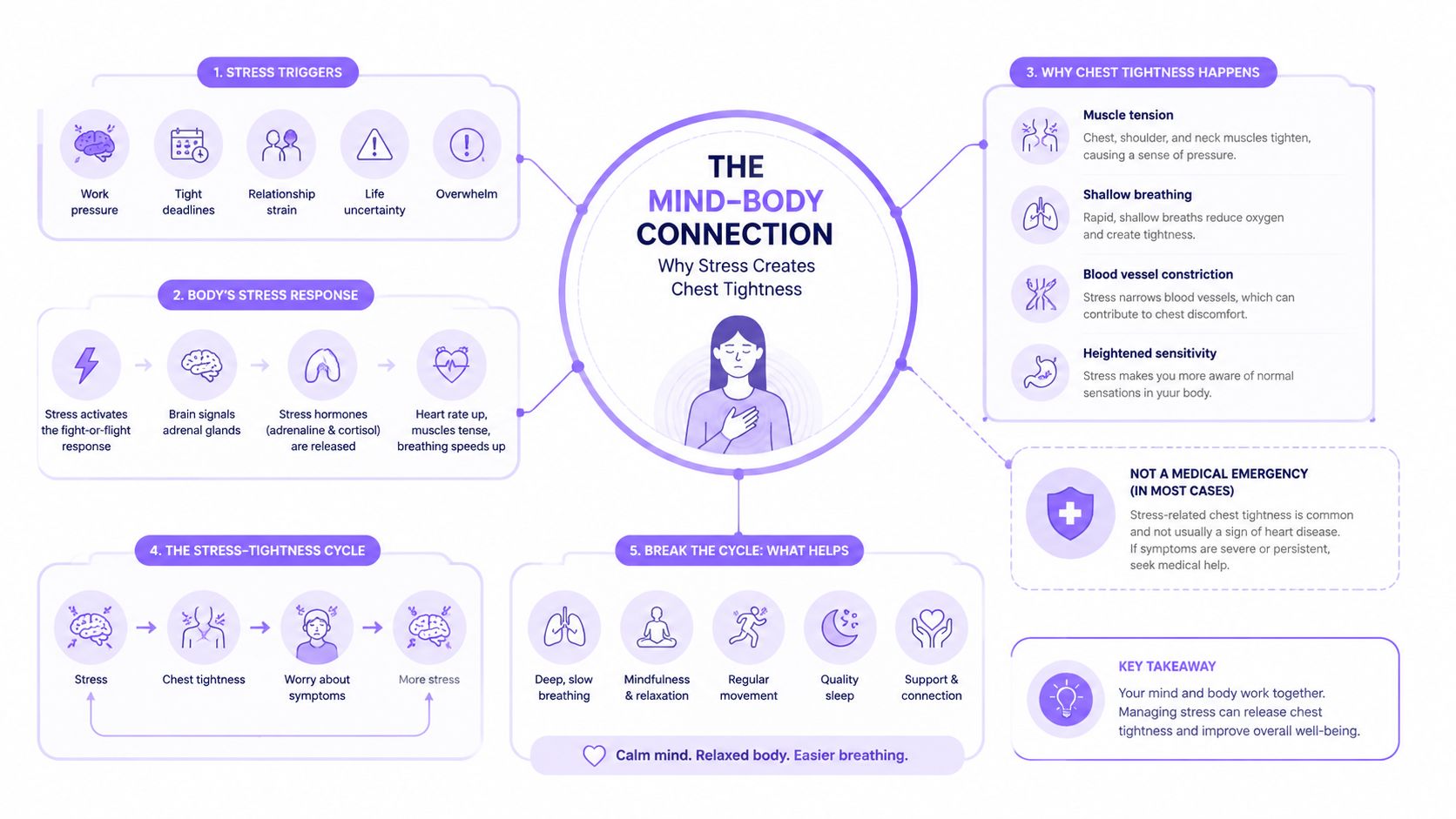
According to GoodRx's explanation of stress-related chest pain, stress-induced chest tightness arises primarily from the activation of the hypothalamic-pituitary-adrenal (HPA) axis and sympathetic nervous system, triggering a surge in catecholamines and cortisol. This fight-or-flight response increases heart rate, increases myocardial oxygen demand, and induces chest wall muscle hypertonia. In non-cardiac cases, hyperventilation from anxiety reduces PaCO2, causing respiratory alkalosis and coronary vasospasm that can mimic angina.
That language is clinical. In plain English, your body gets flooded with stress signals, and the chest is one of the places where those signals become impossible to ignore.
Three common reasons your chest feels tight
The sensation usually comes from a mix of physical changes, not just one thing.
| What stress does | What it feels like |
|---|---|
| Muscles tighten | Pressure, soreness, a band-like squeeze across the chest |
| Breathing becomes shallow or fast | Tightness, air hunger, the feeling that you can't get a full breath |
| Heart rate rises | Pounding, fluttering, chest awareness that can feel alarming |
Muscle tension is the hidden piece
Many people miss this. They assume chest tightness must come from the heart or lungs alone. But stress often makes the muscles around the chest, shoulders, and upper back brace without you noticing.
It's like your body puts on armor.
If you've been clenching your jaw, lifting your shoulders, or hunching over a screen all day, that tension can gather in the chest wall and create a very real squeezing sensation.
Breathing changes can make everything louder
When you're anxious, breathing often becomes quick and shallow. That can leave you feeling like you need more air, which makes you breathe even faster. Then the chest feels tighter, not looser.
Practical rule: If your breathing is high in the chest and rushed, your body may be amplifying the sensation.
This is one reason mindfulness practices help. They interrupt the loop. Not by pretending nothing is wrong, but by sending your nervous system a different message: you are safe enough to slow down.
When to Seek Immediate Help Red Flags to Watch For
Reassurance matters, but so does caution. Chest tightness should never be brushed off automatically. If something feels off, getting checked is the right move.
A useful mindset is simple. When in doubt, get it checked out.
Signs that need prompt medical attention
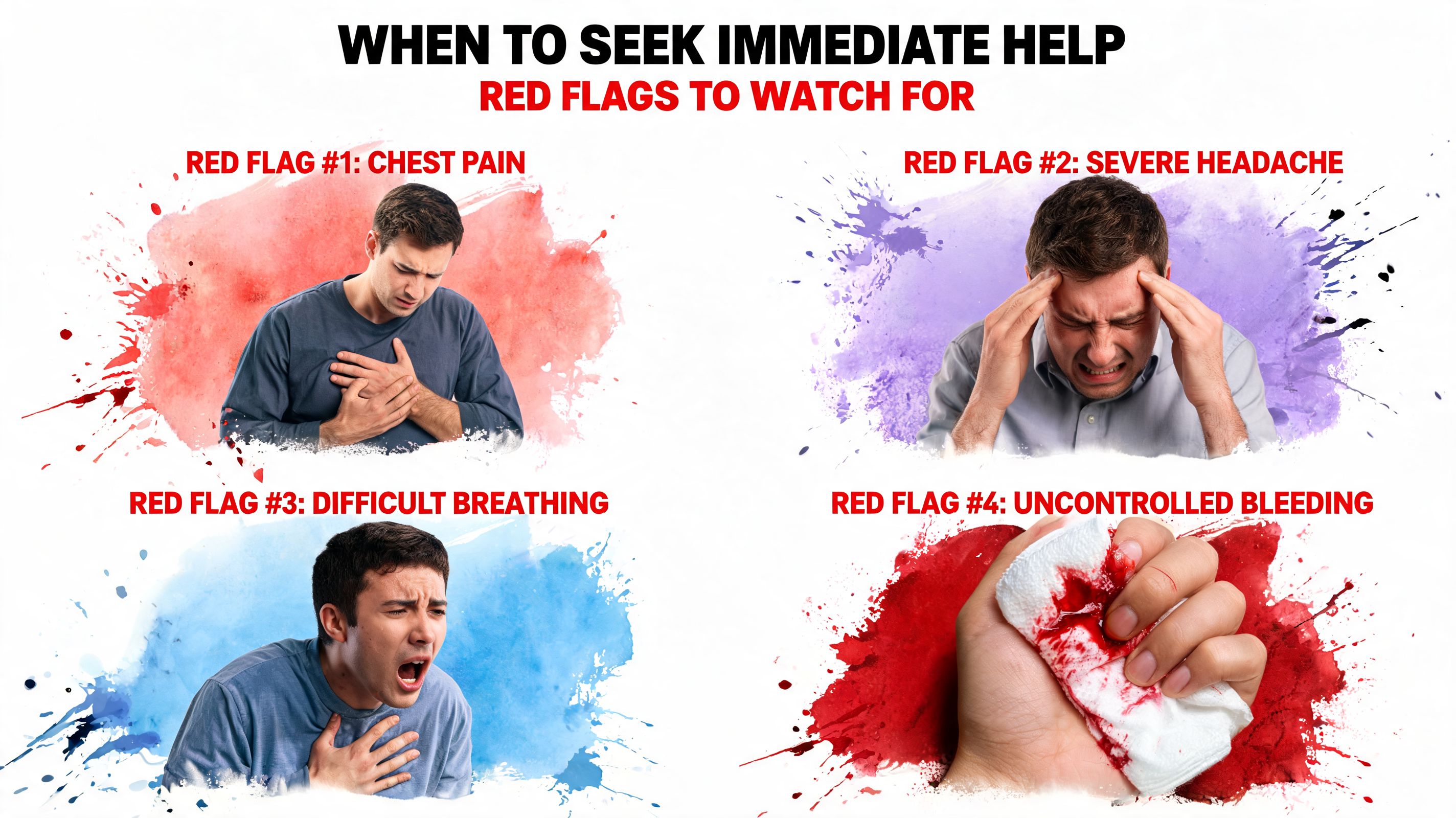
Seek immediate medical help if chest tightness comes with any of these:
- Pain spreading outward: discomfort moving into the arm, jaw, neck, shoulder, or back
- Breathing trouble at rest: especially if you're struggling to breathe even without exertion
- Faintness or major dizziness: feeling like you might pass out, or becoming suddenly weak
- Heavy sweating, nausea, or confusion: especially if these appear suddenly with chest symptoms
- A new or severe pattern: pain that feels stronger, longer, or different from anything you've had before
- Known heart risk or heart history: if you've been told you have a heart condition, don't self-diagnose
Why this matters
Anxiety and cardiac symptoms can overlap. That's why confidence isn't the same thing as certainty. Even people who are familiar with panic can still need medical care if a symptom changes.
Don't try to win a bravery contest with chest pain.
If you've already been evaluated before and told your symptoms are stress-related, that knowledge can help you respond more calmly. But if something feels unusual, severe, or persistent, let a medical professional decide. Peace of mind is valuable too.
In the Moment Calming Your Body and Mind Right Now
When chest tightness hits, your first job isn't to force yourself to “calm down.” That usually backfires. Your first job is to create a little safety inside the moment.
The fastest path is often physical. Give your body signals that the emergency has passed, and your mind usually follows more easily.
Try the 5 4 3 2 1 grounding method
This helps when your thoughts are racing and your attention keeps locking onto the sensation in your chest.
Name 5 things you can see
Look slowly. A window. A mug. A shadow on the wall. Your shoes. The edge of the table.Notice 4 things you can feel
Your feet in your socks. The chair under your legs. Your shirt on your shoulders. Your hands touching.Identify 3 things you can hear
A fan. Traffic outside. The hum of your fridge.Find 2 things you can smell
Coffee. Soap. Fresh air. If you can't smell much, that's okay. Just pause and try.Name 1 thing you can taste
Mint, tea, toothpaste, or even just the inside of your mouth.
This works because anxiety pulls you into prediction. Grounding pulls you back into the present.
Use box breathing without forcing deep breaths
If your chest already feels tight, huge breaths can feel uncomfortable. Keep it gentle.
- Inhale slowly
- Pause
- Exhale slowly
- Pause
Move through those four parts evenly, at a pace that feels manageable. The goal isn't perfect timing. The goal is steadiness.
If holding the breath feels stressful, skip the pauses and make the exhale softer and slower than the inhale. That alone can help signal safety.
A short script for the moment
Say this under your breath:
This is uncomfortable. It doesn't mean I'm in immediate danger. I can slow one breath at a time.
That kind of self-talk matters. Anxious thoughts often pour fuel on the physical sensation. Calm, believable language takes some of that fuel away. If you want more support for the mental side of the spiral, this guide on how to calm anxious thoughts offers simple ways to interrupt the loop.
What not to do
Sometimes relief comes from stopping the habits that intensify the cycle.
- Don't scan your body constantly: repeated checking can make sensations feel louder
- Don't argue with yourself: “I shouldn't feel this” adds tension
- Don't force instant peace: aim for a small decrease in alarm, not perfection
A good target is not “make it disappear right now.” A better target is “lower the intensity a little.” That's enough to start changing the experience.
Building Long-Term Resilience to Stress
Immediate tools help in the moment. Long-term resilience changes how often your system gets pushed into alarm in the first place.
That matters because this experience is common. Statistics on anxiety-related chest pain note that approximately 50% of individuals with generalized anxiety disorder report experiencing chest discomfort, chest pain is present in between 20% to 70% of panic attacks, and about 18% to 25% of patients presenting to emergency units with chest pain are diagnosed with panic disorder. If you've been dealing with this pattern, you're in very human territory.
Change the pattern before the symptom starts
Chest tightness often begins long before you feel it. It starts in the buildup. Overcommitting. Pushing through exhaustion. Letting anxious thoughts run unchecked. Living in mental rehearsal for problems that haven't happened.
Resilience means catching the cycle earlier.
A few practices help:
- Thought reframing: When your mind says, “Something is terribly wrong,” try a more grounded sentence such as, “My body is stressed, and I can respond skillfully.”
- Daily nervous system care: Short walks, mindful breathing, gentle stretching, and regular pauses tell the body that life isn't one long emergency.
- Consistent sleep and routine: The body handles stress better when it isn't already depleted.
Repetition rewires your inner voice
Many people wait until they feel awful before speaking kindly to themselves. That's understandable, but it's late in the process. A calmer inner voice is easier to access during stress when you've practiced it on ordinary days.
That's where affirmations can become useful. Not as magical phrases. Not as denial. As repetition with intention.
If a person regularly practices thoughts like “I am safe enough to slow down” or “I can meet discomfort with steadiness,” those thoughts become more available when the chest tightens. Over time, that can shift the meaning your mind assigns to the sensation.
The body listens to repeated messages, especially the ones you say when no one else is around.
You might keep those phrases in a journal, on your phone, or in a daily mindfulness practice. If you want broader support for this process, this article on how to build mental resilience explores the habits that make emotional recovery steadier over time.
Build a small routine you'll actually keep
A sustainable routine beats an ideal routine you never do. Start with something modest:
| Time | Practice |
|---|---|
| Morning | One minute of slow breathing and one grounding affirmation |
| Midday | Shoulder drop, unclench jaw, notice your breath |
| Evening | Brief reflection on what triggered stress and what helped |
That kind of repetition creates familiarity. And familiarity matters. A body that regularly experiences calm becomes better at returning to calm.
Turning Discomfort into Your Greatest Teacher
Chest tightness can feel like betrayal. In time, it can become information.
It may be telling you that your stress load is full. That your body needs recovery, not more pushing. That your thoughts have drifted into fear and need gentleness, not punishment. That you've been carrying too much alone.
Seen that way, the symptom changes meaning. It's still uncomfortable. But it's no longer just an enemy. It becomes a messenger.
A kinder interpretation changes everything
When you respond to chest tightness with panic, the cycle usually grows. When you respond with curiosity, grounding, and wise caution, the cycle often softens.
That doesn't mean you have to like the sensation. It means you can learn from it.
Ask simple questions:
- What happened before this started?
- What was I telling myself?
- What helped even a little?
- What do I need more of today, rest, support, movement, quiet, reassurance?
You can even deepen that reflection with prompts like these therapy journal prompts for self-awareness and emotional clarity.
The goal isn't to become someone who never feels stress. The goal is to become someone who recognizes the signal earlier, responds more wisely, and trusts their ability to care for themselves.
That's real growth. Not perfection. Practice.
If you want gentle support building that practice, I Become is a thoughtful iOS app for daily affirmations that helps you rewire your inner dialogue over time. With Lock Screen widgets, reminders throughout the day, and four practice modes, Read, Speak, Listen, and Write, it makes it easier to turn calming thoughts into a real routine. Download I Become from the App Store if you'd like a steady companion for creating more calm, clarity, and self-trust.
Found this helpful? Share it with someone who might benefit.