
How to Build Mental Resilience: Thrive in 2026
Learn how to build mental resilience with our practical guide. Discover evidence-based steps, routines, and tools like the I Become app. Thrive under pressure.
Some days the pressure does not arrive as one dramatic crisis. It arrives as ten small hits.
A project slips. You say the wrong thing in a hard conversation. Your phone keeps buzzing. You wake up tired and still expect yourself to perform at full capacity. By noon, your mind starts telling a familiar story. You should be handling this better. You are falling behind. You do not have time to reset.
I know that spiral. Many driven people do.
The good news is that mental resilience is not a rare gift handed to a lucky few. It is a trainable way of responding to stress, disappointment, uncertainty, and change. In fact, research on psychological resilience trajectories found that approximately 66 percent of people maintain relatively stable psychological and physical health following potentially traumatic events, a pattern George Bonanno calls the “resilience trajectory” (Psychological Science).
That matters because it changes the story. Resilience is not unusual. It is profoundly human.
If you want to learn how to build mental resilience, stop treating it like a personality trait and start treating it like training. You do not need a complete life overhaul. You need practices you can repeat when life is calm, and tools you can trust when life gets messy.
I am opinionated about this. Rest matters, but rest alone is not enough. If you are ambitious, purpose-driven, or carrying a lot, you need a more active approach. You need structure. You need small wins. You need better self-talk. You need a plan for the moments when your nervous system gets loud.
That is what this guide is for.
Your Journey to Mental Resilience Starts Here
You miss one deadline and suddenly it feels like your entire week is collapsing. Or maybe nothing “big” happened at all. You are just worn down by constant demands, carrying stress so long that it starts to feel normal.
Many people make the first mistake at this point. They assume resilience means not feeling shaken. That is false. Resilient people feel stress, grief, frustration, and fear. They just learn how to move through those states without letting them run the whole show.
Resilience is more common than you think
A lot of people secretly believe they are bad at coping. They look around and assume everyone else is stronger, steadier, more naturally equipped. That story falls apart under real research.
The most encouraging fact I know is this: resilience is often the default human response, not the exception. That does not mean adversity is easy. It means your mind and body likely already contain more adaptive capacity than your stress would have you believe.
Takeaway: You do not need to become a different kind of person to build resilience. You need to strengthen patterns you already have.
Stop waiting to feel ready
Many people postpone resilience work until life calms down. That is backwards.
You build resilience the same way you build strength. Repetition. Friction. Recovery. Better form. If you only practice calm when everything is easy, you will keep getting blindsided when life gets hard.
That is why I prefer proactive resilience over passive coping. Journaling after a hard day helps. So does sleep. But structured daily practices change your baseline. They make you less reactive, more deliberate, and faster to recover when something knocks you sideways.
What this looks like in real life
A resilient mindset does not mean you become endlessly positive. It means:
- You notice stress earlier instead of realizing you are overwhelmed after the damage is done.
- You interrupt catastrophic thinking before it becomes your reality.
- You keep promises to yourself in small, repeatable ways.
- You recover your footing faster after setbacks.
That is the work. Not perfection. Not pretending. Practice.
Understanding the Foundations of a Resilient Mind
Resilience gets watered down into vague advice all the time. “Stay positive.” “Be strong.” “Bounce back.” None of that is useful when your mind is racing and your energy is low.
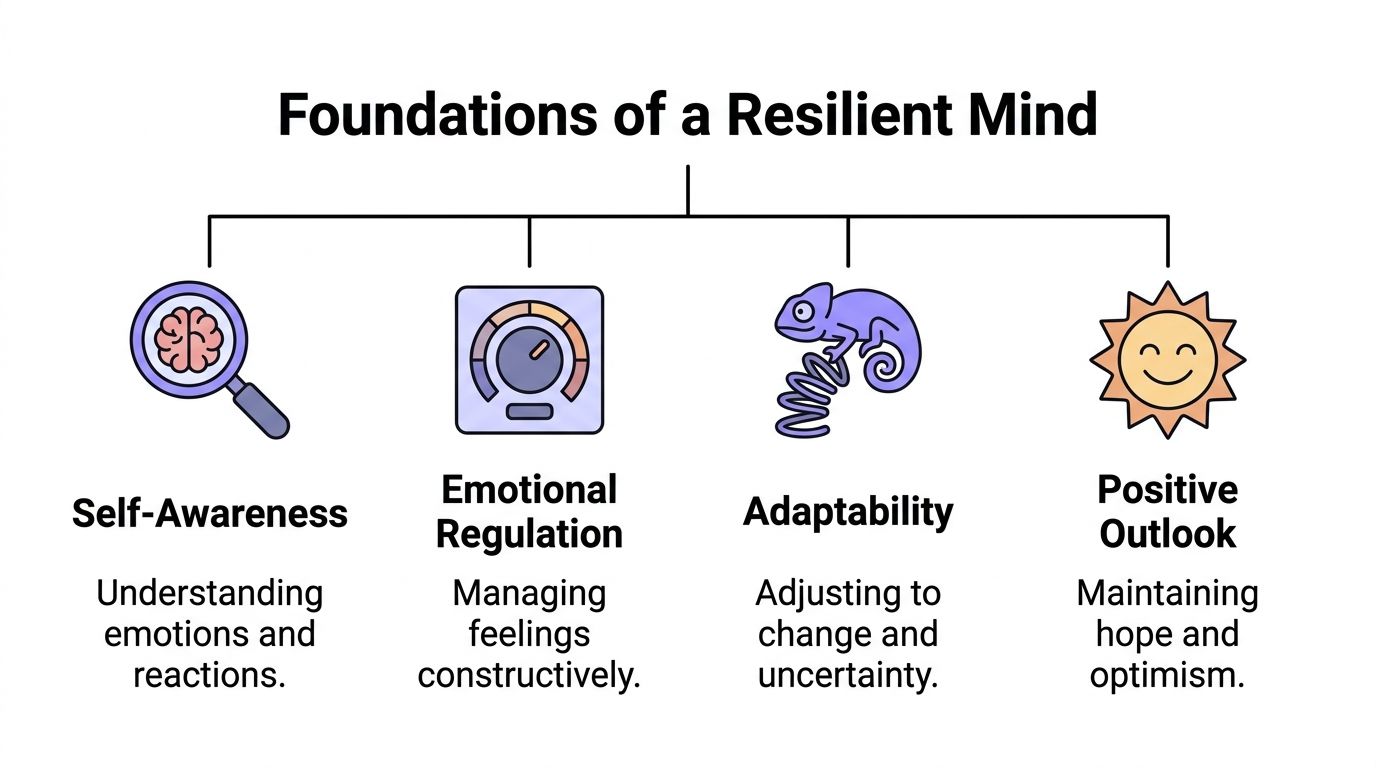
A resilient mind rests on several supports working together.
The American Psychological Association defines psychological resilience as “the process of adapting well in the face of adversity,” and the broader research points to multiple protective factors, including social and emotional skills, positive social interactions, safe neighborhoods, and strong community ties (PMC overview of resilience research).
Think in systems, not traits
This is the shift that makes resilience practical. No single factor decides your outcome. Not mindset alone. Not willpower. Not your morning routine.
Resilience works more like a system.
If your emotional awareness is weak, stress sneaks up on you. If your relationships are shallow, hard seasons feel heavier. If your environment is chaotic, your mind has less room to recover. If your self-talk is harsh, every setback cuts deeper.
That is why generic motivation fails. It targets one piece and ignores the rest.
Four foundations worth strengthening
Here is the cleanest way to think about it.
| Foundation | What it does | What it looks like in daily life |
|---|---|---|
| Self-awareness | Helps you catch patterns early | Naming your mood, noticing triggers, tracking energy |
| Emotional regulation | Stops feelings from taking over behavior | Grounding, breathing, reframing, pausing before reacting |
| Adaptability | Helps you respond to change without breaking | Adjusting plans, loosening perfectionism, finding the next step |
| Positive outlook | Preserves hope without denying reality | Looking for options, meaning, progress, and lessons |
A lot of people obsess over the last one and skip the others. They try to “think positive” while ignoring sleep, relationships, self-knowledge, and coping skills. That never lasts.
Purpose and connection matter more than hype
If you want a sturdy mind, build a life with anchors.
Some anchors are internal. Emotional skills. Reflection. Self-respect. A growth-oriented mindset. If that is an area you want to deepen, this guide on developing a growth mindset is a strong companion to resilience work.
Other anchors are relational. One honest friend. A dependable partner. A mentor. A group where you do not need to perform.
Practical tip: When stress rises, do not ask only, “How do I feel better?” Ask, “Which foundation is weak right now?”
That question gets you out of vague overwhelm and into action. Maybe you need emotional regulation. Maybe you need structure. Maybe you need connection. Maybe your environment is draining you.
Your job is not to master everything at once
Build one layer at a time.
Start by noticing your patterns. Then give yourself tools for regulation. Then create routines that make steadiness easier. Then reinforce your support system.
That is how to build mental resilience in a way that lasts. Not through inspiration alone, but through repeated support across the whole system.
Crafting Your Daily Resilience Ritual
If you want a stronger mind, stop relying on motivation. Build a ritual.
The most effective resilience practices are not dramatic. They are small enough to repeat, clear enough to track, and useful enough to keep. Research on building resilience through small wins emphasizes that consistent micro-habits can reshape stress responses over time. It also found that realistic goals increase completion rates by 42% and tracking progress can boost adherence by 2x (Still I Run on small wins and resilience).

I like a resilience ritual because it gives your mind fewer chances to negotiate. You already know what happens when stress decides your day for you. Ritual flips that.
Build a routine you can win
Do not start with a heroic routine. Start with one you will commit to.
A good morning resilience ritual should take pressure off you, not create more of it. Keep it tight. Keep it repeatable. If you are busy, aim for a short sequence that works even on a hard day.
Try this:
Check in before you check your phone Ask yourself three things. What am I feeling? What is draining me? What matters most today? This creates awareness before the outside world hijacks your attention.
Do one quiet regulating practice Sit for a few minutes. Breathe slowly. Notice your body. Let your nervous system catch up with your ambition.
Write one realistic goal Not your entire life plan. One concrete win for today. Small enough to finish. Meaningful enough to matter.
Track your state Write a few words about mood, energy, or stress. Patterns become obvious when you record them.
Choose one sentence you want your mind to rehearse Affirmations become useful here, not fluffy. A repeated sentence can interrupt mental drift and train a more stable inner voice.
Use affirmations with structure
Affirmations fail when people use them like magic spells. They work better as practice for attention and identity.
Do not pick statements your mind instantly rejects. Pick statements that direct your behavior and reinforce a resilient posture.
Examples:
- When pressure rises, I return to what I can control.
- I can feel stress without becoming my stress.
- Setbacks teach me how to adjust, not who I am.
- I build confidence by keeping small promises to myself.
Those statements do two jobs. They calm the mind and guide action.
If you want help making this a repeatable habit, this piece on building a daily practice can help you turn intention into consistency.
Track the inputs that shape your day
People often track outcomes and ignore the conditions that produce them.
That is a mistake.
Use a notebook or notes app and keep a short daily log. Focus on a few signals only.
- Mood: low, steady, tense, hopeful
- Energy: depleted, average, strong
- Stress triggers: meeting, conflict, poor sleep, overcommitment
- Recovery action: walk, journaling, breathing, honest conversation
This is not busywork. It helps you stop personalizing patterns. You are not “failing.” You may be underslept, overloaded, isolated, or stuck in all-or-nothing thinking.
Here is a useful reset if your ritual starts slipping.
Reset rule: If you miss a day, restart the next day at the smallest version possible. Never punish yourself with a bigger routine.
Keep your ritual flexible
Your routine should survive real life.
On a spacious morning, maybe you journal, stretch, and reflect. On a rushed morning, maybe you do three breaths, one sentence in a notebook, and one grounded intention for the day. Both count.
That flexibility matters because rigid routines often collapse under pressure. A resilient ritual bends.
A short guided video can help if you want support settling into the practice:
A simple weekly review beats constant self-criticism
Once a week, ask:
- What helped me stay steady?
- Where did I get reactive?
- What kept draining me?
- What is one adjustment for next week?
That final question is the whole game. Resilience grows when you respond to your life like a coach, not a critic.
Navigating Stress with In-the-Moment Exercises
Daily rituals build capacity. Acute stress still needs tools.
When your chest tightens before a presentation, when an email spikes your anxiety, when your thoughts start sprinting ahead of reality, you need something immediate. Not theory. Not vague encouragement. A move you can make in the moment.
Mindfulness-based emotional regulation protocols include the 5-4-3-2-1 grounding technique, which can interrupt an amygdala hijack and reduce reactivity by 35%, and cognitive reframing, which has been shown to decrease anxiety by 62% after four weeks of practice (Greene Psychology Group overview).

Use grounding when your mind starts spiraling
Grounding is not glamorous. It is effective.
The 5-4-3-2-1 method works because it brings attention out of racing thought and back into the body and environment.
Try it exactly like this:
- 5 things you can see
- 4 things you can touch
- 3 things you can hear
- 2 things you can smell
- 1 thing you can taste
Do it slowly. Name each item clearly. If you are in public, do it without speaking.
This is one of the best skills for people who tend to overthink because it interrupts mental momentum fast.
Breathe like you mean it
Stress changes breathing before many people notice. Your breath gets shallow, your shoulders creep up, and your body reads that as danger.
Use 4-7-8 breathing when your system feels overloaded. Inhale for 4 seconds, hold for 7 seconds, exhale for 8 seconds. The extended exhale helps shift your body toward calm.
Do not wait until you are panicking to learn it. Practice when you are fine so it is available when you are not.
Challenge the first story your mind tells
Stress loves certainty. Usually the wrong kind.
You get one piece of bad news and your brain fills in the rest. I ruined this. They are disappointed in me. Everything is getting worse.
Reframing is not fake positivity. It is disciplined thinking.
Use this quick sequence:
| Stress thought | Better question | Reframe |
|---|---|---|
| I cannot handle this | What is one part I can handle? | I can take the next step, even if I do not control the whole outcome |
| This always happens | Is that accurate? | This is familiar, but not permanent |
| I am failing | What would a coach say here? | I hit a setback. Now I adjust |
If anxious thinking is a regular battle for you, this guide on how to calm anxious thoughts is worth adding to your toolkit.
Key reminder: In a stress spike, your first job is not to solve your whole life. Your first job is to get regulated enough to think clearly.
Make yourself a personal emergency script
Write it before you need it.
A good emergency script is short, realistic, and specific. Something like:
- Pause.
- Unclench your jaw.
- Take one slow breath.
- Name what is happening.
- Do the next clear thing.
That script can carry you through more moments than you think.
Troubleshooting Common Setbacks on Your Journey
You will miss days. You will get discouraged. You will fall back into old patterns under pressure.
That does not mean your resilience practice is failing. It means you are human.
The biggest trap I see is not stress itself. It is the meaning people attach to inconsistency. One missed journal entry becomes proof they lack discipline. One emotional day becomes evidence they are back at zero.
That is nonsense.

Drop all-or-nothing thinking fast
All-or-nothing thinking turns growth into performance.
You miss one day, so you quit. You have one rough week, so you declare the whole system ineffective. You feel anxious again, so you assume none of your progress was real.
Do not let your perfectionism grade your healing.
A better standard is this: return quickly. That is resilience in action.
High-achievers need a different reframe
If you are ambitious, traditional self-care advice can feel strangely irritating. Slow down. Do less. Take a break. Sometimes that is right. Sometimes it is incomplete.
A real challenge for high-achievers is guilt about self-care practices, and a needed reframe is learning to build emotional regulation without sacrificing goal-oriented momentum, seeing resilience as something that can support performance rather than compete with it (NIH News in Health on nurturing resilience). Driven people often reject good tools for the wrong reason. They assume any pause is weakness. Any reflection is indulgent. Any emotional work is time away from the mission.
I disagree completely.
Resilience practices are performance maintenance for your mind. They improve decision-making, steadiness, and recovery. They help you keep going without constantly paying for it with your nervous system.
Reframe for achievers: You are not stepping away from your goals when you regulate your mind. You are protecting the instrument that pursues them.
What to do when motivation disappears
Motivation is unreliable. Use design instead.
When you do not feel like practicing:
- Shrink the task: Two minutes counts.
- Use cues: Same chair, same notebook, same time.
- Lower the standard: Aim for done, not impressive.
- Review the pattern: Are you tired, overloaded, lonely, or discouraged?
Sometimes the problem is not laziness. It is friction.
Turn setbacks into data
A setback can teach you something if you stop using it as a verdict.
Ask yourself:
- What happened right before I got knocked off track?
- What was I needing but not noticing?
- What is the smallest repair I can make today?
That is how resilient people think. They do not deny the stumble. They study it and move.
Making Resilience Your New Normal
Resilience is not a finish line. It is a way of meeting your life.
You build it when you notice your patterns instead of running from them. You strengthen it when you choose a small grounded action over a dramatic reaction. You protect it when you treat setbacks as information, not identity.
If you have been looking for the perfect method, let that go. What works is consistency with enough compassion to keep going. A simple ritual. Better self-talk. Fast regulation during stress. A willingness to begin again without self-contempt.
That is how to build mental resilience in real life. Not by becoming unshakeable, but by becoming more responsive, more aware, and more steady over time.
You do not need a new personality. You need practice.
Start small today. Breathe on purpose. Write one truthful sentence. Choose one thought worth repeating. Keep one promise to yourself before the day ends.
That is not a minor beginning. That is the path.
If you want a simple way to make this practice stick, download I Become from the App Store. It helps you gently rewire your thoughts through daily affirmations, Lock Screen widgets, and four practice modes, Read, Speak, Listen, and Write, so you can build a resilience ritual that fits real life.
Found this helpful? Share it with someone who might benefit.