
How to Calm Anxious Thoughts and Find Peace
Discover how to calm anxious thoughts with our inspirational guide. Learn actionable grounding techniques and daily routines for lasting anxiety relief.
When your mind is racing, the most powerful thing you can do is gently, but firmly, plant your feet in the present moment. This isn't about fighting off your thoughts or pretending they don't exist. It's about creating a small, quiet space for yourself right here, right now. This simple act of grounding can be enough to stop a worry spiral in its tracks.
Find Your Calm in This Moment
If you’ve ever felt trapped in a storm of anxious thoughts, you know how incredibly isolating it can feel. But you are far from alone. Anxiety is the single most common mental health challenge on the planet.
Before 2020, over 301 million people worldwide were living with an anxiety disorder. By 2021, that number had surged to an estimated 359 million. Yet, despite how common it is, only about 27.6% of people ever get any form of help, often due to stigma or a simple lack of access. You can read more about these anxiety statistics, which show a massive gap between who is struggling and who is getting support.
This is exactly where your personal growth journey begins—with small, compassionate actions you can take for yourself, starting today.

Why Your Mind Gets Stuck in a Worry Loop
Our brains are hardwired to scan for threats—a survival skill that served our ancestors well. In our modern world, though, that internal alarm system can sometimes get stuck in the "on" position, turning everyday concerns into an overwhelming cycle of anxious thoughts.
This creates a feedback loop: a worry pops up, which triggers an emotional and physical response, which in turn convinces your brain there’s more to worry about.
The encouraging news? You don’t need a monumental effort to break this cycle. It all starts with a single, intentional step to shift your focus from the storm inside your head to the solid ground beneath your feet. It's about sending a message to your nervous system: you are safe right now. You can learn more about how to do this in our guided sessions for anxiety.
"The first step toward calming anxiety isn't to silence your mind, but to give it something peaceful to focus on. Your immediate surroundings are a powerful anchor."
Here’s a simple but powerful grounding technique to add to your self-improvement toolkit. You can use it anywhere, anytime you feel your thoughts starting to take over. Think of it as your emergency escape hatch when the mental noise gets too loud.
When your thoughts start to spiral, this 3-step exercise can immediately anchor you back into your body and your environment.
Your Quick Calm Grounding Technique
| Step | Action | Why It Works |
|---|---|---|
| 1. Name 5 Things You Can See | Look around and silently name 5 objects. A pen. A crack in the ceiling. A green leaf outside the window. A dusty speaker. A blue mug. | This pulls your attention out of your internal world and forces your brain to engage with the external environment, interrupting the thought loop. |
| 2. Name 4 Things You Can Feel | Focus on physical sensations. The softness of your sweater. The smooth, cool surface of your desk. The weight of your body in the chair. The slight breeze from a vent. | This reconnects you to your body, grounding you in physical reality instead of abstract worries. |
| 3. Name 3 Things You Can Hear | Listen closely. The hum of your computer. Distant traffic. Your own steady breathing. | Auditory focus helps to narrow your attention even further, creating a moment of mindful presence and pushing intrusive thoughts to the background. |
This little exercise is a reminder that you always have a tool to find your center, no matter where you are.
Ready to start building a gentler inner world? The I Become app can be a wonderful companion on this path, helping you gently rewire your thinking patterns with daily affirmations. Download I Become from the App Store and start nurturing a calmer, more centered you today.
Your Go-To Toolkit for Immediate Relief
When anxiety flares up, it can feel like a tidal wave, pulling you under into a spiral of worry. The key isn't to fight the wave but to have a few simple, powerful anchors you can grab onto in that exact moment. Think of these as your mental first-aid kit—quick, effective strategies to break the cycle and find solid ground again.
You don't need any special equipment or a quiet room. You just need a moment to pause and a willingness to gently shift your focus. What works in a tense meeting might feel different from what you need in a crowded grocery store, so having a few options means you're never caught unprepared.

Master Your Breath with Box Breathing
One of the fastest ways to tell your body it's safe is by changing how you breathe. Anxious, shallow breathing sends a panic signal to your brain. Box breathing is a simple but profound technique to reverse that signal.
It's easy to remember because you're just drawing a square with your breath. Try it now:
- Breathe in slowly through your nose for a count of four.
- Gently hold that breath for a count of four.
- Exhale slowly and completely through your mouth for a count of four.
- Hold the breath out for a final count of four.
Repeat this simple cycle just three to five times. This rhythmic pattern is a direct command to your nervous system to slow down, lowering your heart rate and bringing a quiet sense of control. The best part? It's completely discreet. You can do it at your desk before a big presentation, in line at the post office, or even in the middle of a difficult conversation.
Ground Yourself in the Present with a Sensory Check-In
Anxious thoughts thrive in the future—in the land of "what ifs" and worst-case scenarios. A sensory check-in is your express ticket back to the here and now. It pulls you out of the abstract chaos in your head and anchors you to the real, tangible world around you.
The next time you feel your mind starting to race, pause and find:
- One thing you can see: Really notice it. The way the light catches the dust motes in the air, the intricate pattern on a leaf, or the color of a colleague's coffee mug.
- One thing you can hear: Tune out the noise and isolate a single sound. Is it the low hum of your computer? The distant sound of traffic? Birds chirping?
- One thing you can feel: Bring your attention to a physical sensation. The soft fabric of your sweater against your skin, the solid weight of your feet on the floor, or the coolness of a metal pen in your hand.
- One thing you can smell: Take a gentle sniff. Can you smell the faint aroma of coffee, the clean scent of soap on your hands, or the rain on the pavement outside?
- One thing you can taste: What is the lingering taste in your mouth? Maybe it’s your morning toothpaste, or you can take a sip of water and truly focus on the sensation.
This simple practice is a powerful circuit-breaker. It works by forcing your brain to stop spinning on hypotheticals and instead process concrete, verifiable information from the present moment.
Intentionally Redirect Your Thoughts
Sometimes, you just need to give your brain a new job. When an anxious thought barges in, you don't have to wrestle with it. You can acknowledge it—"Okay, I see you, worry"—and then gently pivot your attention to something else.
This isn't about denial; it's about choice. You are choosing not to let that single thought monopolize your entire mental space. You could pivot to a warm memory, mentally list three things you're grateful for, or run through the plot of your favorite movie. It’s a small, decisive act of reclaiming your focus.
These tools are your allies for in-the-moment relief. For building a deeper, more resilient foundation of calm, an app like I Become can be an incredible companion. It helps you gently rewire those thought patterns with daily affirmations delivered right to your phone via widgets and multiple practice modes. Download I Become from the App Store and start building your own inner sanctuary today.
Rewire Your Mind, One Thought at a Time with Daily Affirmations
Anxious thoughts can feel like a relentless inner critic, showing up uninvited and making it hard to find peace. While in-the-moment calming techniques are lifesavers, building a truly resilient mind happens over time. It’s about gently and consistently shifting your internal dialogue.
This is where the quiet practice of daily affirmations can make a real difference. It’s not about ignoring your problems or slapping on a fake smile. Think of it as an act of self-compassion—a way to intentionally plant more supportive thoughts in your mind. Over time, this practice helps carve out new, more positive mental pathways, loosening the grip of those automatic negative thought loops.
Why This Simple Practice Is So Powerful
Living in our always-on world, it's no surprise that anxiety is on the rise. Its global prevalence grew from 3.7% in 1990 to 4.4% by 2021. Yet despite proven methods, only about 1 in 4 people (27.6%) ever seek out support. Simple, evidence-backed tools like affirmations can help bridge that gap.
Research actually shows that repeating positive statements can lower cortisol—your body's main stress hormone—by up to 20-30% in those who practice regularly. That’s an effect similar to meditation. In fact, people who stick with a daily affirmation routine have reported feeling up to 40% less daily anxiety after just 30 days. This is your chance to become the supportive, calming voice you deserve to hear. You can read more about these anxiety statistics and see just how profound this simple habit can be.
How to Craft Affirmations That Genuinely Resonate
For an affirmation to stick, it has to feel true for you. Generic platitudes often fall flat because they don't speak to your actual fears. The real magic happens when you create statements that are personal, present-tense, and—most importantly—believable.
Start by noticing a thought that trips you up again and again. For instance, if you're constantly thinking, "What if I mess this up?", you can create an affirmation to gently push back.
Instead of a blunt denial like "I won't mess up," try reframing it with something like, "I am capable and resourceful. I will handle each part of this process as it comes."
See the difference? You’re not trying to predict the future. You’re simply reminding yourself of your own strength and ability to cope.
Here are a few more examples to get you started:
- For social anxiety: "I bring my own unique value to every room I enter. Connection is available to me."
- For overthinking: "I trust myself to make good decisions. I release the need to have it all figured out right now."
- For that feeling of general dread: "This feeling is just a visitor. It is not who I am, and it will pass."
Finding the perfect words is a creative process. If you’re feeling a bit stuck, our daily affirmation generator is a great place to find some inspiration.
Four Ways to Make Your Practice Stick
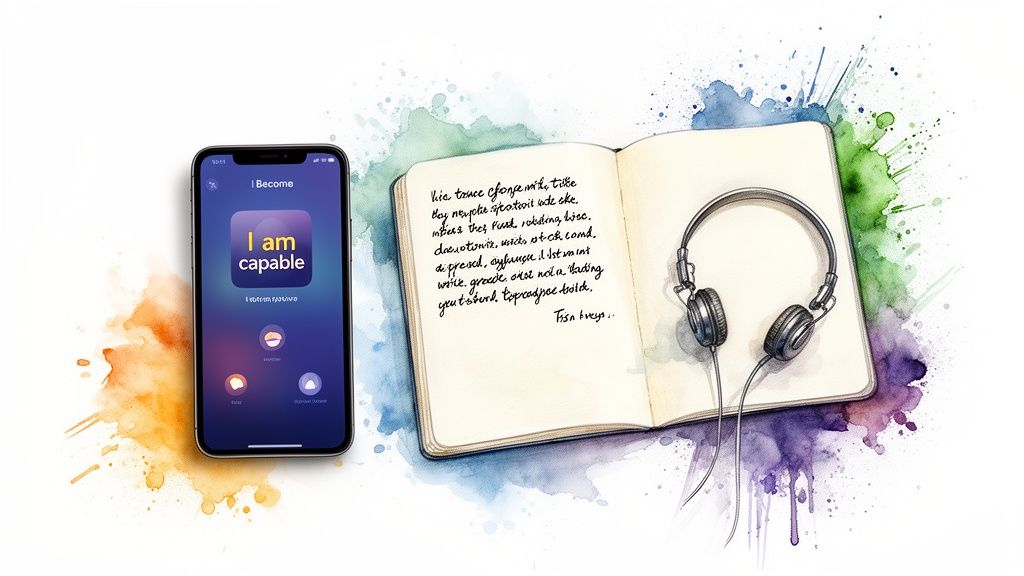
To turn affirmations from just words into a real force for change, consistency is everything. We designed the I Become app around this very idea, building in four distinct practice modes to weave this practice into the fabric of your day.
- Read: Start your morning on the right foot with a quick glance. A simple widget on your Lock Screen can set a positive tone before you even open your phone.
- Speak: There's power in your own voice. Saying your affirmations out loud—maybe in the car or to yourself in the mirror—makes them feel more real and concrete.
- Listen: Pop in your headphones during your commute or while on a walk. Hearing the affirmations spoken in a calm voice is incredibly soothing, almost like a mini-meditation for your self-talk.
- Write: The simple act of putting pen to paper (or finger to screen) connects your mind and body. Use the write mode in the evening to reflect and ground yourself in a peaceful mindset before bed.
By using different senses, you’re giving those new, positive neural pathways more power. This isn't about some massive, life-altering change overnight. It’s about the small, daily acts of kindness you show yourself. Ready to start? You can download I Become from the App Store and begin gently rewiring your thoughts today.
Craft a Daily Rhythm That Quiets Your Mind
True, lasting calm isn't something you achieve in a single, dramatic moment. It’s a quiet strength you build, day by day, through small, intentional choices. While the in-the-moment techniques are your lifeline, creating a gentle, consistent routine is what builds deep resilience against anxiety.
Think of it less like a rigid schedule and more like tending to a garden. You can’t just water it once and expect it to thrive. Your mind needs that same steady, compassionate care to truly flourish.

Bookend Your Day with Gentle Rituals
The way you start your morning and wind down your evening has a massive impact on your entire day. A rushed, frantic morning can put you on edge for hours, while a restless night can leave you feeling depleted before you’ve even begun. Simple, mindful rituals can beautifully bookend your days with a sense of peace.
For a gentle start, you could try:
- Your First Thought: Before your fingers even touch your phone, take a moment to greet the day with purpose. An I Become widget on your Lock Screen can offer a simple, grounding thought like, "I greet this day with peace and potential."
- Mindful Hydration: As you drink your first glass of water, just pay attention. Really feel the cool liquid and notice how it feels as it nourishes your body. It's a tiny act, but it pulls you right into the present moment.
And for settling into the evening:
- A "Digital Sunset": Give yourself a screen-free buffer of at least 30 minutes before bed. The blue light from our devices can disrupt sleep, and quality sleep is a non-negotiable for managing anxiety.
- Two-Minute Reflection: Use the 'Write' mode in the I Become app for a quick wind-down. Scribbling out an affirmation like, "I release today's worries and welcome restorative rest," is a powerful way to consciously let go of the day.
The real magic is in consistency, not intensity. A five-minute ritual you actually do every day is far more powerful than an hour-long practice you only manage once a month.
Weave Mindful Pauses into the Everyday
Your routine doesn't have to live only in the morning and evening. You can sprinkle tiny moments of mindfulness throughout your day to hit the reset button on your nervous system. These are "mindful pauses"—short, intentional breaks that stop stress from piling up.
Set a few gentle reminders on your phone, or use the notification feature in an app like I Become, to prompt a quick, 60-second check-in. When the notification appears, just stop. Take three deep breaths. Notice what's going on in your mind and body without judging it. It’s a small anchor that brings you right back to yourself. You can get more ideas for building these habits in our guide on building a daily practice.
The Quiet Power of Showing Up for Yourself
It’s a tough reality that from 1990 to 2019, global anxiety cases jumped from 311 million to 458 million. Yet, treatment rates are still incredibly low, with just 27.6% of people getting help worldwide. This is where accessible tools like affirmations can make a real difference.
The science is encouraging. fMRI studies have shown that repeating calming phrases consistently activates the brain's prefrontal cortex, which can help quiet the amygdala's fear response by as much as 25%. Research into habit formation tells us it takes about 66 days, on average, for a new behavior to start feeling automatic. You can find more details in recent public health research on this topic.
This is why tracking your progress can be so motivating. Seeing your streak grow in the I Become app isn’t about perfectionism. It’s a visual celebration of the promise you’re keeping to yourself. It’s proof that every small step, every single day, is adding up to a calmer, more grounded you.
Ready to start building your own rhythm of self-compassion? Download I Become from the App Store and begin your journey with a supportive companion in your pocket.
Use Gentle Questions to Dial Down Anxiety
Anxious thoughts have a way of showing up uninvited, disguised as absolute truths. They barge into your head with such force and certainty that fighting back feels completely overwhelming. But what if you didn't have to fight? What if, instead, you could meet them with a bit of gentle curiosity?
This is a powerful shift that comes from mindfulness practices. It’s all about learning to question your worries instead of getting swept away by them. The moment you do this, something incredible happens: you stop being a prisoner of your anxiety and become a calm observer, watching it from a safe distance.
A Thought Is Just a Thought—Not a Fact
Here’s the first thing to remember: a thought is just a thought. It’s not a command. It’s not a prophecy. When a worry like, “I’m going to completely bomb this presentation,” crashes into your mind, it feels like a done deal.
The secret is to gently re-label it. Try saying to yourself, “I’m having the thought that I might bomb this presentation.”
That tiny tweak creates just enough space between you and the anxiety. It allows you to acknowledge the feeling without automatically accepting it as reality. And from that small pocket of peace, you can start asking yourself better, kinder questions.
Your Go-To Questions for Anxious Moments
When an anxious thought starts spiraling, just pause. Take a breath. You don’t need to have all the answers; the goal is simply to find a new perspective. Gently ask yourself one of these questions.
- Is this thought 100% true? Can I know, with absolute certainty, that this is how things will turn out? Anxiety loves to paint in black and white, but real life is almost always a shade of gray.
- What’s a kinder way to look at this? Imagine your best friend came to you with this exact same worry. What would you tell them? Now, try to offer that same compassion to yourself.
- What is one small thing I actually have control over right now? Anxiety feeds on a feeling of powerlessness. Reclaim your power by focusing on one tiny, concrete action. Maybe it’s just taking three deep breaths, tidying your desk, or sending a quick text.
- What is this feeling trying to protect me from? At its core, anxiety is often just your brain’s clumsy attempt to keep you safe. Sometimes, just thanking it for trying to help can soften its grip.
By meeting anxious thoughts with curiosity instead of fear, you strip them of their power. You teach your mind that you are in charge, not the worry of the moment.
Let’s see how this works in real life. Imagine you’re feeling a wave of anxiety about going to a party where you won't know many people. The thought, “Everyone is going to think I’m so awkward,” takes over.
Instead of letting that thought drag you down, you pause and ask: “What’s a kinder way to look at this?”
Maybe the answer that comes back is, “It’s totally normal to be nervous. I don’t have to be the life of the party. My only goal is to find one person to have a nice conversation with.” See how that reframe doesn't deny the anxiety, but makes the whole situation feel so much more manageable?
This practice of questioning your thoughts is a muscle. The more you use it, the stronger your foundation of inner calm becomes. This is where an app like I Become can be a great partner. You can use it to build up new, supportive thought patterns that directly counter your common worries. By choosing affirmations that resonate with you and practicing with them daily, you are actively rewiring your brain for more peace and confidence. Start building your practice with I Become on the App Store.
Let's Talk Through Your Questions on Calming Anxiety
Okay, let's get real for a moment. Starting a new mindfulness practice can bring up a lot of questions. That’s not just normal; it’s a sign that you’re truly engaging with your personal growth. Let's walk through some of the most common worries, so you can move forward with confidence.
How Quickly Will These Techniques Actually Work?
You can feel relief much sooner than you might think. Seriously.
Immediate techniques, like the grounding exercises and box breathing we've talked about, are your in-the-moment first aid. They're designed specifically to hit the brakes on your nervous system when it's in overdrive, often bringing a sense of calm in just a few minutes. Think of them as your go-to tools for acute moments of stress.
The deeper work—like rewiring those automatic thought patterns with daily affirmations—is a more gentle journey. It comes with consistent practice over weeks, not days. Progress isn't a straight line, and you’ll have good days and tough days. That’s part of the path to self-improvement.
The goal isn’t to erase anxiety overnight. It’s about building a kinder, more compassionate relationship with your own mind. It’s about consistency, not perfection.
What if I Miss a Day of Practice?
First, let's get one thing straight: you will miss a day. It happens to literally everyone. Please, don't let that inner critic tell you it's a failure. Instead, see it as a perfect opportunity to practice the most important skill of all: self-compassion.
A missed day is just a missed day. It doesn't undo your progress. The goal here is building a sustainable habit that supports you, not chasing a flawless record. Tools like the friendly notifications and Lock Screen widgets in the I Become app are meant to be gentle nudges, not rigid rules. Every single moment is a new chance to begin again. Just pick it back up when you can, no judgment allowed.
How Can I Possibly Fit This into My Busy Schedule?
I get it. Life is full. That’s exactly why these practices were designed to fit into the cracks of a modern, busy life. You don’t need to find an extra hour you don't have to see a real, tangible benefit. It's all about finding those little pockets of time and using them wisely.
Think about the micro-moments that already exist in your day:
- Doing a 30-second breathing exercise while your coffee is brewing.
- Reading one powerful affirmation from an I Become notification while you wait for the elevator.
- Listening to a short, calming affirmation in the app on your commute home instead of scrolling.
It’s the sum of these tiny, consistent actions that builds a rock-solid foundation of inner calm.
This journey to a calmer mind is yours, but you don't have to walk it alone. Having the right companion can make all the difference. The I Become app is designed to fit right into your life, offering those gentle reminders and powerful tools exactly when you need them. Download I Become from the App Store and start nurturing your mindset today.
Found this helpful? Share it with someone who might benefit.