
How to Break the Stigma & Champion Mental Wellness
A practical guide to break the stigma around mental health. Learn how to foster self-compassion, start conversations, and create real change in your community.
You’re probably here because you’ve felt that moment before. Someone makes a joke about therapy. A friend says they’re “just being dramatic.” A coworker goes quiet and everyone pretends not to notice. You sense that something isn’t right, but the words don’t come fast enough, so the moment passes.
That’s how stigma often works. Not only through cruelty, but through silence, hesitation, and the habit of looking away.
Learning to break the stigma doesn’t require perfect language or expert credentials. It starts with noticing what’s happening inside you, choosing a kinder response, and practicing that choice often enough that it becomes part of who you are. That’s personal work, and it’s also public work. The two belong together.
The Quiet Weight of Unspoken Words
You overhear someone say, “He just needs to toughen up.” No one responds. The room keeps moving, but something heavy stays behind.
Many people know this feeling from both sides. Some have heard dismissive comments when they were already struggling. Others have stayed silent because they didn’t want to make things awkward. Stigma grows in both places. It grows in harmful words, and it grows in the space around them.
The scale of this problem is much bigger than any one conversation. In 2019, 1 in every 8 people worldwide, equating to 970 million individuals, were living with a mental disorder, yet stigma remains a profound barrier to care, with nearly 90% of those affected in developed countries reporting experiences of discrimination, according to TherapyRoute’s review of global mental health stigma statistics. That means this isn’t a side issue. It touches families, friendships, schools, workplaces, and communities almost everywhere.
What stigma looks like in daily life
Stigma isn’t always loud. Sometimes it sounds like:
- Minimizing language like “everyone gets stressed” when someone is trying to talk about something deeper
- Moral judgment when people treat mental health challenges as weakness, laziness, or lack of discipline
- Social distance when people stop inviting, trusting, or listening to someone after learning they’re struggling
- Silence when no one knows how to respond, so no one responds at all
The confusion for many readers starts here. They think stigma only means openly mocking someone. But stigma also includes the small signals that tell people, “Don’t bring that here.”
Mental health stigma often works best when nobody names it.
That’s why awareness matters. Once you can recognize stigma in ordinary moments, you can interrupt it. You don’t have to deliver a speech. You only need to replace one harmful pattern with one humane one.
A better first question
When you notice yourself freeze, try asking:
| Common reaction | More helpful response |
|---|---|
| “I don’t want to say the wrong thing.” | “I can say one kind and respectful thing.” |
| “This isn’t my place.” | “I can still make this moment safer.” |
| “I’m not qualified.” | “I can listen and encourage support.” |
That shift is small, but it matters. Breaking stigma isn’t one heroic act. It’s a series of ordinary choices made with more honesty and care.
Begin Within Healing Self-Stigma Through Self-Compassion
Some of the hardest stigma to challenge doesn’t come from strangers. It comes from your own inner voice.
That voice says you should be able to handle everything alone. It tells you that needing support means you’ve failed. It turns pain into proof that something is wrong with you, instead of seeing pain as part of being human.
A 2021 UK survey found that 58% of people with severe mental illness avoided seeking treatment because of fears about others’ perceptions, while a US CBS News poll found 51% of Americans perceive “a lot” of stigma and discrimination against those with mental health disorders, as summarized by Rethink Mental Illness. When people absorb those messages long enough, they often start policing themselves before anyone else even has the chance.

What self-stigma sounds like
Self-stigma usually doesn’t announce itself. It hides inside everyday thoughts:
- “Other people deserve help more than I do.”
- “If I tell the truth, people will see me differently.”
- “I should fix this on my own first.”
- “If I were stronger, this wouldn’t affect me.”
If these thoughts feel familiar, you’re not broken. You’ve likely learned to survive in a culture that often rewards emotional concealment.
Self-compassion helps because it interrupts that training. It doesn’t mean pretending everything is fine. It means telling the truth without adding shame.
A simple self-compassion practice
You don’t need a long ritual. You need something repeatable.
Name what’s happening
Instead of “I’m a mess,” try “I’m having a hard day.” This sounds basic, but clear naming reduces confusion and softens self-attack.Remove the moral judgment
Replace “I’m weak” with “I’m overwhelmed” or “I’m hurting.” One blames your character. The other describes your experience.Offer yourself one humane sentence
Try, “I’m allowed to need support,” or “I can be gentle with myself while I figure this out.”Repeat it when your mind argues
The first compassionate thought rarely wins immediately. That’s normal. Keep going.
Practical rule: Don’t wait until you believe a kind statement completely. Practice it while you’re still resisting it.
Daily affirmations as retraining
Affirmations work best when you treat them as repetition, not magic. You’re not trying to force fake positivity. You’re giving your mind a healthier sentence to return to when shame takes over.
A few examples:
When you feel embarrassed
“My struggles do not erase my worth.”When you avoid asking for help
“Reaching out is a brave and honest step.”When you fear judgment “I don’t need to earn compassion by suffering in silence.”
When you feel behind
“Healing doesn’t have to look impressive to be real.”
If you want more grounding in this inner work, this guide on how to achieve self-love is a helpful companion to your self-compassion practice.
Where readers often get stuck
Many people worry that self-compassion will make them complacent. In practice, the opposite is often true. Shame tends to shut people down. Compassion makes it easier to be honest, take action, and keep going.
Another common fear is, “What if my affirmations feel cheesy?” Then write ones that sound like you. If “I am radiant and unstoppable” makes you roll your eyes, don’t use it. “I’m learning to treat myself with respect” is quieter, and often more believable.
The point isn’t performance. The point is building an inner environment where healing is possible.
Change the Conversation With Courage and Kindness
Most people don’t need more opinions about mental health. They need better language.
When a conversation turns awkward, many readers swing between two extremes. They either stay silent, or they come in so forcefully that the other person gets defensive. Neither response creates much room for change. Courage with kindness works better.
A useful visual can help you hold that balance in real time.
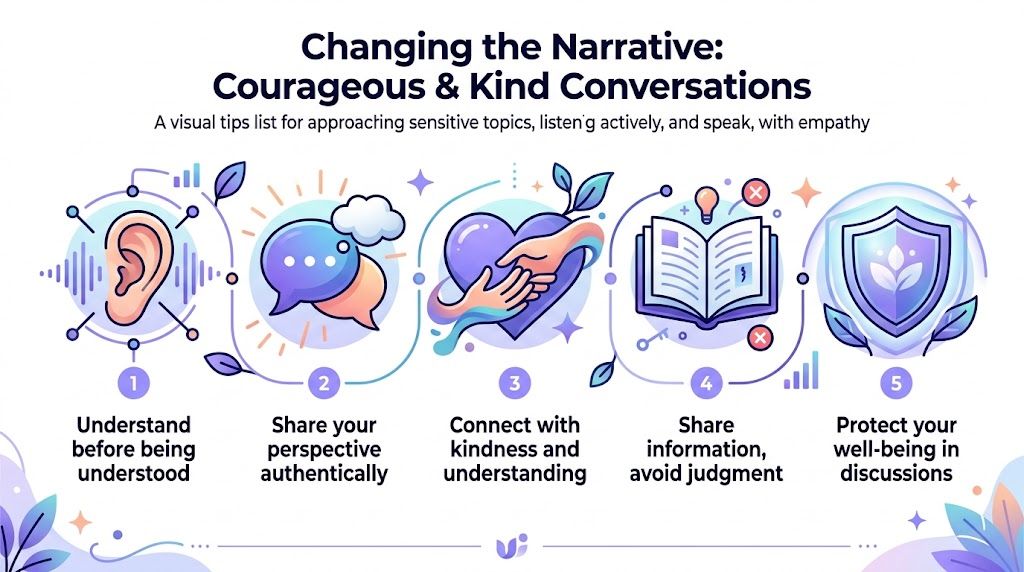
Swap this for that
Here are a few language upgrades that can make conversations safer and more effective.
| Instead of this | Try this |
|---|---|
| “Are you okay?” | “I’ve noticed you seem a bit down lately, and I’m here if you want to talk.” |
| “You just need to stay positive.” | “That sounds heavy. Do you want support, space, or someone to listen?” |
| “That’s crazy.” | “That sounds really difficult.” |
| “Everyone feels like that sometimes.” | “You don’t have to minimize this with me.” |
These shifts matter because they remove pressure. The other person doesn’t have to prove they’re struggling enough to deserve your care.
Three real-life scripts
When checking in on a friend
Keep it specific and gentle. “You’ve been on my mind. I noticed you’ve seemed more withdrawn lately. No pressure to explain, but I care about you.”
When someone makes a dismissive comment
Try calm correction over public humiliation. “I know you may not have meant harm, but that kind of comment can make it harder for people to speak up.”
When sharing your own experience
Use boundaries. “I’ve had my own mental health challenges, and I’ve learned that talking about them helps. I’m sharing that because I want this to feel like a safe conversation, not because I need you to fix anything.”
For readers trying to build confidence in these moments, this article on how to put yourself out there can help you speak up without abandoning yourself.
A short video can also model the tone you’re aiming for. Watch it, then notice which phrases feel natural enough to borrow.
Protecting the conversation and yourself
Kindness doesn’t mean endless availability. Some conversations aren’t safe, and some people aren’t open.
- Set limits early if someone becomes mocking or hostile
- Choose privacy for vulnerable conversations when possible
- Ask consent before going deeper, especially with sensitive topics
- Leave room for silence so the other person doesn’t feel pushed
“I care about this, but I don’t want to argue about someone’s pain.”
That sentence can end a draining exchange while staying grounded in your values.
Mobilize Your Community From Your Own Backyard
Big social change often begins with something surprisingly modest. A small event at a library. A school discussion circle. A few posters at a neighborhood cafe. A conversation series in a faith group. None of those actions look grand on their own, but they create repeated contact with a better message.
That repeated contact matters. A systematic review of youth anti-stigma interventions found that education-based programs have a small but significant short-term effect on reducing stigma, improving attitudes and knowledge more effectively than other types of interventions. The practical takeaway is encouraging. You do not need to launch a massive campaign to make a difference. Clear education, delivered well, can help.

Local actions that are realistic
If “community advocacy” sounds intimidating, start with projects that fit in ordinary life.
A story-sharing evening
Host a small gathering at a library, studio, or community room where people can share lived experience, poetry, journaling, or reflections. Use clear ground rules about confidentiality, consent, and the right to pass.A myth-busting poster series
Ask a few local businesses if they’ll display simple, respectful posters that challenge common misconceptions. Keep the language human, not clinical.A book or article discussion group
Pick one short reading each month and gather a small group to discuss themes like shame, support, burnout, or belonging.A school or youth workshop
If you work with young people, propose a discussion that mixes information with reflection. Facts matter, but people also remember stories and practical language.
What makes a small campaign work
Not every awareness effort helps. Some events stay so vague that nobody leaves knowing what to do differently. Others unintentionally reinforce stereotypes by treating people as cautionary tales instead of full human beings.
A stronger local effort usually includes:
| Stronger choice | Weaker choice |
|---|---|
| Specific myths and respectful corrections | Generic “let’s talk more” messaging |
| Clear safety guidelines | Oversharing without boundaries |
| A chance for reflection and discussion | One-way lecturing |
| Helpful next steps | Inspiration with no action |
Community work gets more sustainable when you make it small enough to repeat.
A gentle starter plan
If you want one practical idea, try this. Invite a few friends or neighbors for a one-hour conversation on mental wellness language. Ask each person to bring one phrase they’ve heard that feels harmful, and together rewrite it into something kinder and more accurate.
That exercise works because it is concrete. It helps people hear stigma in real language, not abstract theory. It also gives them a replacement sentence they can use the next day.
You don’t need everyone to agree with you immediately. You’re planting vocabulary, confidence, and permission. Those are often the first ingredients of change.
Advocate for Systemic Change in Your Workplace and Beyond
Interpersonal kindness matters, but systems shape what people feel safe enough to do. A supportive friend helps. A humane workplace policy helps too. So does a manager who speaks openly, a school that trains staff well, or an organization that treats mental health as part of everyday wellbeing rather than a hidden crisis.
One evidence-based direction is worth paying attention to. Research on stigma reduction and program evaluation notes that contact-based approaches, such as leaders sharing personal stories, help humanize mental health conditions. The same source reports that Rose Hill Center’s transformational care model helped 88% of residents avoid rehospitalization after one year. The broader lesson is not that every workplace should copy a care model. It’s that humanizing contact and thoughtful structure can matter more than slogans.

Questions to ask at work
You don’t need to become a policy expert overnight. Start by looking at what already exists.
What support is visible
Can employees easily find mental health benefits, leave policies, or assistance resources?What language do leaders use
Do they only discuss mental health when someone is in crisis, or do they treat it as a normal part of health?What happens after disclosure
If someone shares that they’re struggling, do they meet care, confusion, or quiet penalty?What training exists
Are managers taught how to respond respectfully and refer people appropriately?
These questions move the issue out of the realm of “awareness” and into culture.
A practical script for raising the topic
If you want to approach HR, a manager, or a community leader, keep your suggestion concrete.
You might say: “I’d love to see us make mental health support more visible and easier to access. Could we review how resources are communicated, and consider opportunities for leaders to share supportive messages or personal stories if they’re comfortable?”
That approach does three things well. It avoids accusation, offers a clear direction, and leaves room for collaboration.
What to recommend
Different workplaces and organizations have different needs, but these ideas often travel well:
- Leader modeling through voluntary story-sharing or messages that reduce shame
- Clear resource communication so people don’t have to dig when they’re already overwhelmed
- Manager guidance on how to respond without diagnosing, dismissing, or overstepping
- Regular conversation spaces that normalize mental wellness before crisis hits
Structural change becomes more likely when you ask for one specific improvement instead of “better culture” in general.
If your influence is local rather than corporate, the same principle applies. Bring one thoughtful request to a school board, community center, or volunteer group. Ask for a discussion series. Ask for better resource visibility. Ask for safer language in programming. Systems shift when ordinary people keep asking humane questions.
Build Sustainable Resilience for the Journey
People who care intensely often burn out unseen. They become the listener, the organizer, the one who notices, the one who speaks up. Then one day they feel emotionally flat, impatient, or discouraged, and they wonder whether they’ve become less compassionate. Usually, they haven’t. They’re depleted.
That’s why resilience belongs in any conversation about how to break the stigma. If you want to keep showing up for other people, you need practices that help you come back to yourself.
Digital tools and self-management apps are increasingly recognized for their potential to reduce stigma and encourage help-seeking, especially for busy professionals and students who value privacy and accessibility. That matters because support doesn’t only happen in therapy offices, workshops, or group settings. It also happens in the small moments when someone chooses to pause, breathe, reflect, and tell themselves the truth in a kinder voice.
Resilience is built in ordinary moments
Many people think resilience is about pushing harder. Often it’s about recovering faster and more honestly.
A sustainable rhythm might include:
- A short morning check-in where you notice your emotional state before the day runs away from you
- A grounding phrase you return to when you feel responsible for everyone
- A written reflection after difficult conversations so stress doesn’t stay trapped in your body
- A small boundary practice such as delaying replies when you’re overwhelmed
None of this is dramatic. That’s why it works. Repetition makes it real.
Use affirmations as fuel, not escape
Some readers worry that daily affirmations are too inward-looking for people who care about social change. I see them differently. A grounded inner practice can make outer action steadier, less reactive, and more compassionate.
Try affirmations that support both honesty and stamina:
Before a hard conversation
“I can speak with clarity and care.”After hearing someone’s pain
“I can care without carrying everything alone.”When progress feels slow
“Small acts of courage still matter.”When you feel discouraged
“I’m allowed to rest and stay committed.”
For a deeper look at sustaining yourself through stress and challenge, this guide on how to build mental resilience offers practical support.
A rhythm you can actually keep
You do not need an elaborate personal growth routine. You need a practice you’ll return to when life gets noisy.
Here’s one example:
| Time of day | Small resilience action |
|---|---|
| Morning | Read one grounding affirmation before checking messages |
| Midday | Take one slow breath and ask, “What do I need right now?” |
| Evening | Write a few sentences about what felt heavy and what helped |
That rhythm supports advocacy because it lowers the chance that your care turns into self-erasure.
Your nervous system is part of your advocacy toolkit.
When you care for it, you’re not stepping away from meaningful work. You’re making it possible to continue.
If you want a simple way to turn self-compassion into a daily practice, download I Become from the App Store. It helps you build a steady affirmation ritual with personalized prompts, Lock Screen widgets, and four practice modes: Read, Speak, Listen, and Write. If you’re ready to support your own mental wellness while becoming a calmer, stronger voice for others, I Become is a gentle place to begin.
Found this helpful? Share it with someone who might benefit.