
How to Achieve Self Love: A Practical Guide for 2026
Learn how to achieve self love with a practical plan. Discover mindset shifts, daily rituals, and a 30-day roadmap to build genuine self-worth and compassion.

You know that moment when your day is technically over, but your mind keeps going. You replay what you said in a meeting. You remember the text you never answered. You compare yourself to people who seem calmer, kinder, more confident, more together.
A lot of people call that a confidence problem. Sometimes it is. But often, it is something deeper. It is the ache of feeling disconnected from yourself.
That is why learning how to achieve self love is not about forcing cheerful thoughts on top of exhaustion. It is about building a relationship with yourself that feels honest. Gentle. Steady. Strong enough to hold your mistakes without turning them into your identity.
The True Meaning of Self Love in a Busy World
Self-love gets reduced into a very small idea online. Buy something nice. Take a bath. Say something sweet in the mirror. Those things can be supportive, but they are not the whole picture.
The more lasting version of self-love is quieter. It grows when your actions match your values.
If you care about kindness but speak to yourself harshly, that mismatch hurts. If you value honesty but keep pretending you are fine when you are overwhelmed, that gap drains trust in yourself. Self-worth gets weaker when your inner life and outer behavior pull in different directions.
Research summarized by Olivia Felice Mendoza’s article on self-love and integrity argues that the most lasting self-esteem comes from purpose and integrity, not just positive affirmations. The same source notes that 68% of self-help app users drop off within 30 days due to a lack of purpose alignment. That fits what many people already feel. Motivation fades when a practice feels disconnected from what matters to them.
What integrity looks like in everyday life
Integrity does not mean perfection.
It means asking small, brave questions like:
- When I say I value rest: Do I treat rest like a need, or like a reward I have to earn?
- When I say I value compassion: Do I offer any to myself when I mess up?
- When I say I value growth: Do I let myself learn slowly, or do I shame myself for not changing fast enough?
Self-love often begins there. Not in self-praise, but in self-honesty.
Self-love is less about convincing yourself that you are amazing every second, and more about becoming someone you can trust.
Why affirmations still matter
Affirmations are useful. They can interrupt old mental grooves and support a kinder inner climate.
But they work best when they are tied to values. “I am worthy” can help. “I act with self-respect by honoring my limits” often resonates more because it connects belief to behavior.
That is the heart of this approach. You are not trying to perform self-love. You are practicing it in ways your nervous system, habits, and daily choices can recognize.
Shifting Your Foundational Mindset from Critic to Coach
Many people try to build self-love while still using the voice of an inner drill sergeant. They push harder, judge faster, and expect instant results. Then they wonder why the process feels brittle.
A kinder path starts with mindset.
Research on health-related habit formation found that building new habits typically takes 2 to 5 months, not the popular idea of 21 days, according to a systematic review and meta-analysis on habit formation and growth mindset. The same research found that a growth mindset correlated with longer self-tracking use with r(288) = 0.25, p < 0.01. In plain language, people who believe they can develop tend to stay with the practice longer.
That matters for self-love. Your capacity for self-compassion is not fixed. It can be trained.
Fixed voice versus growth voice
Your inner critic usually speaks in absolutes.
| Inner critic | Inner coach |
|---|---|
| “I always ruin things.” | “I do not like what happened, but I can repair it.” |
| “I should be better than this by now.” | “I am learning a new way to respond.” |
| “I am too sensitive.” | “Something in me needs care and attention.” |
| “If this still feels hard, I must be failing.” | “Difficulty is part of practice.” |
The coach voice is not fake positivity. It is accurate, steady, and useful.
Catch the critic without becoming the critic
A common confusion shows up here. People notice harsh self-talk, then immediately judge themselves for having it.
That only creates a second layer of pain.
Try this instead:
Name it. “That is my critic talking.”
Get curious. “What is this voice trying to protect me from?”
Respond with guidance. “Thank you for trying to help. Shame is not the strategy I am using now.”
That shift from shame to curiosity changes the whole process. You stop treating yourself like a problem to solve and start treating yourself like a person to support.
Practical reframes for everyday moments
Here are a few real-life swaps you can practice this week:
After making a mistake at work From: “I am so embarrassing.” To: “I made a mistake. I can correct it and learn from it.”
After missing a routine From: “I have no discipline.” To: “A missed day is information, not proof that I cannot do this.”
After comparing yourself to someone else From: “Why can’t I be like them?” To: “What do I admire there, and how can I express that in my own way?”
Curiosity softens defensiveness. When you stop attacking yourself, you can finally hear what you need.
Patience is part of the method
If your self-talk has been harsh for years, it makes sense that a new voice feels unfamiliar. You are not doing it wrong because it feels awkward.
You are practicing a skill.
If you want extra support with that shift, the guide on how to develop a growth mindset offers helpful language for moving from fixed identity statements into more flexible, compassionate thinking.
One helpful test is this. Ask, “Would I speak this way to someone I love who was trying their best?” If the answer is no, that is your invitation to begin again with a coach voice.
Building Your Daily Rituals for Self-Compassion
Self-love becomes real when it has a place in your day.
Not a dramatic overhaul. Not a perfect morning routine. Just a few repeatable actions that tell your body and mind, “I matter here too.”
A neuroscience-based approach described in this guide to learning to love yourself emphasizes three moves: cultivating curiosity over shame, using mindfulness practices like box breathing to activate the parasympathetic nervous system, and using repetition with affirmations to support neural rewiring. The same source states that consistent 10-minute daily sessions can yield a 65% improvement in self-acceptance within 4 weeks.
That does not mean every day feels magical. It means small repetition counts.
A short visual can help you settle into that idea:
A five-minute ritual that feels doable
Try this simple sequence:
One minute of box breathing Inhale for 4 seconds, hold for 4 seconds, exhale for 4 seconds.
One minute of grounding touch Place a hand on your heart or upper chest. Let your shoulders drop.
Two minutes of affirmations Read them slowly, or say them out loud.
One minute of intention Ask, “What is one value I want to live today?”
This works because it does more than change thoughts. It creates safety first, then introduces kinder language.
Write affirmations that match your values
A lot of affirmations feel flat because they sound borrowed. They are broad, polished, and emotionally distant.
Value-based affirmations feel different. They connect who you want to be with how you want to act.
Try this formula:
I am becoming someone who + value-aligned action
Examples:
- I am becoming someone who speaks to herself with respect.
- I am becoming someone who honors rest without guilt.
- I am becoming someone who tells the truth about what she needs.
- I am becoming someone who treats mistakes as part of growth.
- I am becoming someone who chooses integrity over approval.
If you want more ideas, this collection of self-loving affirmations can help you find wording that feels natural instead of forced.
The best affirmation is not the most impressive one. It is the one you can believe enough to practice.
Sample scripts for different moments
For self-doubt I do not need to earn my worth through perfection. I can learn without attacking myself. I trust myself to take the next small step.
For burnout Rest is part of how I care for my life. Slowing down does not make me lazy. My needs deserve my attention.
For people-pleasing I can be kind without abandoning myself. My boundaries protect what matters. I do not need everyone’s approval to belong to myself.
For gratitude and steadiness I notice what is good and still make room for what is hard. I am allowed to grow at a human pace. Today, I choose one loving action.
When affirmations feel cringey
That reaction is common.
Usually, the statement is either too far from what you can believe, or it is too vague to feel meaningful. If “I love everything about myself” makes you roll your eyes, use a bridge statement instead:
- I am learning to treat myself with more kindness.
- I am open to seeing myself more fairly.
- I can practice respect before full confidence arrives.
That is not watering it down. It is making it usable.
Going Deeper with Reflective Journaling Prompts
Affirmations plant seeds. Journaling helps you see what the soil is like.
You might tell yourself, “I deserve peace,” and still snap at people, overcommit, or ignore your own limits. Journaling helps you notice why. It turns self-love from a slogan into self-understanding.
According to Wondermind’s article on self-love, journaling-based emotional discovery can drive a 72% gain in self-esteem within 8 weeks. The same source describes a simple structure: track emotions, analyze triggers to uncover needs and form an action plan, and practice verbal vulnerability, which it says can increase self-compassion by 75%.
A simple three-part journaling practice
Start with observation.
Then move into interpretation.
End with response.
That sounds abstract, so here is what it can look like in real life.
You have a day where one small comment from a coworker lingers all evening. Instead of saying, “I am overreacting,” you open your journal.
Part one: Track what you felt
Write what happened, what emotion came up, and where you felt it in your body.
Prompts:
- What feeling was strongest today?
- Where did I feel it physically?
- What moment triggered it?
- What story did my mind start telling?
Sometimes you discover the obvious feeling is not the deepest one. Irritation may be covering hurt. Numbness may be covering fear.
Part two: Analyze what the feeling is asking for
This is the part many people skip.
Emotions are not always instructions, but they often carry information.
Try prompts like:
- If this feeling could speak, what would it ask for?
- What value felt crossed here?
- What need of mine was ignored, dismissed, or stretched too thin?
- Does this moment remind me of an older pattern?
A short example: “I felt angry when my friend changed plans last minute. Under that anger was disappointment. Under that disappointment was a need to feel considered.”
That is useful. It gives you something real to work with.
Part three: Respond with compassion and action
Close the loop by asking:
- What would a caring response to myself look like tonight?
- What boundary, repair, or request might help?
- What one action would bring me back into integrity?
That action might be very small. Go to bed earlier. Say no to one extra task. Send an honest message instead of pretending nothing bothered you.
Journaling is not about producing beautiful insight. It is about telling the truth gently enough that you can hear it.
Prompts for value-aligned self-love
Use these when you want to connect emotions with integrity:
- Where did I feel most like myself today?
- Where did I abandon myself to keep the peace?
- Which value did I honor today?
- Which value did I neglect?
- What would self-respect look like in tomorrow’s schedule?
- What am I trying to prove, and what would happen if I stopped?
- Where am I asking affirmations to do work that a boundary should do?
If you want a longer list to choose from, these self-love journal prompts can give you more ways into the practice.
One last note. Journaling does not have to stay private forever. Sometimes self-love deepens when you speak with honesty to a trusted friend, mentor, or therapist. Being witnessed with care can soften shame in ways silence cannot.
Navigating Obstacles on Your Self-Love Journey
Individuals often do not fail at self-love because they are incapable of it.
They get discouraged by normal resistance and mistake that resistance for proof they should stop.
When it feels selfish to care for yourself
This is especially common if you are used to being helpful, capable, or emotionally available for everyone else.
Caring for yourself is not selfish. It is how you stop making your body pay for your loyalty to everyone else. Rest, boundaries, honesty, and emotional care make you more present, not less loving.
If guilt shows up, do not argue with it for an hour. Try one small act anyway. Drink water before answering one more request. Take five quiet minutes before reentering a busy room. Let behavior teach your mind that care is safe.
When affirmations seem like they are not working
Sometimes people expect affirmations to erase insecurity quickly. When that does not happen, they assume the practice is fake.
A better question is this: are the affirmations helping you notice, interrupt, and redirect old patterns? If yes, they are working. Perhaps subtly. But still working.
If they feel empty, adjust them. Make them more believable, more specific, and more connected to values. “I am perfect” usually bounces off. “I can respond to myself with respect today” has somewhere to land.
When you slide back into old habits
You will. Everyone does.
A hard day, conflict, poor sleep, grief, stress, deadlines. Old patterns often return when your system feels overloaded. That does not erase progress. It reveals where you still need support.
Try this reset:
- Pause first: Take a few slow breaths before analyzing anything.
- Name the moment: “I am back in a familiar pattern.”
- Reduce the task: If your usual practice feels too big, do the smallest version.
- Repair quickly: One kind sentence to yourself counts. One honest journal line counts. One value-aligned choice counts.
Progress in self-love is not measured by never struggling again. It is measured by how you return to yourself when you do.
When the practice feels awkward
New tenderness can feel uncomfortable if you are used to pressure.
That discomfort does not always mean the practice is wrong. Sometimes it means your system is stretching into a kinder way of being. Let it be a little awkward. Let it be a little imperfect. You do not need to wait until self-love feels elegant to begin.
Your 30-Day Roadmap to Cultivate Self-Love
A month is long enough to notice change and short enough to feel possible.
Instead of trying to transform your whole life, give each week one job.
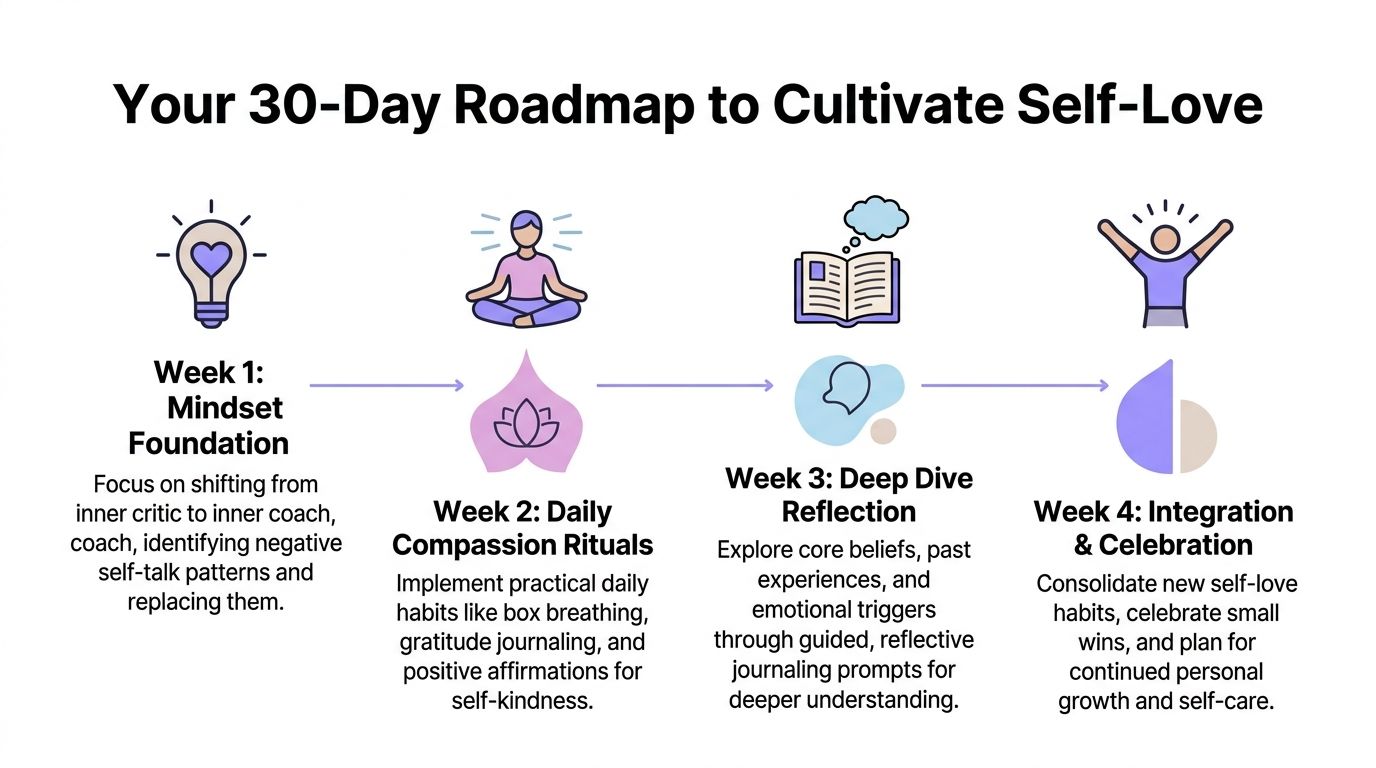
Week by week focus
Week 1. Mindset foundation Notice your inner critic. Write down recurring phrases. Practice turning judgment into curiosity.
Week 2. Daily compassion rituals Add a short breathing practice and a few value-based affirmations. Keep it simple enough that you can repeat it.
Week 3. Deep reflection Journal about emotional triggers, unmet needs, and places where your actions do or do not match your values.
Week 4. Integration and celebration Choose one small daily action that reflects self-respect. Honor your wins, even the quiet ones.
Tracking helps more than many people realize. According to Psychology Today’s summary of the science behind habit tracking, a meta-analysis of over 19,000 participants found that monitoring goal progress significantly increased goal attainment. The same piece explains that each checkmark can reinforce an identity-based shift, such as becoming someone who prioritizes their well-being.
That is why a simple streak, checkmark, or daily note can matter. You are not just recording behavior. You are collecting evidence of who you are becoming.
How to achieve self love becomes much less mysterious when you approach it this way. Notice your patterns. Calm your system. Speak to yourself with intention. Tell the truth in your journal. Choose actions that match your values. Repeat.
If you want gentle support while building this practice, I Become is a thoughtful place to start. The iOS app helps you build a steady affirmation ritual with personalized statements, Lock Screen widgets, and four practice modes called Read, Speak, Listen, and Write. If consistency is your biggest challenge, its streak tracking can make your progress feel visible and motivating. Download I Become from the App Store and let your daily reminders become small proofs that you are learning how to care for yourself with more honesty, compassion, and integrity.
Found this helpful? Share it with someone who might benefit.