
How to Put Yourself Out There When It Feels Impossible
Discover how to put yourself out there with gentle, actionable steps. Learn to build confidence, manage social anxiety, and embrace new opportunities.
Let's get one thing straight: "putting yourself out there" isn't some grand performance. It’s not about suddenly transforming into a fearless extrovert who commands every room.
It’s something much quieter, much more meaningful. It’s the gentle art of simply allowing yourself to be seen—one small, courageous step at a time. It’s about letting curiosity, not fear, lead the way on your personal growth journey.
The Gentle Art of Showing Up for Yourself

I get it. The very thought of putting yourself out there can feel terrifying. Your mind might flash to images of giving a speech, walking into a party completely alone, or hitting ‘publish’ on a project you’ve poured your heart into.
The heart-pounding, palm-sweating physical reaction is real. And so is that nagging inner voice whispering, “What if I’m not good enough?” or “What will they think of me?”
That feeling is completely human. We’re wired for connection, which means the thought of rejection or judgment can feel like a genuine threat. It’s no wonder so many of us choose to stay hidden, even when we’re yearning for new friends, new opportunities, and new experiences.
A Journey of Self-Compassion
But here’s a warm truth: learning to show up for yourself isn’t about taking one giant, terrifying leap. It’s a journey you take with yourself, built on a foundation of small, intentional, and incredibly kind actions. The real work begins on the inside, long before you ever say a single word to a stranger.
This journey is about:
- Welcoming your fears. Give them a name and a seat at the table, but don't let them drive the car.
- Celebrating the small wins. Realize that making eye contact with the barista is just as much a victory as starting a conversation.
- Choosing curiosity over judgment. Approach a new situation wondering, "What could I learn?" instead of assuming, "This will go badly."
The goal isn’t to eliminate fear. It's to build your courage so that it becomes louder than your doubt. It’s about proving to yourself, through gentle and consistent practice, that you are capable of handling whatever comes next.
That’s exactly what we’re going to do here. Together, we’ll explore how to rewire that inner critic and cultivate an inner voice that champions you. You’ll get real-world exercises to gently expand your comfort zone, plus authentic ways to start and navigate conversations.
This whole process starts with the words you repeat to yourself every day. When you build a safe and positive inner world, you create the foundation you need to bravely step into the outer world. A great way to start is with daily affirmations. The I Become app is designed to help you do just that, gently rewiring your thoughts for confidence. You can download it from the App Store and start your journey today.
Rewire Your Inner Critic with a New Mindset
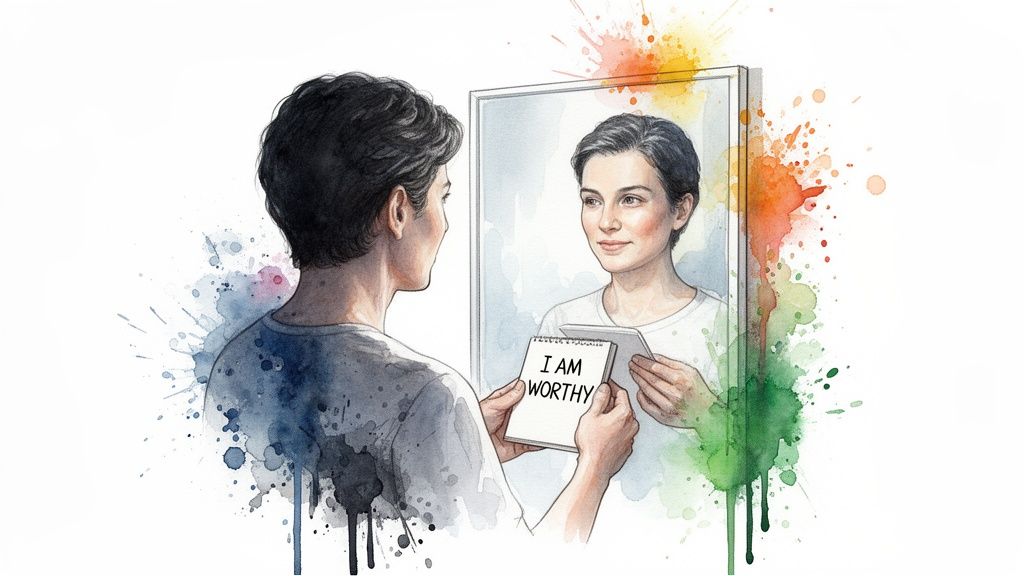
Before you ever take that first step into a crowded room or hit ‘send’ on a vulnerable message, the real work has to happen inside. The journey of putting yourself out there begins with the quiet, internal process of rewiring that inner critic—the voice that works so hard to keep you small and safe.
You know that voice, don't you? It’s the one whispering doubts, fears, and all the worst-case scenarios.
It loves to ask, "What if they don’t like me?" or insists, "I’m just going to make a fool of myself." This self-talk isn’t just a random thought. It's a powerful force that can create a very real barrier between you and the connections you want so badly.
But here’s the beautiful truth: that voice doesn't have to be in the driver's seat. You can intentionally build a stronger, kinder, and more supportive inner advocate. This isn’t about pretending fear doesn't exist. It's about learning to see it, acknowledge it, and then consciously choose a more empowering thought.
From Self-Doubt to Self-Belief
Changing your mindset is a practice, just like meditation. It takes gentle, consistent effort. The very first step is simply to notice the negative thoughts as they pop up, without judging yourself for having them. When you catch your mind saying, "I have nothing interesting to contribute," just see it for what it is—a thought.
Then, you can gently question it. Is it really 100% true that you have nothing interesting to say? Or is it more likely that you’re just feeling anxious? This gentle pushback creates just enough space for a new perspective to take root. This is a cornerstone of learning how to develop a growth mindset, which teaches you to see challenges as opportunities instead of threats.
Daily affirmations are an incredible tool for actively introducing these new, more helpful thoughts. By consistently repeating positive statements, you start to carve fresh neural pathways in your brain, slowly making confidence your new normal.
Creating Your Affirmation Ritual
To make this practice stick, it helps to have a simple, accessible tool. This is where an app like I Become can become a true partner in your personal growth. It helps you turn passive wishing into an active, daily ritual.
Here’s a simple way you can start using it to build your own inner advocate:
- Choose a Focus: Jump in by selecting a focus area like ‘Confidence’ or ‘Self-Worth.’ This will give you affirmations that are tailored to exactly what you’re working on.
- Engage Your Senses: Experiment with the different practice modes—Read, Speak, Listen, or Write. See what feels right. I've found that speaking affirmations out loud or writing them down makes them feel so much more real and powerful.
- Stay Consistent: Pop a widget on your Lock Screen for a gentle nudge right when you need it. Building a streak feels great, but more importantly, it reinforces your commitment to yourself.
This entire process is about nurturing a new relationship with yourself—one built on encouragement, not criticism.
I am worthy of connection and new experiences.
Embracing an affirmation like this one isn't about pretending you're fearless. It’s a declaration that you are willing to be brave despite the fear. It’s your permission slip to be seen.
If you're ready to start building that more supportive inner voice, you can download I Become from the App Store and begin your practice today.
Build Your Confidence With Small, Courageous Steps

Real, unshakeable confidence isn't something you're born with or find in a single moment of bravery. It’s built, one small, intentional action at a time. Each tiny step forward provides your brain with concrete proof that you are courageous.
The idea of putting yourself out there can feel like staring up at a skyscraper. It’s overwhelming. But you don't have to leap to the top floor in a single bound. Instead, think of it as building your own personal courage ladder, one comfortable rung at a time.
You start with tiny, low-stakes actions that feel safe and manageable. This is how you gently expand your world without sending your anxiety into overdrive. For a deeper look at the data, the latest mental health numbers from NAMI.org are incredibly insightful.
Get Comfortable in New Spaces—Alone
So, where do you even begin? The first rung on your ladder doesn't require you to say a single word to anyone. The goal is simply to get comfortable being by yourself in new environments and observing the world around you.
Try one of these simple, solo missions:
- Become a coffee shop regular. Order your favorite drink, find a quiet corner, and just be present for a few minutes. Take in the aroma of coffee, the low hum of conversation, the clinking of cups. Your only job is to exist in that space.
- Find a bench and people-watch. Go to a local park or a bustling town square and just observe with gentle curiosity. It's a wonderful mindfulness practice that helps you feel connected to the world from a safe distance.
- Wander through a local market. Browse the colorful stalls and notice the energy of the crowd without any pressure to talk or buy. You’re simply getting used to the gentle rhythm of a social setting.
These small acts are incredibly powerful. They give you solid evidence that you can step into a social environment and be completely okay.
Your First Week Courage Ladder
To make this feel even more doable, I’ve put together a simple 7-day plan. Think of this as your roadmap for the first week. Remember to give yourself credit for every single action, no matter how small it feels. Each one is a huge win.
| Day | Your Small Action | Your Affirmation Focus |
|---|---|---|
| Day 1 | Go to a coffee shop and just sit for 15 minutes. | "I am safe and comfortable in new spaces." |
| Day 2 | Make brief eye contact and smile at one stranger. | "My smile is a gift I can share freely." |
| Day 3 | Give a genuine compliment to a cashier or barista. | "I enjoy connecting with others." |
| Day 4 | Ask a store employee a simple, low-stakes question. | "My voice deserves to be heard." |
| Day 5 | Attend a free local event for just 15 minutes. | "I am brave for trying new things." |
| Day 6 | Share a positive comment on a friend's social media post. | "I add value to my communities." |
| Day 7 | Reflect on your week and celebrate your progress. | "I am proud of the steps I am taking." |
This isn't about perfection; it’s about practice. If a day feels too hard, just repeat a previous day's action. The point is to keep showing up for yourself.
Every small act of courage is a deposit into your confidence account. Over time, these deposits compound, building a rich reserve of self-trust and resilience.
You can amplify this whole process by pairing these actions with a tool designed to reinforce your progress. In the I Become app, you can use the streak tracker to create momentum and see a visual record of your consistency. Each checkmark is a piece of evidence that you're building a new identity.
Ready to start collecting your proof? Download I Become from the App Store and begin your journey today.
How to Start and Navigate Conversations Authentically

So you did it. You walked into the party, the networking event, the new class. You took those first brave steps. But now you’re standing there, and a whole new kind of fear creeps in: What on earth do I say? The dread of an awkward silence or fumbling your words can feel just as intense as the fear of showing up in the first place.
Here’s the secret that changed everything for me: the goal is connection, not performance. You don't have to be the wittiest person in the room. You don’t need to be brilliant or charming. You just need to be you.
This simple shift moves your focus away from a frantic search for the "perfect" thing to say and toward a genuine curiosity about the person in front of you. When you truly want to learn about someone, the pressure just melts away.
Finding Your Opening
The best way to start a conversation is to forget the cheesy lines and just talk about what’s happening right in front of you. Grounding your opener in the shared environment makes it feel completely natural and effortless.
Think about where you are and try one of these:
- At a professional event: "This has been such an interesting afternoon. What brought you out to this event?" or "I really enjoyed that last speaker. What was your biggest takeaway from her talk?"
- Somewhere casual, like a party: "I love the music they're playing. Do you know who this artist is?" or "This food is incredible! Have you tried the mini quiches yet?"
- In a class or workshop: "I'm really excited to dive into [the topic]. What part of it are you most curious about?"
These are all open-ended questions. They can’t be answered with a simple "yes" or "no," which instantly gives the conversation somewhere to go.
An open-ended question is like a gift you offer someone. It shows you're genuinely interested in their thoughts and experiences, not just looking for a quick answer. This is where real connection sparks.
The Gentle Art of the Graceful Exit
Knowing how to start is only half the battle. If you’ve ever worried about getting “trapped” in a conversation, you know how much anxiety that can cause. Having a few polite exit strategies in your back pocket is a game-changer for your confidence.
When you’re ready to move on, you can say something simple and warm:
- "It was so great chatting with you! I'm going to grab another drink, but I hope you have a wonderful rest of your night."
- "Well, I don't want to monopolize all your time. It was a pleasure to meet you!"
- "Thank you for the great conversation. I see a friend I need to catch up with, but it was lovely connecting."
See? No drama, no awkwardness. Just a clear and kind way to wrap things up. The confidence to use these tools comes from a strong inner foundation. Daily affirmations can be a huge part of building that. Placing an I Become affirmation widget on your phone with the words, "I am open to new connections," can give you that quiet shot of courage right when you need it.
For more ideas, check out our guide on affirmations to improve communication.
Handling the Bumps in the Road and Building Your Bounce-Back Muscle
Let's be real for a moment. When you start putting yourself out there, some moments are going to feel… well, awkward. A conversation might die a slow, painful death. You’ll suddenly feel like every eye in the room is on you. Or a friendly gesture just doesn't land how you imagined. It’s so easy to file these moments under “Failure.”
But what if they aren’t failures at all?
What if every one of those cringey pauses or fumbled conversations was just feedback? Think of it less like a final grade and more like a clue. It’s a piece of the puzzle, teaching you what feels right, what doesn’t, and how you connect with different people. Embracing this perspective is how you start building genuine, unshakable resilience.
And you don't have to just grit your teeth and "power through" the discomfort. You can learn to be your own first responder. Simple grounding techniques, like taking three intentionally slow, deep breaths, can send a powerful signal to your brain: "I'm okay. I'm safe," even when your cheeks are burning.
Turning That Sting of Rejection Into Strength
The fear of rejection is a huge one, and it feels so personal, doesn't it? The real trap is letting one uncomfortable interaction write a whole negative story about who you are. A conversation that fizzles out doesn't mean you're "boring." It just means you and that one person, in that one moment, weren't a match. That's all.
An awkward moment isn’t a reflection of your worth. It’s just a moment. The real win is that you were brave enough to try in the first place.
This is where you can get really intentional with your inner work. When you feel that familiar sting, instead of letting your mind spiral, you can have a better response ready. This is the perfect time to pull up an affirmation you’ve already chosen to ground yourself in self-compassion. It’s a practical way to interrupt the negative feedback loop. If those anxious thoughts tend to take over, our guide on how to calm anxious thoughts has some fantastic strategies you might find helpful.
Your Pocket-Sized Resilience Kit
Going into social situations with a plan for the tough moments makes them feel so much smaller. Think of it as your own personal resilience toolkit, ready to go whenever you need it.
Here’s what you can pack in it:
- A Self-Soothing Practice: Know your go-to calming technique. Will it be deep breathing? Or maybe the 5-4-3-2-1 grounding method, where you name 5 things you see, 4 you can touch, 3 you hear, 2 you smell, and 1 you taste.
- A Pre-Loaded Affirmation: Before you even leave the house, pick an affirmation that feels right. Something like, “I am resilient, and I can handle whatever happens.”
- A Curious Mindset: Instead of asking, "What did I do wrong?" try asking, "What can I learn from that?" This simple switch changes everything.
Developing this kind of bounce-back ability lets you brush yourself off and get back in the game, knowing that every single attempt is making you stronger. Having this support system right in your pocket can be a game-changer. You can even use I Become to create your own resilience affirmations and have them on hand for when you need that boost.
Frequently Asked Questions
As you start this journey of putting yourself out there, it's completely normal for a few questions—and maybe a few fears—to pop up. Let's walk through some of the most common concerns I hear from people just like you.
What If I'm An Introvert? Do I Have To Become An Extrovert?
Not at all. In fact, please don’t! The goal is never to change who you are at your core. It's about learning to express your authentic self in a way that feels good to you.
For an introvert, putting yourself out there often looks different, and that's a huge advantage. Your path might be about fostering a few deep, one-on-one connections instead of trying to command a crowded room. It's about finding that sweet spot right at the edge of your comfort zone and gently pushing it, not forcing yourself into situations that leave you feeling totally drained. It's about intentional connection, not just constant socializing.
Your quiet energy is a real strength. It allows you to listen more deeply, make more thoughtful observations, and bring a calm presence to conversations that many people find incredibly appealing.
The key is to honor your natural energy. Reinforcing this with affirmations in the I Become app, like “My quiet presence is powerful” or “I thrive in meaningful conversations,” can be a wonderful way to celebrate your introverted strengths as you grow.
How Long Does It Take To Feel Confident?
Honestly, there’s no finish line. Confidence isn't a destination you arrive at one day; it’s a muscle you build with practice, little by little. The most important thing is to be incredibly patient and kind to yourself throughout the process.
Instead of waiting for some huge, dramatic shift, learn to spot and celebrate the small victories. Did you make eye contact with the barista today? That's a win. Did you last one minute longer at a party than you normally would? That's a huge win. Acknowledge it.
This is where consistency really creates momentum. A simple habit-building tool can make a world of difference here. Using something like the streak tracker in I Become gives you visual proof that you're showing up for yourself, day after day. It reminds you that every small step forward is real, tangible progress.
What's The Best Way To Handle Rejection Or An Awkward Moment?
First, take a breath and just let yourself feel it. That sting of awkwardness or rejection is a universal human feeling. Don't beat yourself up for it or tell yourself you "shouldn't" feel that way. Just allow it to be there for a moment.
Then, you have to consciously reframe what just happened. A conversation that fizzles out isn't a verdict on your personality or your worth. It’s usually just a simple moment of mismatched energy. You just didn't click with that person, and that is perfectly okay. It happens to everyone.
The real trick is to stop yourself from replaying the moment on a loop in your head. Have a go-to self-compassion phrase ready. Something like, "I am brave for trying, and this moment does not define me," can be incredibly grounding. The more you practice this, the more you'll realize that these moments are not only survivable, but they also make you incredibly resilient.
Can An App Really Help Me Put Myself Out There?
While an app is no substitute for therapy, it can be an incredibly powerful and accessible ally. So much of the fear we feel is driven by that automatic, negative inner voice that runs on a loop in the background.
An app like I Become is designed to help you intentionally interrupt that loop. By consistently hearing, reading, and speaking positive statements about yourself, you literally begin to build new, more helpful thought patterns in your brain.
The various practice modes—Read, Speak, Listen, and Write—help you absorb these new beliefs from every angle, which is what makes them stick. Think of it as your personal confidence gym, helping you train your mind so that taking those steps in the real world feels so much less intimidating.
This whole journey is yours and yours alone to shape, one brave step at a time. If you feel ready to start rewiring your thoughts for more courage and connection, you can begin your practice with I Become. Download it from the App Store and discover the power of affirming the person you're already becoming.
Found this helpful? Share it with someone who might benefit.