
Learning to Be Alone: A Guide to Joy in Solitude
Discover how learning to be alone can be your greatest strength. Our 2026 guide offers gentle steps for finding confidence and joy in solitude today.
Somewhere in your day, there's probably a quiet pocket you don't quite know what to do with. Maybe it's the few minutes after you wake up, the walk back from work, the empty apartment after dinner, or the moment you reach for your phone just so you don't have to feel the silence.
A lot of people assume that being alone automatically means something is wrong. It can feel like proof that you're disconnected, behind, or somehow missing what everyone else seems to have. But learning to be alone isn't about withdrawing from life. It's about building the kind of inner steadiness that lets you enjoy your own company without feeling abandoned by it.
That shift matters. Solitude can become a skill. And like any skill, it gets easier when you practice it gently, with the right mindset and a few small rituals that fit real life.
From Lonely to Liberated Rethinking Your Time Alone
Being alone and being lonely are not the same experience.
That sounds simple, but it can take years to feel true. Many of us were taught to read aloneness as rejection. If we're by ourselves on a Friday night, eating lunch alone, or walking without company, the mind can rush in with a story: no one wants me, something is missing, I should be more connected than this.
Sometimes that story points to real pain. A 2023 to 2025 WHO summary discussed by Riskology notes that 1 in 4 adults globally experience chronic loneliness, and that chronic loneliness is linked to 29% higher mortality risk. That's serious. It also isn't the same thing as chosen, nourishing solitude.

Two very different inner states
Positive solitude usually has a quiet, grounded quality. You may still feel tender or reflective, but there's space in the experience. You can think. You can breathe. You still feel connected to yourself.
Clinical loneliness tends to feel sharper. It can make time alone feel threatening, not restorative. The same Riskology summary notes that a simple 3-item UCLA Loneliness Scale can help people check whether they may be moving into clinical risk, and that a score over 6 may indicate concern.
A useful question is this: Does my alone time help me return to myself, or does it make me feel more unsafe inside myself?
Practical rule: Solitude supports growth when it creates calm, reflection, or clarity. If it consistently deepens fear and disconnection, it may be time for support, not more isolation.
A healthier way to name what you want
If you're trying to enjoy your own company, you are not aiming for emotional numbness. You are not trying to prove you don't need people. You are learning a steadier relationship with yourself.
That's why the phrase learning to be alone matters. It turns aloneness from a passive condition into an active practice. You're not waiting to feel comfortable someday. You're building comfort with attention, intention, and care.
A few examples make the difference clearer:
- After a busy day, you sit with tea and breathe for a few minutes. That's solitude.
- You spend the same few minutes spiraling about why no one texted back. That's loneliness or anxious rumination.
- You take yourself on a quiet walk because you want to reset. That's solitude.
- You avoid everyone because connection feels too painful. That may need more support than a self-care ritual can provide.
This distinction can be relieving. It means your wish for quiet is not a flaw. It may be the start of self-trust.
Start Your Solitude Practice with Gentle Awareness
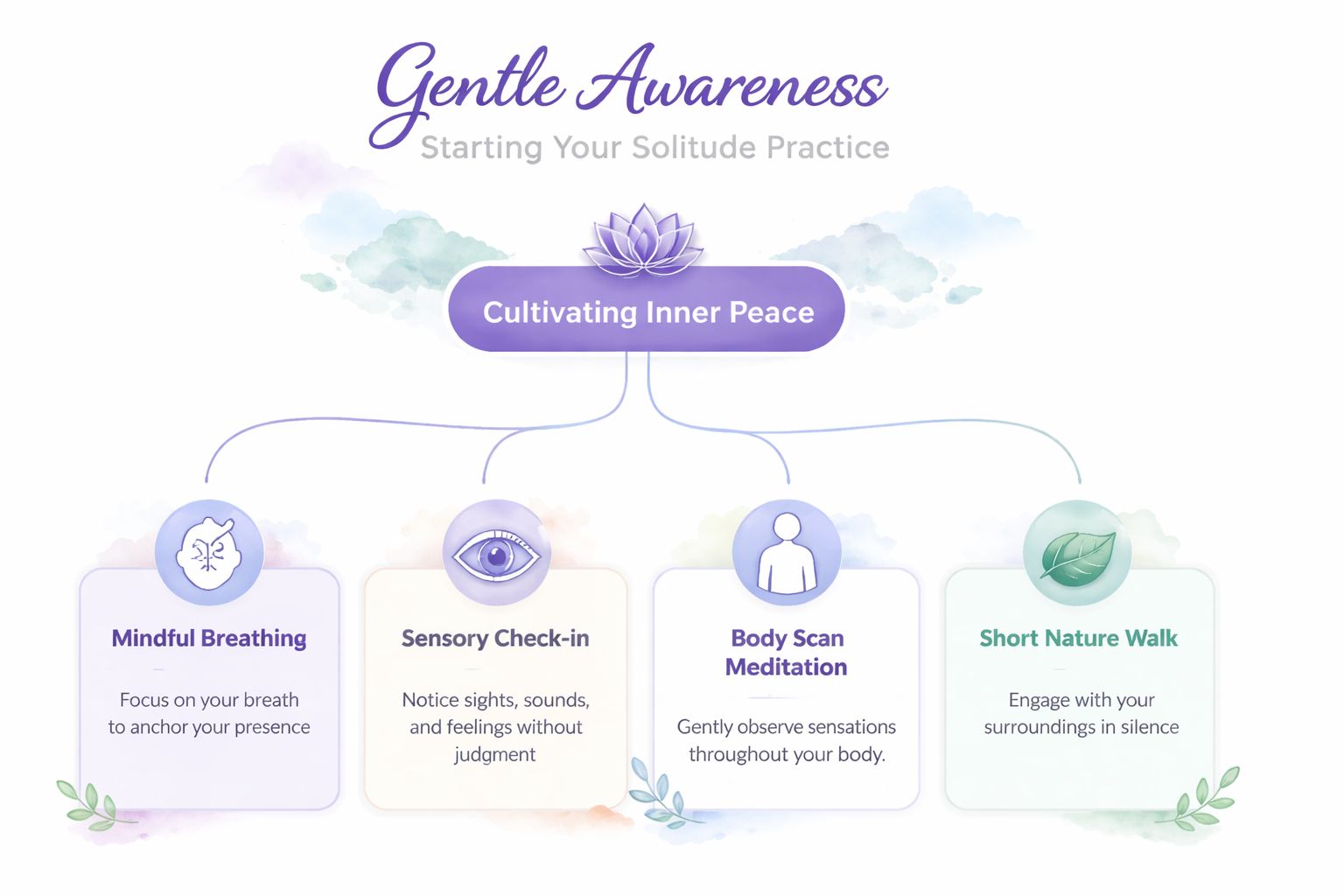
The first step isn't to plan a solo weekend or become instantly comfortable with silence. The first step is much smaller. It's learning how to stay present with yourself for a few minutes without rushing to fill the space.
Research discussed in Behavioral Scientist's coverage of Thuy-vy T. Thomas's solitude skills work suggests starting with short 5 to 10 minute sessions focused on emotion-facing, which is often the hardest part. That same piece notes that participants in the program improved solitude enjoyment, with effect sizes of d=0.65-0.85.
Start with less than you think you need
If being alone feels edgy, don't make your practice bigger. Make it kinder.
Try this for one week:
- Pick one small window. Early morning, after lunch, in the car before going inside, or right before bed all work.
- Set a clear limit. Keep it to 5 to 10 minutes so your nervous system knows this is manageable.
- Put your phone out of reach. Not because phones are bad, but because distraction can block the exact self-contact you're trying to build.
- Stay with what's here. Notice your thoughts, mood, body sensations, and breath without trying to correct them.
That's enough. You do not need to produce insight. You are practicing contact.
A simple awareness exercise
Use this when your mind feels busy.
- Begin with your breath: Notice one inhale and one exhale without changing either.
- Name what you feel: “Tense.” “Restless.” “Calm.” “Unsure.” Keep it plain.
- Scan your body: Jaw, shoulders, chest, stomach, hands.
- Notice the room: One sound, one color, one texture.
- Close gently: Ask, “What do I need next?” Not forever. Just next.
You're not trying to empty your mind. You're teaching yourself that you can stay with your experience and remain safe.
Protect the moment
A solitude practice falls apart when it stays vague. “I'll do it when I have time” usually means it won't happen.
Treat your alone time like a small appointment with your inner life. If it helps, connect it to something stable you already do. Sit still while your coffee cools. Pause before turning on music in the car. Take the long way home once a week.
If you want extra support for this kind of inner quiet, this guide to meditation for inner self connection offers a gentle companion practice.
Here's the heart of it. Don't wait until you feel ready for solitude. Readiness often arrives after repetition, not before it.
Weave Joyful Rituals into Your Daily Life
Awareness is the doorway. Ritual is what makes solitude feel warm.
Once you stop treating time alone as an empty gap, you can start filling it with small experiences that tell your mind, this is mine, and it's good to be here. Not every ritual has to be deep. Some of the best ones are ordinary and sensory: a mug of tea, a page of journaling, a walk without a destination, a song you don't skip.

One person might turn a quiet morning into a tiny ceremony. They light a candle, write three lines in a notebook, and sit by the window before the day gets loud. Another person might use their commute home as a transition ritual, taking a few slow breaths before stepping back into family or work responsibilities. Someone else might keep a sketchbook open on the kitchen table and doodle while dinner cooks.
These moments matter because beliefs shape experience. In a 2-week study published in PMC, people with negative beliefs about being alone experienced a 35% sharper increase in loneliness, while people with positive beliefs saw a 22% decrease. The same study found that reframing exercises, including journaling positive alone experiences or using affirmations, helped 68% of participants shift those beliefs.
Rituals that make solitude feel alive
You don't need a long list. You need a few rituals you'll return to.
- Morning page ritual: Write down one thought, one feeling, and one thing you're grateful to notice.
- Curiosity walk: Leave your headphones out and let yourself notice doors, trees, sounds, and light.
- Creative play: Sketch, bake, stretch, rearrange flowers, read poetry. No performance. No outcome.
- Affirmation moment: Choose one sentence that softens the old fear around being alone.
Some examples of affirmations for solitude:
- “My own company is a safe place to land.”
- “Quiet helps me hear myself clearly.”
- “Being alone can be nurturing, not empty.”
This short video can give you a calming pause if you want help easing into that feeling:
Make it easy to repeat
A ritual works best when it fits inside life as it already is.
| Moment in your day | Small solitude ritual |
|---|---|
| Before checking messages | Read one affirmation slowly |
| Lunch break | Eat the first few bites without scrolling |
| End of workday | Sit in silence for a minute before moving on |
| Before bed | Write one kind sentence to yourself |
Try this: Instead of asking, “How do I enjoy being alone?” ask, “What would make this next ten minutes feel more loving?”
That question is gentler, and usually more useful.
How to Navigate Difficult Emotions When Alone
A lot of people get discouraged right here. They finally create a little quiet, and instead of peace they meet boredom, irritation, sadness, or anxiety.
That doesn't mean solitude is wrong for you. It often means the noise was covering feelings that were already waiting underneath.
A helpful reframe comes from a 2024 University of Arizona study on loneliness and being alone. Researchers found that people generally don't experience loneliness until they spend more than 75% of their time in solitude. In the study, people spent 66% of their time alone on average, and there was only a 3% overlap between being alone and feeling lonely.
Your fear may be louder than the reality
Many people worry that more alone time will automatically pull them into loneliness. The Arizona findings challenge that assumption. There's a wide space where solitude can exist without emotional harm.
That matters if you're practicing learning to be alone and feeling nervous about “too much” quiet. A peaceful hour by yourself, a solo morning routine, or a reflective walk is not the same thing as slipping into isolation.
Hard feelings during solitude are not proof that solitude is harming you. Often, they are signs that your inner world is asking to be noticed with more kindness.
What to do when the mind starts spiraling
When difficult emotions show up, resist the urge to label the whole practice a failure. Stay concrete.
Try this sequence:
- Name the emotion clearly. “I feel anxious.” “I feel lonely.” “I feel flat.”
- Locate it in the body. Chest, throat, stomach, forehead.
- Reduce the demand. Don't ask yourself to enjoy the moment. Ask yourself to stay for one more breath.
- Shift from story to sensation. Move from “I'll always feel this way” to “my chest feels tight right now.”
- Add a grounding action. Sip water, stand near a window, place a hand on your chest, or step outside.
If anxious thinking tends to hijack your quiet time, this guide on how to calm anxious thoughts can help you interrupt the spiral without fighting yourself.
Watch for these common traps
Some forms of alone time soothe you. Others keep you stuck.
- Passive numbing: Endless scrolling can look like downtime while leaving you more disconnected.
- Rumination disguised as reflection: Replaying the same fear isn't the same as processing it.
- All-or-nothing expectations: If you expect every solo moment to feel peaceful, normal discomfort will feel like defeat.
A better goal is steadiness. Not perfection. Not bliss. Just the ability to remain with yourself a little more gently than before.
Recognize and Celebrate Your Progress
Progress in solitude rarely looks dramatic. It usually arrives without a sound.
You notice that a canceled plan doesn't send you into panic. You make dinner without needing background noise every second. You take a walk alone and realize you're not enduring it. You're there.
That kind of change deserves attention. A 2024 analysis of U.S. loneliness statistics from CrossRiver Therapy found that solitude tolerance appears to improve with practice and life experience. The analysis reports that over 80% of youths under 18 describe frequent loneliness, while 40% of adults over 65 do.

What growth can look like
The signs are often subtle at first:
- You recover faster when silence feels awkward.
- You plan small solo moments on purpose instead of only ending up alone by accident.
- You talk to yourself more kindly when discomfort appears.
- You enjoy simple things more fully because your attention isn't always scattered outward.
That's real development. It's not less meaningful because it's quiet.
Keep a gentle record
You don't need a complicated tracker. A few notes are enough.
Try ending the day with one of these:
- “Today, being alone felt…”
- “One moment I stayed present was…”
- “A ritual that helped me was…”
Or use a tiny check-in table like this:
| Question | Your reflection |
|---|---|
| Did I choose any alone time today? | Yes or no, with no judgment |
| How did it feel at first? | Restless, calm, resistant, neutral |
| How did it feel at the end? | More settled, same, still difficult |
| What helped most? | Breath, journaling, walking, tea, music |
Growth in solitude looks less like “I never feel lonely” and more like “I know how to return to myself.”
If this skill strengthens with age and practice, then every small repetition counts. You are not behind. You are training.
Embrace Your Journey Toward Self-Reliance
Learning to be alone is not about becoming distant, unreachable, or self-contained in a rigid way. It's about becoming a person who can rest in their own presence.
That changes everything. When you stop treating solitude like a punishment, you can use it as a place to reset, listen inward, and rebuild your energy. A few quiet minutes become less threatening. A free evening becomes an opening instead of a void. Your relationship with yourself starts to feel more reliable.
Some days will still feel uncomfortable. That's part of the process. You're meeting parts of yourself that distraction used to drown out. If you keep showing up with patience, your alone time can become a source of calm rather than something to escape.
If you're navigating solo living too, this reflection on how to live by yourself can support the deeper emotional side of building a life that feels like home.
The most hopeful part is this: you do not have to master solitude all at once. You only have to practice returning to yourself, one small moment at a time. A quiet cup of coffee. A walk around the block. A single kind sentence in your own mind.
That is enough to begin.
If you want support turning these small moments into a daily practice, download I Become from the App Store. It's a thoughtful iOS affirmation app designed to help you gently rewire your thoughts through personalized affirmations, Lock Screen widgets, and four simple practice modes: Read, Speak, Listen, and Write. If you're learning to be alone and want your quiet moments to feel more encouraging, I Become can help you build a steady ritual that fits into real life.
Found this helpful? Share it with someone who might benefit.