
10 Best Free Self Love Courses for Your 2026 Journey
Start your journey to self-acceptance with a free self love course. Explore our top 10 picks for 2026, with detailed reviews to find the perfect fit for you.
Begin Your Journey Home to Yourself: A Guide to Free Self-Love Courses
Does that quiet, critical voice in your head sometimes feel too loud? The journey to self-love isn't about fixing a flaw. It's a compassionate and courageous act of returning to yourself. If you're ready to nurture a kinder inner world, you're in the right place.
Modern self-love learning has become much more grounded than it used to be. In the 2000s, psychologist Kristin Neff helped give self-compassion a practical framework built around self-kindness, common humanity, and mindfulness, which helped move the conversation beyond vague inspiration and toward teachable practice, as summarized by Ness Labs on the history of self-love. That matters when you're choosing a free self love course, because the best options don't just hype you up for a day. They help you build repeatable habits that soften negative self-talk over time.
If you've also been feeling overstimulated, stretched thin, or disconnected from yourself, that's not unusual. The same pressure that sends people searching for journaling prompts, affirmations, meditation, and even sandalwood's healing traditions often starts with the same need: “I want to feel more at home in my own mind.”
Below are the best free options I'd recommend. Some are academic and structured. Some are gentle and therapeutic. Some work best if you pair them with a daily reinforcement tool like I Become, especially if you want the lessons to show up in your real life, not just inside a course dashboard.
1. The Science of Well-Being (Yale University on Coursera)
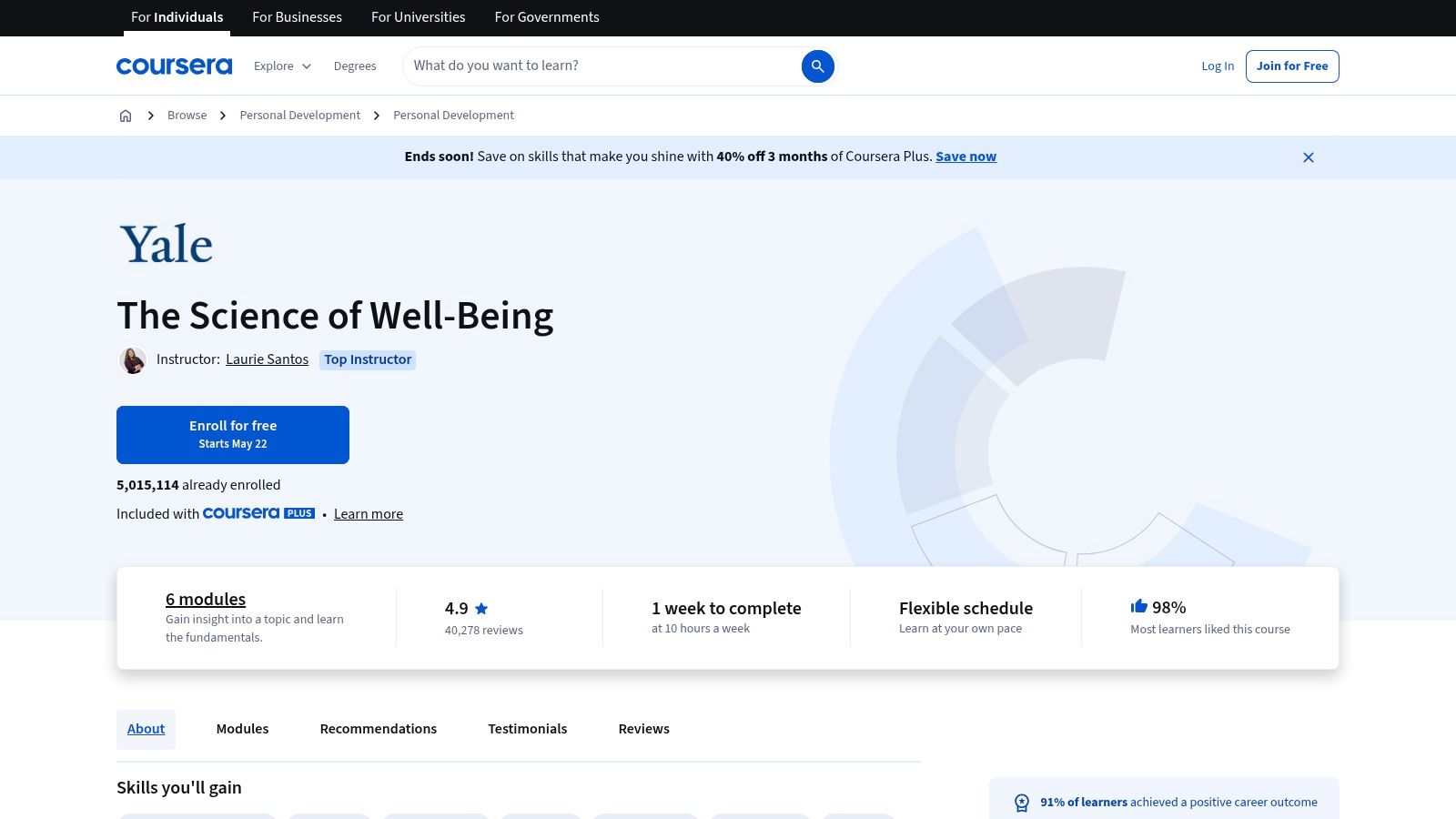
If you want a free self love course that feels credible and structured, this is one of the strongest places to begin. It isn't labeled “self-love” in a narrow sense, but it teaches the habits that support healthier self-regard: gratitude, kindness, reflection, and behavior change.
What makes it useful is the rewiring angle. You're not only learning ideas about well-being. You're asked to practice them, which is where many self-love resources fall short.
Best for people who want rigor
The Yale format works well for people who like weekly progress, prompts, and a classroom feel. Free audit access lets you learn without committing to a certificate, which keeps the barrier low.
Trade-off matters here. Because it's a broader happiness course, you'll need to translate some lessons into self-love language yourself. For many learners, that's fine. For others, it can feel a little indirect.
- Structured pacing: A multi-week rhythm gives you room to revisit exercises instead of rushing through them.
- Behavior focus: The “rewirement” tasks are more helpful than passive video-watching.
- Community layer: Discussion spaces can help if motivation drops.
Practical rule: If a course teaches a great reflection but you never repeat it after the lesson ends, it won't change much. Turn one exercise into a daily cue.
That's where a companion tool helps. If a Coursera lesson surfaces a recurring thought like “I'm behind” or “I'm not enough,” save a replacement statement in I Become's guide to changing negative thought patterns, then reinforce it in the app through Read, Speak, Listen, or Write mode.
Use the course site here: The Science of Well-Being on Coursera
2. The Science of Happiness (UC Berkeley / Greater Good Science Center on edX)
This is the course I'd suggest for someone who wants warmth and research in the same place. UC Berkeley's Greater Good Science Center has long centered compassion, gratitude, connection, and emotional skills that support a more accepting relationship with yourself.
A lot of people search “free self love course” when what they need is guided practice in kinder attention. This option fits that need well, especially if shame or isolation is part of the picture.
Where it helps most
Its biggest strength is that it doesn't treat happiness as constant positivity. It leans into habits and relational well-being, which often supports self-acceptance more effectively than endless affirmations alone.
The limitation is similar to Yale's. It's broader than self-love, so you'll need to be intentional about choosing the practices that strengthen your inner dialogue.
Compassion tends to land more deeply when you practice it during ordinary moments, not only during emotional crises.
That's why I like pairing this kind of course with something you'll touch every day. If a Berkeley lesson gives you a compassion phrase that resonates, put it somewhere visible. I Become's Lock Screen widgets are especially good for this because they place the message back in front of you during the exact moments when old self-criticism usually returns.
A few things stand out:
- Short lessons: Easier to fit into a busy week than long lecture-heavy modules.
- Applied activities: Better for reflection than passive inspiration feeds.
- Compassion focus: Especially useful if self-love feels too abstract as a concept.
If you want to enroll, visit The Science of Happiness on edX
3. Mindfulness for Wellbeing and Peak Performance (Monash University on FutureLearn)
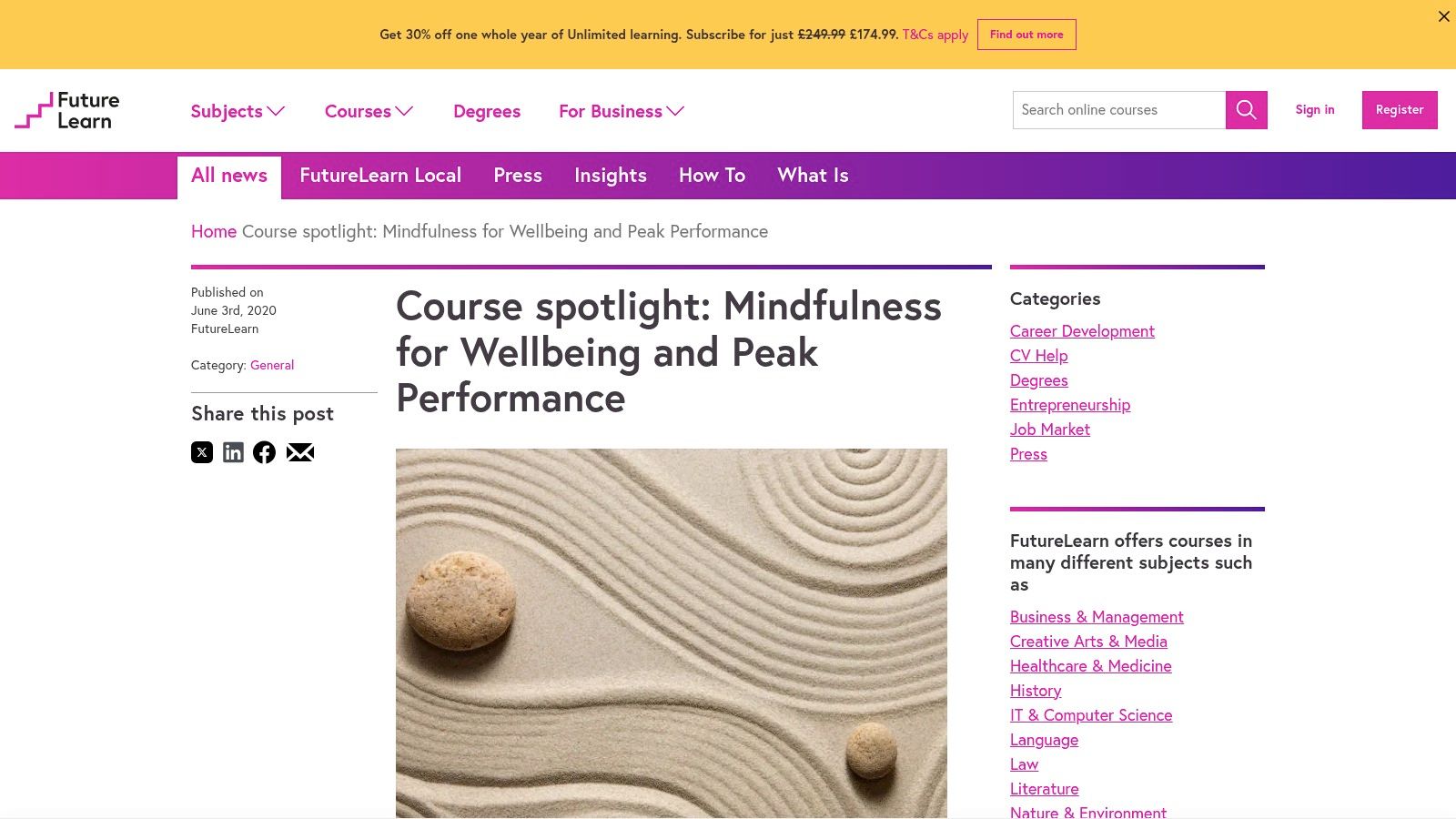
Some people don't need more mindset content. They need less internal noise. That's where this Monash course stands out. It approaches self-kindness through mindfulness and “heartfulness,” which can be much more effective when your mind is busy, anxious, or overperforming.
This is a strong pick if your self-criticism gets louder under stress. Mindfulness often helps by slowing the reaction loop before you pile judgment onto whatever you're already feeling.
A better fit for overstimulated minds
Monash works well for beginners because it tends to teach from direct experience. You practice. You notice. You come back. That's simpler, and often more sustainable, than trying to think your way into self-love.
There is one practical catch. FutureLearn's free tier is usually tied to course runs, so access can feel less flexible than permanently open platforms.
- Guided practices: Helpful if meditation apps feel too vague.
- Self-compassion modules: A stronger match for this topic than many generic mindfulness courses.
- Educator support: Useful if you prefer some guidance rather than a fully solo format.
The wider context also supports why these compact digital formats keep showing up. A well-known example, the 21 Day Self Love Course on YouTube, frames self-love as a short guided journey and highlights practices like compassionate self-talk, gratitude journaling, and guided tools. That reflects a larger shift toward shorter, mobile-friendly learning that fits everyday life.
If mindfulness helps you notice a harsh inner script, use I Become right after the lesson. Record a simpler replacement statement in your own voice and replay it later through Listen mode. That step matters because calm awareness alone doesn't always rewrite the sentence you habitually use against yourself.
Explore the program through Monash mindfulness course details on FutureLearn
4. Build Your Self-Esteem (Alison)
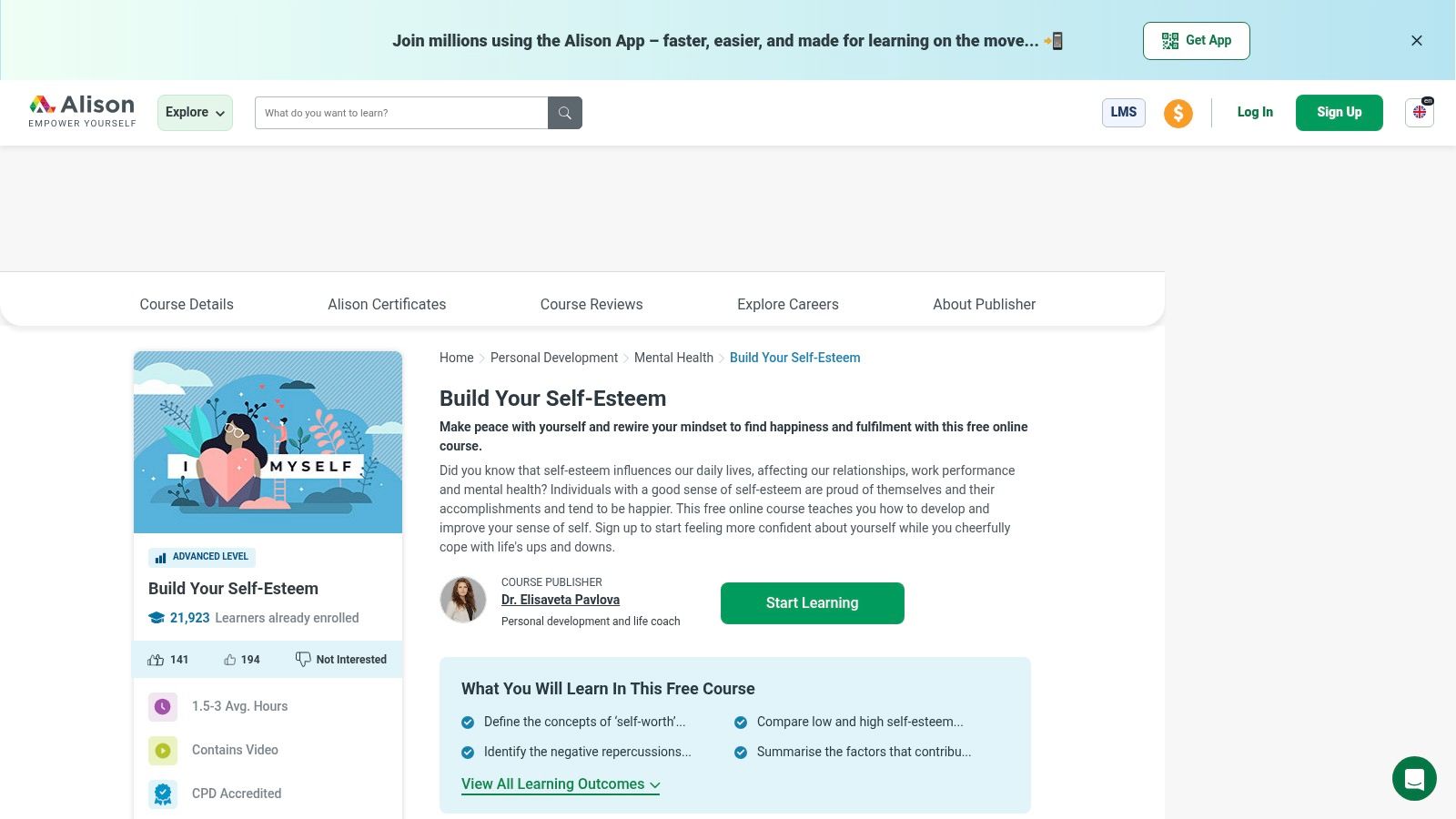
If you want something fast, direct, and less academic, Alison's self-esteem course is a practical choice. It doesn't have the same prestige as a university platform, but that's not always the deciding factor. Sometimes a shorter course is exactly what gets started.
This one is useful when your main pain point is self-worth. It gives you a more focused entry point than the broader happiness courses.
Good when you need momentum quickly
The bite-size format makes it approachable if you've been procrastinating on inner work because everything feels too big. Built-in self-assessments also help you pause and notice patterns, which can be more grounding than consuming another motivational video.
The trade-off is depth. If you want a richer psychological framework, this probably becomes a starter course rather than your long-term home base.
A short course can work better than a deep course if you actually finish it and use one practice from it daily.
This is also a smart option to pair with affirmation work. If the course helps you identify one belief that keeps repeating, such as “I don't deserve rest” or “I'm only valuable when I achieve,” build your next step around that. This self-love practice guide from I Become is a helpful follow-on if you want to carry the lesson into real daily repetition.
A few practical notes:
- Always-free learning access: Good if you don't want a time-limited free tier.
- Quick modules: Easier for busy students and professionals.
- Less polish: The presentation may feel simpler than MOOC platforms.
Take a look at Build Your Self-Esteem on Alison
5. Palouse Mindfulness MBSR (Mindfulness-Based Stress Reduction)
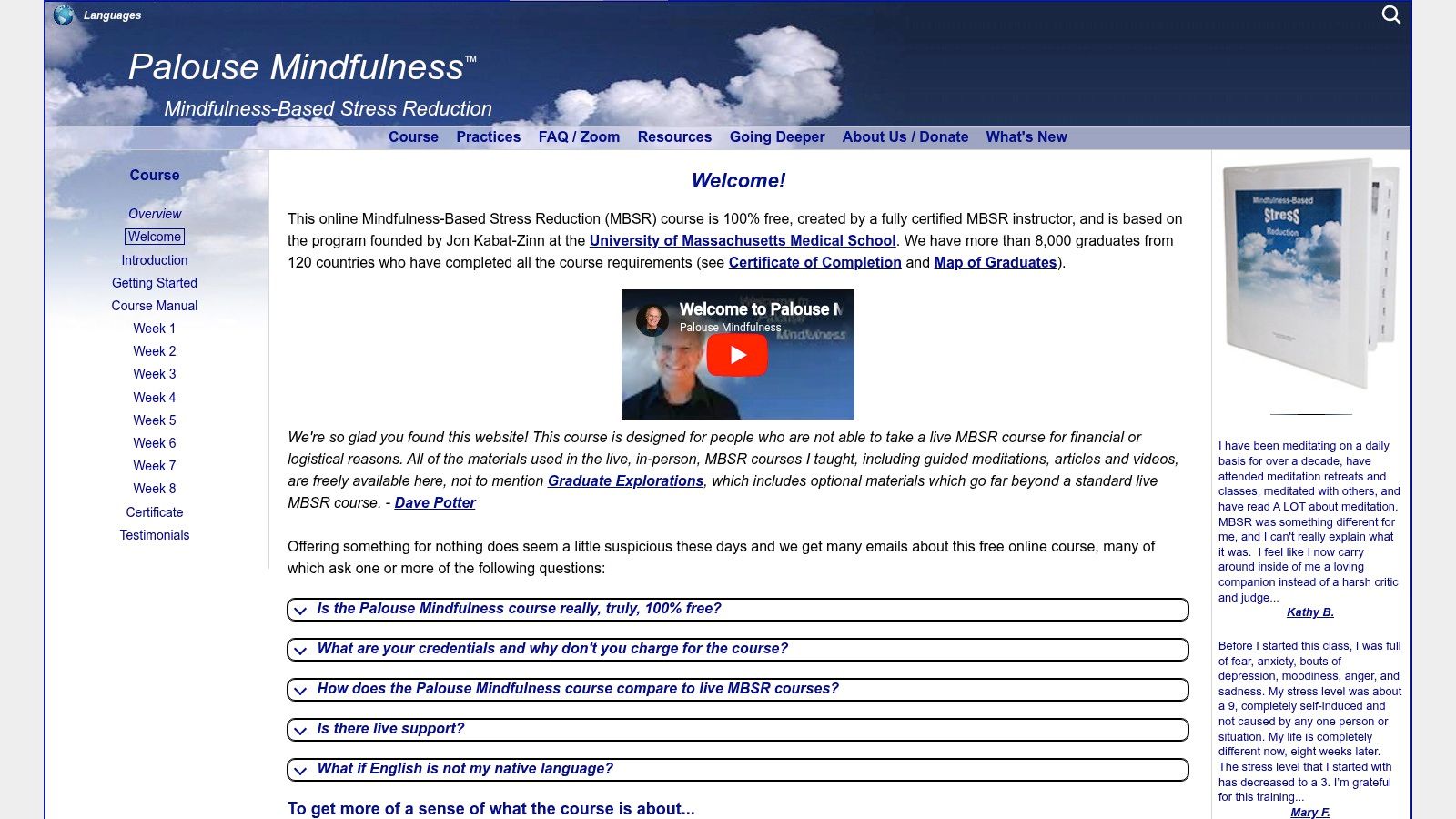
Palouse Mindfulness is what I'd point people to when they want a serious practice, not just a taste of one. It offers a full self-paced MBSR-style structure with guided meditations, readings, and weekly practices, all without the usual friction of registration gates.
This isn't a “feel better in one sitting” resource. It's a patient, steady training in non-judgment and attention, which often becomes the foundation for real self-kindness.
Best for people ready to commit
If your inner critic is firmly ingrained, a full mindfulness curriculum can be more helpful than a short burst of positivity. You're learning to observe thoughts without automatically agreeing with them.
That said, this is time-intensive. If you're already exhausted, it may feel like too much unless you intentionally scale it down.
- Thorough format: Strong for people who want a real weekly framework.
- Downloadable practices: Easier to revisit than courses locked behind a dashboard.
- No registration barrier: Helpful when you want to begin immediately.
One thing I've seen repeatedly is that meditation can reveal a harsh inner tone very clearly, but it doesn't always replace it on its own. That's why I like combining MBSR with a more active reinforcement tool. After a meditation session, write one compassionate sentence in your notes, then move it into I Become or keep building your reflection with meditation for your inner self.
Use the full program here: Palouse Mindfulness MBSR
6. CompassionateUSA Micro-Course
Not everyone needs an eight-week commitment. If you're emotionally tired, skeptical of long programs, or just trying to begin without pressure, CompassionateUSA's micro-course makes sense.
Its biggest strength is accessibility. You can move through short video lessons and journal prompts without needing a whole lifestyle reset first.
When short is actually better
Micro-learning often gets dismissed, but it has a real place in self-love work. If shame rises quickly, a smaller dose can feel safer and easier to return to than a heavy curriculum.
The obvious downside is that it won't carry you very far by itself. Think of this as a primer, not a complete path.
- Fast completion: Good if you need an early win.
- Journal prompts: Stronger than surface-level inspiration posts.
- Compassion lens: Helpful if your self-talk is harsh and your relationships feel strained too.
A useful way to use this course is to choose one prompt that hits a nerve, then stay with it for several days instead of rushing onward. That's where integration starts. If a lesson asks how you'd speak to a friend in pain, take your answer and make it your next affirmation sequence in I Become. Read it in the morning, speak it at midday, and listen to it at night.
Visit CompassionateUSA Micro-Course
7. Navigating Distress with Self-Compassion (Sarana Institute)
Some courses are best for growth. This one is best for tenderness. If you're in a painful season, Sarana Institute's distress-focused self-compassion series offers a softer landing than performance-driven self-improvement platforms.
That distinction matters. When someone is overwhelmed, they usually don't need a push. They need a way to stay with themselves without adding more pressure.
A gentler choice for hard seasons
The trauma-sensitive framing is the reason this course earns a place on the list. It treats distress as something to be met carefully, not solved quickly.
The trade-off is scheduling. Live cohorts can be powerful, but they also ask more from your calendar, and recordings may vary depending on the offering.
Some of the best self-love teaching doesn't sound like motivation. It sounds like permission to slow down and stop attacking yourself.
If you're trying to understand what self-compassion looks like in daily life, explore self-compassion with That's Okay. Then keep the course work simple. One replayed session, one note, one supportive phrase saved in your phone is enough for a hard day.
This course can pair beautifully with I Become if you keep your affirmations extremely gentle. Not “I'm unstoppable.” More like “I'm allowed to be where I am today” or “I can meet this moment with care.”
You can register through Navigating Distress with Self-Compassion at Sarana Institute
8. Dove Self-Esteem Project (Confident Me / Free Being Me toolkits)
This isn't a traditional single-path course, and that's exactly why it belongs here. The Dove Self-Esteem Project offers a library of free lesson plans, activities, and facilitator resources focused on body confidence and self-esteem.
If you're a parent, teacher, youth mentor, or even an adult who learns best through worksheets and guided activities, this resource is unusually practical. It gives you exercises you can actually use with real people, not just ideas to think about.
Especially useful for families and educators
For youth settings, this may be one of the most actionable free self love course alternatives available. The material is organized for guided discussion, which can help teens and groups more than solo journaling sometimes does.
The limitation is just as clear. Adult solo learners looking for a linear, introspective course may find the toolkit format less emotionally immersive.
One wider signal makes resources like this easier to understand. The personal development market was estimated at USD 48.4 billion in 2024 and projected to reach USD 67.21 billion by 2030, with a projected 5.7% CAGR from 2025 to 2030 according to Grand View Research. That scale helps explain why free educational resources now sit alongside paid coaching, apps, and guided programs. Free often works as the entry point, while habit tools and deeper support carry the practice forward.
- Free downloads: Easy to access and share.
- Facilitator-friendly: Strong for classrooms and group settings.
- Not fully linear: Better as a resource library than a single sequence.
Browse the materials at Dove Self-Esteem Project
9. Free Self-Care Course (NeuroSystemics)
If your self-love work keeps collapsing when your body is stressed, this course offers an important reminder. You can't always think your way into safety. Sometimes your nervous system needs support first.
NeuroSystemics brings together compassion, awareness, resiliency, and strength with somatic and mindfulness practices. That makes it especially useful for people whose inner critic spikes when they're dysregulated.
Why body-based tools matter
A lot of self-love advice assumes you're already calm enough to reflect clearly. That's not always true. When your body is in a threat state, affirmations can feel distant or even irritating.
This course helps bridge that gap. It gives self-compassion a more physical entry point, which can make your mental practice more believable.
- Somatic tools: Helpful when talk-based approaches haven't stuck.
- Cohort support: Can create accountability if you prefer learning with others.
- Variable availability: You may need to catch the right enrollment window.
There's also a strong audience fit for this kind of mobile-first support. In The Body Shop's Self-Love Index, people who used social media more than two hours a day scored 57, while those using it less than an hour a day or not at all scored 67, and the report said the average score was 53 on a 0 to 100 scale in its Self-Love Country Report. If you're overstimulated online, short regulation practices and app-based reminders can be more realistic than waiting for one ideal hour of calm.
See upcoming availability at NeuroSystemics Free Self-Care Course
10. Self-Care and Wellbeing A Practical Guide for Health & Social Care (University of Edinburgh on FutureLearn)
This one is framed for health and social care contexts, but don't let that scare you off. The reflective exercises and self-compassion tools translate well to everyday life, especially if you're a caregiver, helper, student, or anyone who's better at caring for others than caring for yourself.
I recommend it for people who want something short and practical, with enough structure to keep them engaged but not so much that it feels heavy.
Practical and grounded
The strongest part of this course is that it links well-being skills to real situations. That makes self-compassion feel less like a lofty concept and more like something you can apply after a hard shift, a difficult conversation, or a draining week.
The free-tier limitation is the usual FutureLearn issue. You may need to move with the course timing rather than assuming it will wait for you indefinitely.
Content alone rarely creates durable change. Repetition, personalization, and prompts are what turn insight into a habit.
That gap matters across almost every free self love course. A 2024 meta-analysis summarized by Lisa A. Romano's article on loving the self notes that digital behavior-change interventions work best when they include personalization, prompts, and repeated practice. That lines up with what many people experience firsthand. The lesson helps, but the reminder is what keeps the lesson alive next Tuesday.
For that reason, this is one of the easiest courses to combine with I Become. Take one sentence from your reflection each week and turn it into a repeated daily affirmation. Keep it specific, believable, and kind.
Explore it at Self-Care and Wellbeing on Class Central
Top 10 Free Self‑Love Courses, Comparison
| Resource | Key features ✨ | Quality ★ | Price / Value 💰 | Target audience 👥 | Standout 🏆 |
|---|---|---|---|---|---|
| The Science of Well‑Being (Yale, Coursera) | ✨ 10‑week rewirement tasks; quizzes, reflections, forums | ★★★★☆ university‑level rigor | 💰 Free to audit; paid certificate optional | 👥 Learners seeking evidence‑based habit change | 🏆 Research‑backed, immediately actionable habit tools |
| The Science of Happiness (UC Berkeley, edX) | ✨ Short videos; weekly activities; compassion & connection focus | ★★★★ Evidence‑based center content | 💰 Free to audit; certificate paid | 👥 Those wanting social‑connection & compassion skills | 🏆 GGSC credibility + practical social practices |
| Mindfulness for Wellbeing & Peak Performance (Monash, FutureLearn) | ✨ Guided mindfulness; self‑compassion modules; tip sheets | ★★★★ Beginner‑friendly, well reviewed | 💰 Free during runs; upgrade for extended access | 👥 Beginners wanting mindfulness + performance gains | 🏆 Clear self‑compassion modules with educator facilitation |
| Build Your Self‑Esteem (Alison) | ✨ Bite‑size modules; self‑assessments; printable exercises | ★★★ Practical and accessible | 💰 100% free to study; certificate costs extra | 👥 Quick learners and beginners seeking fast wins | 🏆 Totally free core content for immediate application |
| Palouse Mindfulness MBSR | ✨ Full 8‑week MBSR; guided meditations; practice logs | ★★★★☆ Thorough, lineage‑based curriculum | 💰 Completely free; no registration required | 👥 Committed learners seeking full MBSR training | 🏆 Rare full‑length MBSR available at no cost |
| CompassionateUSA Micro‑Course | ✨ Short video lessons; journal prompts; fast integration | ★★★ Quick, approachable primer | 💰 Free access | 👥 Busy beginners wanting quick self‑compassion tools | 🏆 Ultra‑fast, practical entry point to daily practice |
| Navigating Distress with Self‑Compassion (Sarana) | ✨ 7‑week trauma‑sensitive series; live + recordings | ★★★★ Gentle, facilitator‑led support | 💰 Free (donations welcome) | 👥 People in distress needing guided, sensitive care | 🏆 Trauma‑informed, facilitator‑led model for crisis relief |
| Dove Self‑Esteem Project (toolkits) | ✨ Ready‑to‑use lesson plans; age‑appropriate activities | ★★★★ Research‑informed educational resources | 💰 Free downloadable toolkits | 👥 Teens, parents, educators & youth facilitators | 🏆 Extensive, classroom‑ready curricula for body confidence |
| Free Self‑Care Course (NeuroSystemics) | ✨ CARE framework; somatic + mindfulness tools; group support | ★★★★ Interdisciplinary, body‑based approach | 💰 Free when cohorts run; dates vary | 👥 Those needing nervous‑system regulation & somatic skills | 🏆 Strong somatic emphasis for regulation + compassion |
| Self‑Care & Wellbeing (Univ. of Edinburgh, FutureLearn) | ✨ 3‑week reflective course; practical tools for carers | ★★★★ Short, practice‑oriented | 💰 Free to join; optional paid upgrade | 👥 Health & social care workers (adaptable for personal use) | 🏆 Short, reputable course with immediately usable tools |
Your Journey Is a Practice, Not a Performance
Choosing any of these courses is already a meaningful act of self-commitment. You don't need to pick the “perfect” one to begin. You just need one that feels doable enough to return to when life gets busy, emotions get messy, or motivation fades.
The biggest mistake people make with self-love work isn't choosing the wrong course. It's expecting a course alone to do all the work. Learning helps. Reflection helps. But what changes your inner world most reliably is repetition in ordinary life. The phrase you see when you wake up. The kinder sentence you use after a mistake. The breath you take before reacting. The reminder that shows up right when old criticism starts speaking.
That's why integration matters so much. If you choose Yale or Berkeley, pull one lesson into a daily practice. If you choose Palouse or Monash, use mindfulness to notice your patterns, then reinforce a gentler replacement thought. If you choose Alison, CompassionateUSA, or Sarana, don't rush through the material. Let one insight stay with you for several days. If you're using a cohort-based course, protect your energy by keeping your follow-through simple.
You also don't need to make your practice elaborate. A few minutes is enough. Read one affirmation in the morning. Speak one out loud before work. Listen to one while walking. Write one after a hard moment. The point isn't intensity. It's consistency. Gentle consistency often reaches places that force never does.
There's also room for your path to be imperfect. Some weeks you'll feel open and reflective. Some weeks all you'll manage is one kind sentence to yourself, and that still counts. Self-love doesn't become real when you do it flawlessly. It becomes real when you come back to it, especially after you've drifted.
If you want more inspiration for the bigger picture of growth, discover powerful personal objectives and then bring them back down into one small daily action. That's where this work starts to feel lived, not just learned.
Ready to make supportive self-talk a daily habit? Download I Become from the App Store and begin your practice today.
If you want your free self love course to become a real daily ritual, I Become is a beautiful next step. The app helps you gently rewire your thoughts with personalized affirmations, Lock Screen widgets, and four practice modes. Read, Speak, Listen, and Write. It's especially helpful when you want course insights to show up in everyday moments, not stay buried in old notes. Download I Become and give your self-love practice a place to live each day.
Found this helpful? Share it with someone who might benefit.