
Jealous vs Envy: Key Differences and How to Cope
Confused about jealous vs envy? Learn the key psychological differences and find gentle coping strategies to turn these emotions into personal growth.
You're scrolling without thinking much. A friend announces a new relationship. A coworker posts a promotion. Someone your age shares photos from a trip you've wanted for years. Your chest tightens for a second.
You might call that feeling jealousy. You might call it envy. The two terms are commonly used interchangeably. In everyday conversation, we blur them together all the time.
But if you've ever tried to work with these feelings in a mindful, honest way, the distinction matters. The better you can name what's happening inside you, the better you can respond to it with care instead of shame.
An All-Too-Familiar Feeling
You see a post from someone you know. They're smiling, thriving, loved, chosen, recognized. Suddenly your mind starts talking.
Maybe it says, “Why do they get that and not me?”
Maybe it says, “What if I'm being replaced?”
Maybe it says both.
That moment can feel messy because the emotional signal isn't always clean. One part of you may be grieving what you don't have. Another part may be bracing to protect something you do have. The outside trigger is simple, but the inside experience isn't.
When the feeling is hard to name
Many people get stuck at this point. They assume a painful social emotion is just a sign they're insecure, petty, or immature. It usually isn't that simple.
These reactions are deeply human. They often appear when something important is touched. Love. Belonging. Status. Safety. Self-worth. Hope.
You don't need to judge the feeling first. You need to identify it accurately.
That small shift changes everything. If you mistake envy for jealousy, you may try to soothe yourself when what you really need is a goal. If you mistake jealousy for envy, you may push yourself to “improve” when what you really need is reassurance, trust, or a boundary.
Why understanding jealous vs envy matters
For personal growth, this isn't just a vocabulary lesson. It's a self-awareness skill.
When you know whether you're dealing with jealous vs envy, you can ask better questions:
- If it's envy, what am I longing for, and what does that reveal about my values?
- If it's jealousy, what am I afraid of losing, and what would help me feel safer?
- If it's mixed, which part needs attention first?
That kind of reflection softens reactivity. It also makes mindfulness more practical. Instead of trying to “stop being negative,” you can respond to the underlying emotional need beneath the surge.
And that's often where growth begins. Not in pretending the feeling isn't there, but in meeting it clearly.
The Core Difference Between Jealousy and Envy
The simplest way to remember the difference is this:
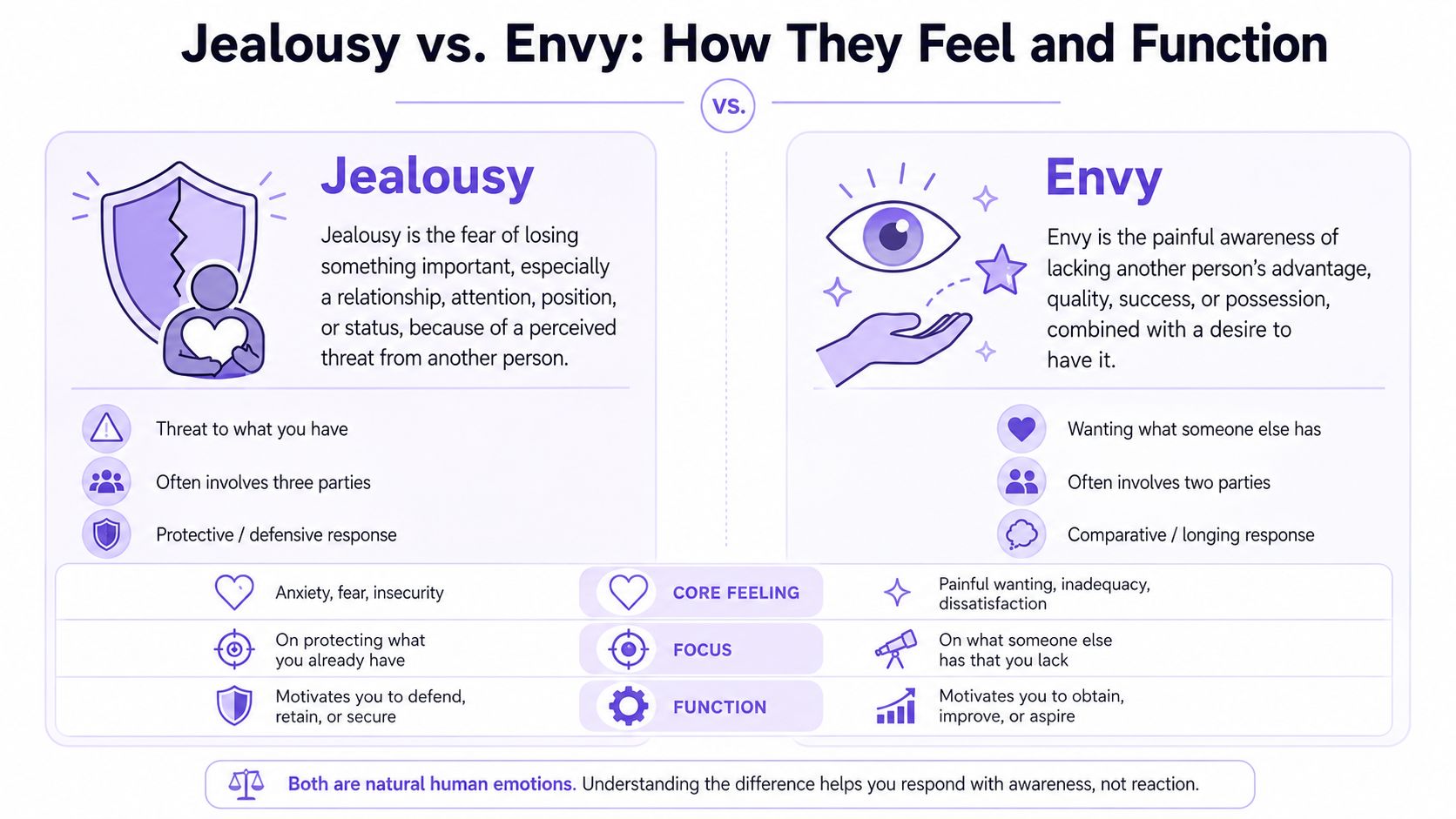
Envy is when you want something someone else has.
Jealousy is when you fear losing something you value to someone else.
That's the heart of jealous vs envy.

Envy is a two-person comparison
Think of envy as a line between you and another person.
They have something you want. It could be beauty, confidence, attention, money, creative skill, career momentum, a peaceful relationship, or a lifestyle that seems effortless. The pain comes from the gap between where they are and where you are.
A common example is seeing a colleague get promoted and thinking, “I wish that were me.”
Jealousy is a threat to something you already have
Jealousy usually involves a triangle. You, something you value, and a perceived rival.
That valued thing might be a romantic relationship, a friendship, a role, a reputation, or even your place in a group. The feeling says, “Something important to me might be taken, weakened, or given to someone else.”
A common example is feeling unsettled when your partner seems emotionally close to someone else, or when a friend starts giving another person the attention you used to receive.
Psychology backs up the distinction
This difference isn't just a language preference. A 1993 study published via NIH/PubMed established that jealousy and envy are psychologically distinct emotions. The study linked jealousy to fear of loss, distrust, anxiety, and anger, while envy was tied to feelings of inferiority, longing, resentment, and disapproval.
That matters because the emotional pattern points to a different response.
Practical rule: If the pain is about wanting what they have, start with envy. If the pain is about protecting what's yours, start with jealousy.
You can feel both at once, of course. You might envy someone's confidence and feel jealous of the attention they receive from a person you care about. Human emotions overlap.
Still, if you can spot the main driver, you'll know where to work first.
A Deeper Comparison of How They Feel and Function
Some feelings are easy to label. These two often aren't. They can both show up as irritation, comparison, self-doubt, or obsessing over another person. That's why a side-by-side view helps.
Jealousy vs Envy at a glance
| Dimension | Jealousy | Envy |
|---|---|---|
| Core concern | Losing something valuable | Lacking something desirable |
| Primary focus | Protecting a bond, role, or status | Closing a gap between you and someone else |
| Typical setup | You, what you value, and a rival | You and the person who has what you want |
| Emotional tone | Fear, distrust, anxiety, anger | Inferiority, longing, resentment, disapproval |
| Inner question | “Will this be taken from me?” | “Why don't I have that?” |
| Psychological drive | Loss-avoidant | Gain-oriented |
| Common impulse | Monitor, defend, seek reassurance | Compare, strive, withdraw, criticize |
| Helpful response | Reassurance, trust repair, boundaries | Goal-setting, self-comparison, competence-building |
The inner voice sounds different
Jealousy and envy don't just think different thoughts. They defend different needs.
Jealousy often sounds like this:
“I don't want to lose my place.”
Envy often sounds like this:
“I want what they have, because I feel behind without it.”
Those voices can produce similar behaviors from the outside. Scrolling. Brooding. Comparing. Overanalyzing. But the engine underneath is different.
Loss-avoidant versus gain-oriented
A useful psychological distinction comes from the idea of the control target. Psychology Today's explanation of jealousy and envy frames envy as gain-oriented and jealousy as loss-avoidant.
That means envy pushes you toward acquiring something. Jealousy pushes you toward preventing loss.
This is why the same advice doesn't work for both.
- Jealousy often needs safety: honesty, secure communication, clearer expectations, or grounding when fear spikes.
- Envy often needs direction: a realistic goal, a return to your own path, or a way to turn admiration into action.
- Mixed feelings need sorting: before you react, ask which part is loudest right now.
Why people confuse them
Everyday language doesn't help. People say “I'm so jealous” when they mean “I wish I had that.” In casual speech, that's normal.
But for self-reflection, precision is useful. If your friend buys a home and you feel bad because you want one too, that's envy. If your friend gets closer to your partner and you feel threatened, that's jealousy.
When you name the emotion correctly, you stop treating every comparison wound as the same problem. That's where coping becomes more skillful and less chaotic.
Why We Feel These Emotions in a Modern World
You're not weak for feeling these emotions. In many cases, your mind is responding exactly as human minds do. It notices status, closeness, belonging, and signs of possible loss. Then it reacts.
Modern life multiplies those triggers.
Social comparison is everywhere now
A UC San Diego analysis of envy found that more than three-fourths of participants reported experiencing envy in the past year. The same report noted that about 80% of people under 30 said they had felt envy in the last year, and younger adults were especially likely to envy others for romance and looks.
That makes intuitive sense. When you're still forming identity, relationships, and direction, comparison can feel especially loud. You're often measuring who you are becoming against people who seem to be arriving faster.
Feeds intensify both envy and jealousy
Social platforms create a strange emotional environment. You can see hundreds of lives in a short sitting, but mostly through polished fragments. Promotions get posted. Engagements get announced. Friend groups look effortless. Bodies look flawless. Careers look linear.
That stream tends to trigger envy when you feel behind, and jealousy when a post pokes at belonging or attachment. A comment, a tagged photo, or a visible social bond can stir fear that your place is less secure than you thought.
If your emotional reactions in relationships feel especially intense, it can help to discover your attachment style. The way you learned to seek closeness and safety often shapes how quickly jealousy gets activated.
For the thought spiral that often follows, this guide on changing negative thought patterns can help you catch the loop before it takes over your day.
Common modern triggers
A few environments reliably amplify jealous vs envy:
- Workplaces: salary, title, praise, visibility, and access to opportunity
- Dating and relationships: attention shifts, ambiguity, old wounds, and fear of replacement
- Social media: constant exposure to curated milestones and status signals
- Friend groups: inclusion, perceived closeness, and shifting group dynamics
None of this means you're doomed to compare forever. It means your emotions are responding to conditions that make comparison unusually easy and unusually frequent.
That recognition matters. Shame says, “What's wrong with me?” Awareness asks, “What keeps activating this, and how can I care for myself better inside it?”
From Comparison to Compassion Turning Envy and Jealousy into Growth
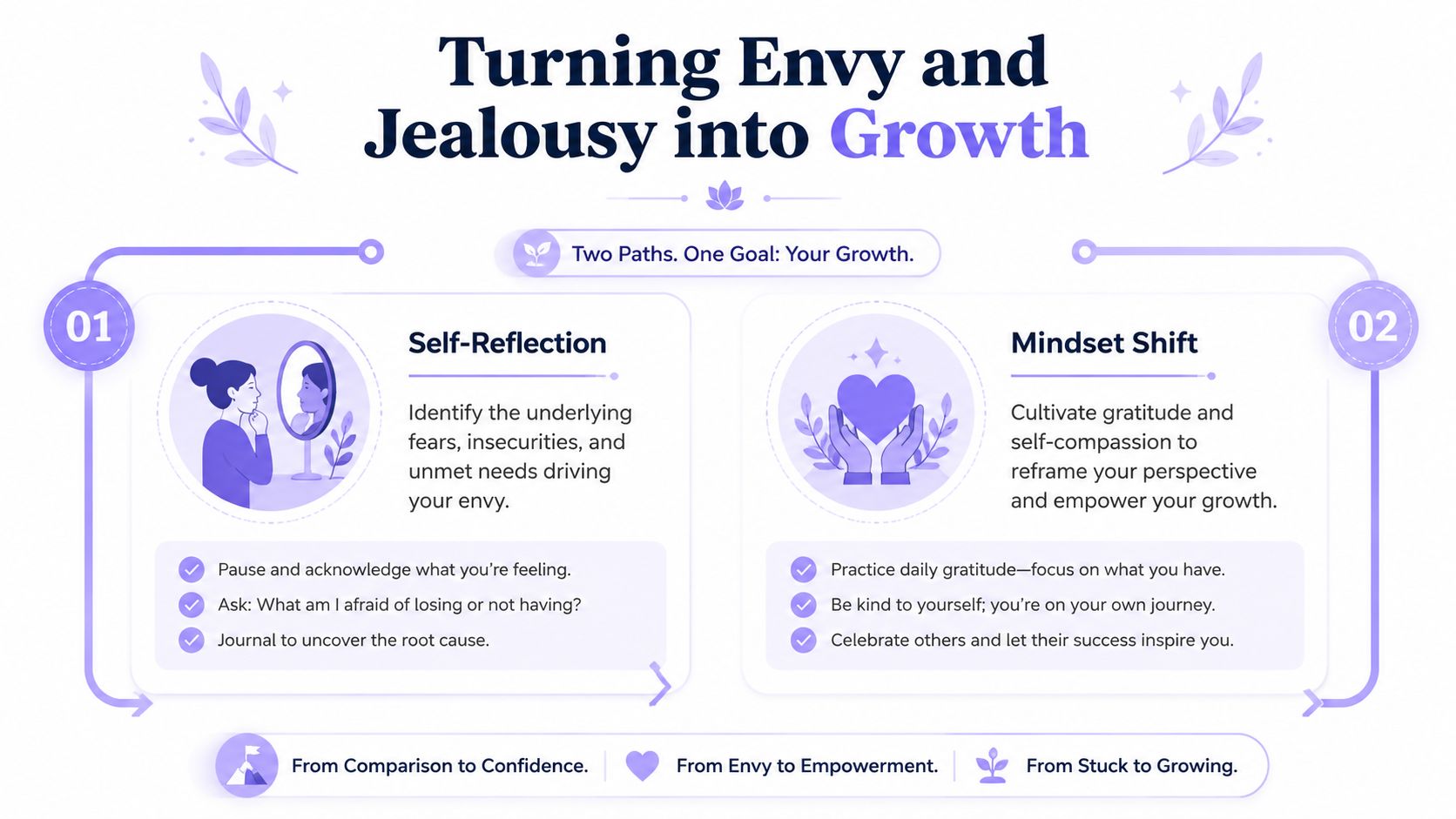
Painful emotions can become useful signals when you stop wrestling them and start listening with discernment. Jealousy and envy both carry information. They just point in different directions.
If the feeling is jealousy
Jealousy usually needs steadiness more than self-improvement. The first task is to calm the threat response.
Try this sequence:
Pause before checking or reacting
Jealousy often creates urgency. You want to inspect, question, or interpret everything immediately. Slow that down. A few calm breaths and a short delay can prevent a fear reaction from becoming a relationship wound.Name what feels at risk
Is it love, attention, exclusivity, respect, or your role in someone's life? Be specific. Vague fear grows. Named fear becomes workable.Ask for clarity instead of control
Reassurance is different from policing. You can say, “I'm feeling insecure and I'd like to talk,” without accusing or demanding.Strengthen internal safety
Ground in what is true right now, not just what you fear. Notice supportive actions, clear commitments, and the difference between a trigger and a fact.
Sometimes jealousy isn't asking you to compete harder. It's asking you to feel safer.
A short reflective practice can help here. Write down: “What am I afraid I'll lose?” Then write: “What evidence do I have right now?” That gap often softens the panic.
If the feeling is envy
Envy can become surprisingly useful when you treat it as information about desire. Underneath the sting, there's often a clue about what matters to you.
Try a different sequence:
- Turn comparison into data
Ask what exactly you envy. Not their whole life. The specific quality, opportunity, or outcome. - Translate longing into a goal
If you envy someone's confidence, maybe your real desire is self-trust. If you envy their creative output, maybe your real desire is consistency. - Shrink the gap into a next step
Envy gets more painful when the goal feels abstract and far away. Small, repeatable actions reduce helplessness. - Limit trigger exposure when needed
Curated feeds can push your mind into repetitive upward comparison. Reduce contact with accounts that reliably leave you feeling diminished.
A growth mindset practice becomes useful here. It helps you shift from “They have what I lack” to “What can I build from where I am?”
Different emotions need different self-talk
A helpful insight for habit-building is that envy and jealousy respond to different messages. The Good Trade's discussion of jealousy vs envy notes that envy-focused affirmations work best when they reduce inferiority, while jealousy-focused affirmations work best when they build security.
So don't use the same script for both.
- For envy: “I am capable and on my own path.”
- For jealousy: “What I have is safe and cherished.”
That distinction matters because generic positivity often bounces off. A targeted statement lands better when it speaks directly to the wound.
A short guided reflection can help you settle into that mindset:
A compassionate reset practice
When you're not sure what you're feeling, use this brief check-in:
- Body: Where do I feel this? Tight chest, hot face, heavy stomach, restless hands?
- Story: What is my mind saying I lack or might lose?
- Need: Do I need direction, or do I need reassurance?
- Action: What is one kind response I can make today?
This is how comparison becomes compassion. Not by pretending the feeling is noble, but by meeting it with enough honesty that it can transform.
Building a Kinder Mindset with Daily Affirmations
Affirmations won't erase jealousy or envy overnight. What they can do is interrupt the automatic story those emotions tell, then give your mind a steadier one to practice.
That's especially helpful because both emotions repeat themselves. The same fears. The same comparisons. The same conclusions. A daily practice gives you something new to rehearse.

Affirmations for envy
Use statements that reduce inferiority and bring you back to your own path.
- “Their success does not limit my own.”
- “I can admire without diminishing myself.”
- “I am growing in my own timing.”
- “What I want can become a direction, not a punishment.”
Affirmations for jealousy
Use statements that build steadiness, worth, and emotional safety.
- “I am secure, worthy, and grounded.”
- “I can ask for clarity without abandoning myself.”
- “Fear is present, but it isn't the whole truth.”
- “What I value can be cared for with honesty and calm.”
Repetition matters because the mind learns from what it hears often, not only from what is intellectually true.
If you want to create your own personalized statements, this guide on how to write affirmations is a strong place to start.
When to get extra support
Sometimes these emotions aren't occasional pangs. They become constant, intrusive, or disruptive. They may start affecting sleep, concentration, trust, communication, or self-esteem.
In relationship contexts, outside support can be especially helpful. If you want a grounded resource on understanding jealousy in relationships, that article offers a thoughtful starting point.
You don't need to wait until things are falling apart to talk with a therapist or counselor. Support is appropriate when a feeling keeps repeating in ways you can't unwind alone.
If you want gentle, daily support for shifting comparison into self-trust, I Become can help. The iOS app lets you practice affirmations in four modes, Read, Speak, Listen, and Write, so the habit fits your style and your day. With daily prompts, Lock Screen widgets, and a simple routine you can consistently keep, it's a practical way to reinforce envy-soothing thoughts like “I'm on my own path” and jealousy-calming reminders like “I am safe and worthy.” Download I Become from the App Store and start building a kinder inner voice, one repetition at a time.
Found this helpful? Share it with someone who might benefit.