
How to Write Affirmations That Truly Work
Learn how to write affirmations that are powerful and believable. Our step-by-step guide covers wording, examples, and how to build a lasting practice.

Some days, your mind starts criticizing you before your feet even hit the floor. You miss one email, forget one task, feel one awkward moment in a conversation, and your inner voice turns it into a whole story about who you are.
That's the moment many people start searching for how to write affirmations. Not because they want cheesy slogans, but because they're tired of carrying around thoughts that make daily life heavier than it needs to be.
A good affirmation doesn't pretend everything is perfect. It gives your mind a kinder sentence to practice. Over time, that can shape how you feel, how you respond, and even what you do next.
Why Your Thoughts Deserve a Gentle Rewire
You might know this pattern well. You're about to walk into a meeting, take a test, send a message, or look in the mirror, and a quiet sentence appears in your mind: I'm not ready. I always mess this up. I'm just not that kind of person.
Those thoughts can feel automatic. They can also feel factual, even when they're only familiar.

Affirmations offer another option. Not a fantasy. Not a forced smile. Just a deliberate sentence that helps you interrupt an old mental groove and practice a more supportive one.
That idea has more weight than many people realize. In one study, participants who wrote self-affirmations undertook significantly more physical exercise a week later than a control group, which helped show that believable, specific affirmations can affect real behavior, not just mood, as summarized in David R. Hamilton's discussion of the science of affirmations.
If you've felt skeptical, that's reasonable. A lot of affirmation advice online sounds too polished to trust. But the stronger view is much simpler. A repeated thought can become a habit. A different repeated thought can become a different habit.
Affirmations work best when they feel grounded enough for your mind to accept and your actions to follow.
That's why the wording matters so much. The sentence has to feel like something you can stand inside, not something you immediately want to argue with.
If you're curious about the research side, this overview of the science of affirmations is a helpful next read. For now, think of affirmations as a gentle rewiring practice. You're not trying to become someone fake. You're giving your mind a better direction to return to.
The Three Pillars of an Effective Affirmation
The best affirmations are usually simple. When people struggle with them, it's often because they make them too long, too vague, or too far away from what feels real.
The clearest foundation comes from the University of Wisconsin–Madison's health guide, which recommends that affirmations start with “I” or “I am,” use the present tense, and stay as a single positive sentence. It also notes that this structure makes the statement easier to remember and repeat in daily life, as explained in the University of Wisconsin–Madison positive affirmations guide.
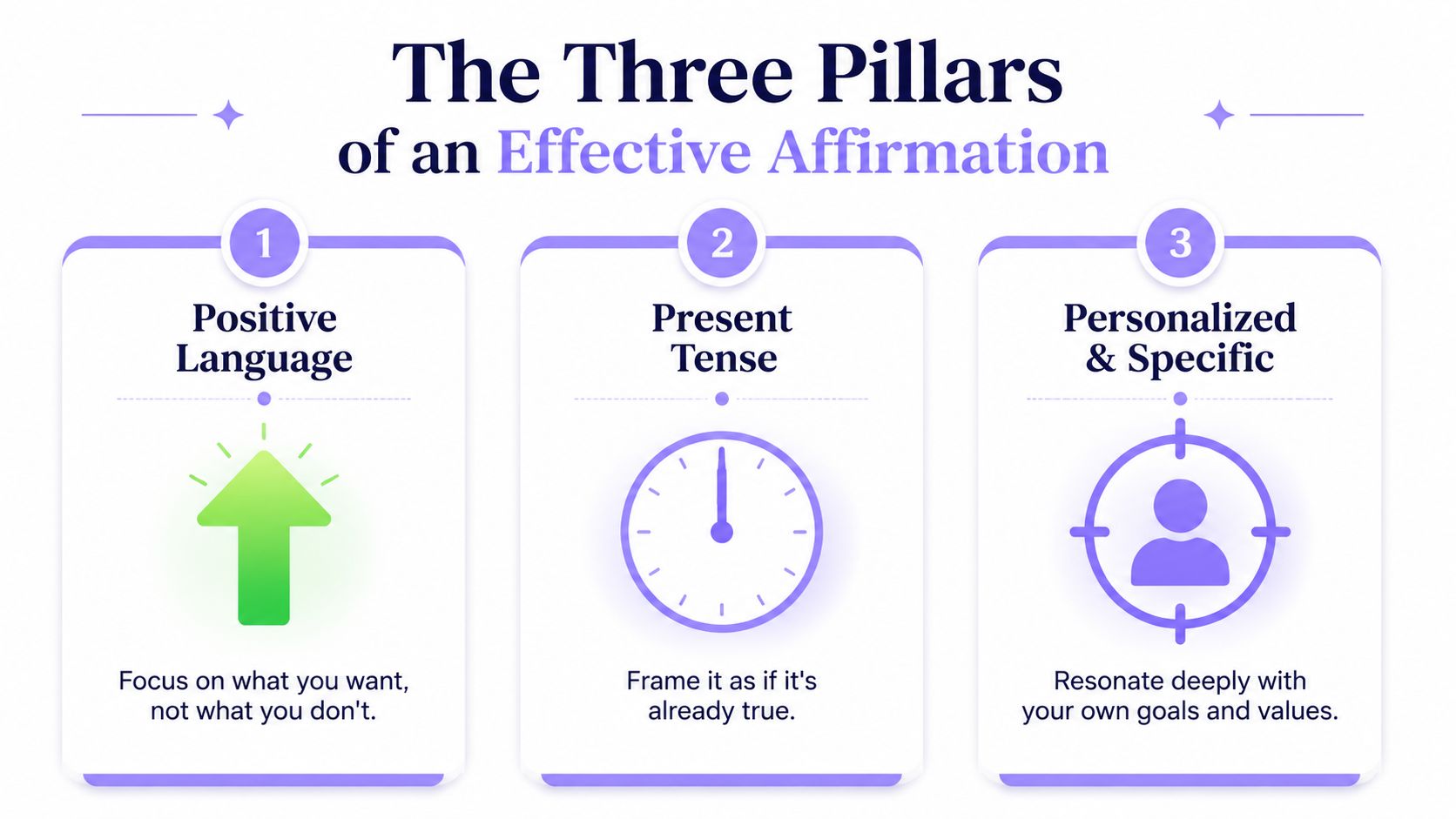
Use positive language
Your mind needs a clear direction. If you write, “I am not so anxious,” the focus still lands on anxiety. A stronger version points toward what you want to feel instead.
Try this shift:
Instead of “I won't panic”
Try “I am grounded and steady”
Instead of “I'm not lazy”
Try “I take small, meaningful action”
Positive wording isn't about denying difficulty. It's about giving your attention a useful target.
Write in the present tense
Present tense helps the affirmation feel immediate. “I will be confident” keeps confidence somewhere in the distance. “I am learning to trust myself” invites your mind into the process now.
Many beginners get stuck at this stage. They think present tense means they have to write something dramatic like “I am fearless.” You don't. Present tense can still be gentle, honest, and realistic.
Practical rule: Write the sentence as something you can practice today, not something you're postponing for a better future self.
Make it personal
Affirmations work best when they sound like they belong to you. Start with I or I am, and keep the sentence close to your actual life, values, or behavior.
A personal affirmation sounds like this:
- I am allowed to take up space
- I am becoming more at ease in my body
- I bring care and focus to my work
A generic slogan may sound nice. A personal sentence is easier to feel.
Here's a quick checklist you can use before you keep any affirmation:
| Checkpoint | What to ask |
|---|---|
| Positive | Does it focus on what I want, not what I'm trying to avoid? |
| Present tense | Does it sound current and alive, not delayed? |
| Personal | Does it begin with I or I am and reflect my real life? |
If your sentence passes those three tests, you're already much closer to an affirmation that can support you.
How to Write Your Personal Affirmations
Writing your own affirmation is easier when you stop trying to sound wise. You don't need a poetic sentence. You need one honest sentence that meets you where you are and points you where you want to go.
A practical workflow is to choose one focus area, turn the negative belief into its positive opposite, write it in the present tense, and keep it short. Guidance on affirmation journaling also suggests using bridge statements like “I am open to...” when a direct statement feels too far away, as described in this five-step affirmation journaling guide.
Start with one area, not your whole life
Pick one part of life that feels tender or important right now. That might be confidence, stress, work, money, body image, relationships, or rest.
Then ask yourself one question: What thought keeps repeating here?
Maybe it's:
- I'm behind
- I'm awkward
- I can't handle this
- I'm not disciplined
- I'm too much
- I'm not enough
That sentence is your raw material.
Flip the thought without making it fake
Now translate the limiting belief into a supportive opposite. You're not trying to create a movie trailer version of yourself. You're writing a sentence your nervous system can work with.
Here's a useful pattern:
- Name the old thought
- Ask what you'd rather believe
- Write the new sentence in plain language
- Shorten it until it feels easy to repeat
For example:
- Old thought: “I always ruin things”
- Better direction: “I can handle mistakes with care”
- Final affirmation: I respond to mistakes with patience
That's stronger than a dramatic sentence you don't believe.
Use a bridge statement when needed
Sometimes the positive opposite still feels too sharp. If you've spent years thinking “I'm unattractive,” the sentence “I am beautiful” might create inner resistance. That doesn't mean affirmations don't work for you. It usually means the statement needs a bridge.
Bridge affirmations sound like this:
- I am open to seeing myself more kindly
- I am learning to trust my voice
- I am becoming more comfortable with success
- I am willing to believe change is possible
These are powerful because they lower the fight inside your mind. They create movement without demanding instant total belief.
If your affirmation feels fake, soften it until it feels usable.
Examples you can adapt
You don't need to copy these word for word. Use them to see the pattern.
| Focus Area | Limiting Belief | Powerful Affirmation |
|---|---|---|
| Self-worth | I'm not enough | I am enough as I grow |
| Confidence | I always second-guess myself | I trust myself to take the next step |
| Anxiety | I can't calm down | I am safe enough to take one slow breath |
| Work | I'm not capable | I bring focus and care to my work |
| Body image | I hate how I look | I am learning to treat my body with respect |
| Money | I'll never get it together | I am becoming more thoughtful with money |
| Relationships | I'm hard to love | I am worthy of honest and caring connection |
| Motivation | I never follow through | I take small actions that support my goals |
If you want more inspiration before writing your own, this words of affirmation list can help you find language that feels natural.
Keep it short enough to remember
Long affirmations are harder to use in real life. If you can't remember it while walking, waiting, or feeling stressed, it's probably too long.
Try trimming until you reach the core message:
- “I am learning to trust that I have what it takes to move through difficult situations with grace”
becomes
I trust myself to handle hard moments
That shorter version is easier to repeat, and repetition is what helps a sentence become familiar.
Bring Your Affirmations to Life Four Ways
Writing the affirmation is only the first step. The deeper shift happens when you return to it often enough that it starts showing up on its own in the moments you need it.
Guidance on affirmation practice emphasizes repetition over complexity and notes that repeating a statement multiple times in a session, such as three times, can help the mind retain and internalize it more fully, as described in this guide to writing and practicing affirmations.

Read them when you need a reset
Reading works well when your mind feels scattered. Seeing the words in front of you can interrupt the speed of anxious thinking.
Keep your affirmation somewhere visible:
- On a sticky note by your desk
- In your journal beside your morning pages
- On your phone screen where you'll notice it
Reading is simple, and that's part of why it works. You don't need a perfect mood to begin.
Speak them to add presence
Speaking an affirmation out loud can feel awkward at first. That's normal. But hearing your own voice say a supportive sentence often makes it land differently.
You can whisper it, say it in the mirror, or repeat it quietly while walking. What matters is the feeling of participation. You're not just reading words. You're practicing a different inner tone.
Write them to deepen the message
Writing slows you down. It gives your attention somewhere to rest and can help the affirmation feel more deliberate.
Some people like to write the same sentence several times. Others prefer writing it once and then adding a few lines about why it matters. Both are useful. The point is contact, not performance.
A short guided practice can help if you want something you can follow along with:
Listen when you want support without effort
Listening is gentle. It works well during commutes, walks, or those tired parts of the day when reading or journaling feels like too much.
This mode can be especially comforting if you're trying to replace a harsh inner voice with a steadier one. Let the words meet you while you fold laundry, sit in traffic, or breathe before sleep.
Some days, the best affirmation practice is the one that asks the least of you and still keeps the thread unbroken.
When deciding how to write affirmations for your own routine, don't just ask what sounds good. Ask what you'll repeat. A sentence practiced in a small, steady way will help more than a beautiful sentence you forget.
Common Mistakes That Weaken Your Affirmations
A lot of people give up on affirmations for the wrong reason. They assume the practice failed, when really the wording was fighting them the whole time.
The biggest problem is often a believability gap. When an affirmation is too lofty, your mind may reject it. Guidance on writing affirmations warns that a statement like “I am a billionaire” can feel so disconnected from your current self-concept that it triggers cognitive dissonance instead of support, as discussed in this guide to writing believable affirmations.
The sentence is too far from your lived reality
If you're overwhelmed, “I am completely peaceful at all times” probably won't help. Your mind knows it doesn't match your experience. That mismatch can create tension instead of relief.
Try bringing the statement closer:
Too far: I am completely fearless
Closer: I am learning to meet fear with steadiness
Too far: I love every part of myself
Closer: I am practicing more kindness toward myself
Closer doesn't mean weak. It means workable.
The affirmation is crowded
Some people try to fit their whole healing journey into one sentence. The result sounds noble, but it's hard to remember and harder to believe.
Watch for affirmations like this:
I am confident, peaceful, magnetic, productive, abundant, healthy, and aligned in every area of my life.
That's too much to hold. Pick one thread. One sentence. One emotional direction.
The words don't sound like you
An affirmation should stretch you a little, but it still has to sound natural in your own voice. If you'd never say “I radiate cosmic prosperity,” don't use it just because it looks good on a graphic.
Try language you'd use in a calm, honest moment:
- I can handle this one step at a time
- I am allowed to rest
- I am becoming more comfortable being seen
You use it as pressure instead of support
An affirmation isn't a test you pass by believing hard enough. If you recite it with frustration, trying to force a breakthrough, you may end up more discouraged.
A better approach is softer:
- Notice resistance without judging it
- Adjust the wording until it feels more believable
- Stay consistent instead of trying to feel transformed immediately
Self-compassion matters most in these moments. If an affirmation feels fake, that's useful information. It means your mind needs a gentler bridge, not a harsher push.
Building a Consistent Affirmation Ritual
The most helpful affirmation practice is the one that fits into your real life. Not your ideal life. Your actual mornings, your actual stress, your actual attention span.
The easiest way to stay consistent is to attach affirmations to something you already do. Say one while your coffee brews. Read one after brushing your teeth. Write one before opening your laptop. That kind of pairing makes the practice easier to remember.
Make the ritual light enough to keep
You don't need a long ceremony. A small ritual often lasts longer.
Try one of these:
- Morning cue. Read your affirmation as soon as you wake up.
- Stress cue. Repeat it before meetings, tests, or difficult conversations.
- Evening cue. Write it in a journal before bed.
The University of Wisconsin–Madison guide mentioned earlier also suggests using affirmations first thing in the morning, before a big event or test, or when you feel anxious or discouraged. That timing works because it connects the sentence to moments when you most need support.
Let visibility do some of the work
Keep your affirmation where your eyes can find it easily. A note on your mirror, a card in your wallet, or a reminder on your phone can all help. The goal isn't to force positivity. It's to make the kind sentence easier to return to than the harsh one.
If you want ideas for making the habit stick, this guide on building a daily practice offers simple ways to make repetition feel natural instead of rigid.
Start small. Stay kind. Let the sentence become familiar through use, not pressure.
If you want steady support while building your practice, I Become is a gentle next step. The iOS app helps you practice affirmations in four simple ways: Read, Speak, Listen, and Write. It also includes daily affirmations, widgets, and supportive reminders that make it easier to keep your ritual going, even on busy days. Download it from the App Store and give yourself a kinder thought to return to, one day at a time.
Found this helpful? Share it with someone who might benefit.