
How to Talk Confidently: A Gentle, Practical Guide
Learn how to talk confidently with our guide to mindset, body language, and vocal practice. Start building authentic self-assurance one conversation at a time.
Your heart starts racing before you even raise your hand. You have a thought to share in the meeting, on the call, at dinner, or in class, but by the time you're ready to say it, someone else has moved the conversation on. Later, you replay the moment and think, “Why didn't I just speak?”
That experience is more common than many admit. Many people don't struggle because they have nothing to say. They struggle because fear gets loud right before their voice does.
Learning how to talk confidently isn't about becoming the loudest person in the room. It's about building trust in your own voice so you can speak clearly, steadily, and without shrinking yourself. That kind of confidence can be learned. It grows through mindset, body language, vocal habits, and small daily practice.
The Quiet Fear of Not Being Heard
A lot of people know this feeling well. You rehearse a sentence in your head. You even know it's a good point. Then the moment arrives, and your throat tightens, your chest feels shallow, and your words come out smaller than you meant them to.
Sometimes this happens in obvious high-pressure moments, like a presentation. Sometimes it happens in ordinary conversations. You want to introduce yourself with ease, ask for what you need, or tell a story without second-guessing every word. Instead, you hold back and call yourself “bad at speaking.”
That label can feel permanent, but it isn't.
Confident speaking is not a personality type. It's a set of skills. You can practice how you think before you speak, how you hold your body while you speak, and how you use your voice once the words begin. If your mind tends to spiral beforehand, it helps to work on calming the internal noise too. This guide on how to calm anxious thoughts can support that part of the process.
What confidence often looks like in real life
Confidence doesn't always sound bold or dramatic. Often, it looks like this:
- Speaking one beat slower so your words land
- Holding your posture steady instead of folding inward
- Pausing instead of filling silence with nervous filler words
- Trusting your message enough to say it clearly
You don't need to feel fearless before you speak. You need a way to stay with yourself while you do it.
That's an important difference. Many people wait to speak until they finally “feel confident.” In practice, confidence usually comes after repeated, imperfect attempts. You speak. You survive. You learn. Then your nervous system starts to believe, “I can do this.”
A gentler way to build the skill
If you've been hard on yourself about this, try a softer frame. You are not fixing a flaw. You are training a capacity.
That means small steps count. A clearer sentence counts. Looking up instead of down counts. Taking one calm breath before answering counts. These moments may seem tiny, but they build a pattern. Over time, that pattern becomes presence.
Rewire Your Mindset for Authentic Confidence
Before people hear your voice, you usually hear your own thoughts. If those thoughts sound like, “I'll mess this up,” “I'm awkward,” or “They probably don't care what I think,” your body often follows that script.
That's why confident speaking starts inside. If your inner dialogue is harsh, your voice tends to become hesitant. If your inner dialogue becomes steadier, your words usually do too.

Notice the story you keep repeating
Two patterns show up often.
The first is negative self-talk. That's the running commentary that says you're not articulate enough, smart enough, polished enough, or ready enough. The second is imposter syndrome, where you assume everyone else belongs in the conversation more than you do.
These patterns are persuasive because they sound familiar. Repeated thoughts often feel true because you've heard them so many times.
A more useful question is, “Is this thought helping me speak the way I want to speak?”
Use affirmations in a grounded way
Affirmations work best when they feel believable enough to practice, not magical enough to bypass reality. You're not pretending you never get nervous. You're giving your mind a new script to rehearse.
Try statements like:
- My voice is steady and clear
- I don't need perfect words to communicate well
- My message matters
- I can pause, breathe, and begin again
- I'm learning to speak with calm and conviction
Write one down and repeat it before a conversation that matters. Say it in the mirror. Say it while walking. Say it before you unmute on a call. Repetition matters because confidence grows through familiarity.
Practical rule: Pick one affirmation and use it for several days instead of switching constantly. Your mind learns through repetition, not novelty.
Pair mindset work with preparation
Mindset and preparation work best together. Research summarized by Novorésumé's public speaking statistics notes that 90% of anxiety before making a presentation comes from a lack of preparation, 95% of respondents believe public speaking fear can be overcome through proper coaching, instruction, and counseling, and 91% of presenters feel more confident presenting with a well-designed slide deck.
Those numbers point to something hopeful. Confidence isn't reserved for naturally fearless people. It grows when uncertainty drops.
A simple formula helps:
| Situation | Unhelpful thought | Better replacement |
|---|---|---|
| Speaking in a meeting | “I need to sound impressive” | “I need to make one clear point” |
| Giving a presentation | “I can't be nervous” | “I can be prepared and still feel nerves” |
| Joining a group conversation | “I'm behind” | “I can enter with one honest sentence” |
If you want to strengthen that internal shift more broadly, this article on how to develop a growth mindset is a helpful companion.
Mastering Confident Body Language and Presence
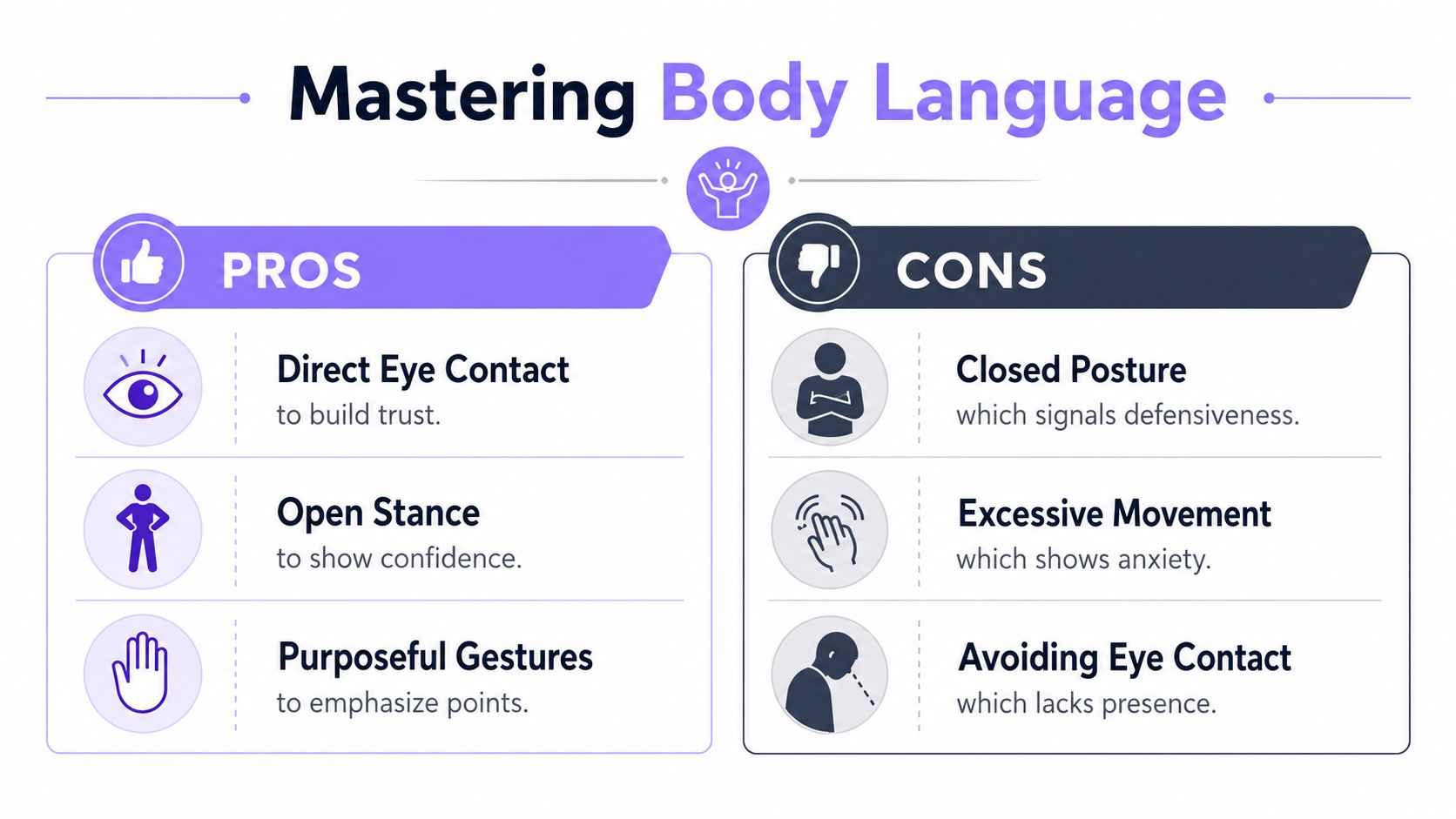
People respond to more than your words. They notice how you carry yourself, where you place your attention, and whether your body seems open or guarded. Research from UCLA, as cited by Corporate Communication Experts, found that 57% of a message's impact comes from body language and facial expressions, 36% from vocal characteristics, and 7% from the words themselves.
That doesn't mean words don't matter. It means your presence shapes how those words are received.
Start with posture, not performance
You don't need a dramatic “power pose.” You need a posture that helps you breathe and stay present.
Try this before you speak:
- Plant your feet: Feel both feet on the ground instead of shifting constantly.
- Lift through your chest: Not in a stiff way. Just enough to give your lungs space.
- Drop your shoulders: Tension often sits there first.
- Unclench your hands: Rest them naturally or use them intentionally.
This kind of posture does two things. It signals steadiness to other people, and it gives your body a calmer base to work from.
Make eye contact feel human
Many people hear “make eye contact” and assume they need to stare. That usually makes both people uncomfortable.
A better approach is to look at someone long enough to connect, then glance away naturally while thinking, then return. In a group, share your gaze around the room instead of locking onto one person. On video calls, look into the camera when making an important point, then back to the screen to stay conversational.
Open body language doesn't mean acting bigger than you are. It means removing the physical habits that make you disappear.
Give your hands a job
Nervous energy often shows up in fidgeting. If your hands don't know what to do, they may tug at sleeves, tap a pen, or clasp too tightly.
Try this quick comparison:
| Habit | What it can signal | Better option |
|---|---|---|
| Crossed arms | Guardedness | Relax arms at your sides |
| Constant fidgeting | Anxiety | Rest hands loosely, then gesture on key points |
| Looking down | Withdrawal | Lift your gaze to the person or room |
| Shrinking posture | Uncertainty | Stand or sit tall with a relaxed spine |
Purposeful gestures help when they match your words. If you're listing three points, let your fingers count them. If you're emphasizing contrast, let your hands show the difference. Small, clear gestures often look more confident than big, scattered ones.
Finding and Projecting a Confident Voice
A confident voice isn't only about volume. It's about rhythm, clarity, and the sense that you believe what you're saying.
Many people try to sound confident by speaking louder or faster. That often backfires. Speed can make you sound rushed, and loudness can sound forced if your body is tense.

Slow down enough to be understood
When nerves show up, your pace usually speeds up. Your brain wants to get through the moment quickly. Your listener, meanwhile, needs time to absorb what you're saying.
Try this exercise. Read one paragraph out loud at your normal pace. Then read it again and deliberately leave a tiny space at each comma and period. Speakers often discover that their “slow” version sounds clearer and more grounded.
Focus on three parts of vocal delivery:
- Pace: Aim for steady, not rushed.
- Pitch: Let your voice settle into its natural range instead of pushing it higher when nervous.
- Projection: Send your voice forward with breath support, not throat tension.
Replace filler words with silence
“Um,” “like,” “you know,” and “I guess” often appear when your brain needs a second to catch up. That's normal. But too many fillers can make your message sound less settled than it is.
A pause works better.
Research discussed in Preply's guide to speaking with confidence notes that “pausing power” can boost perceived confidence by 30% more than just increasing volume, especially for anxious speakers. That's powerful because a pause does more than remove clutter. It makes your words sound chosen.
Try using a pause when you:
- finish an important sentence
- need a moment to think
- want to answer a question without rushing
- notice yourself about to say “um”
Here's a helpful demonstration of vocal presence in action:
Build a voice that sounds like you
A confident voice should still sound natural. You are not trying to become a radio host or a stage actor unless that's your actual goal. You're aiming for a version of your voice that is less apologetic, less hurried, and more supported.
A short warm-up can help before any conversation:
- Take one slow breath and exhale fully.
- Hum gently for a few seconds to wake up your voice.
- Say one sentence clearly such as, “I'm ready to speak calmly.”
- Begin your first line a touch slower than feels necessary.
Silence used on purpose sounds more confident than words used to hide your nerves.
Create a Daily Practice Routine That Sticks
Confidence grows faster when it becomes a routine instead of a rescue plan. If you only practice on the days you feel nervous, you'll keep associating speaking with pressure. Daily practice makes confidence familiar.
That matters because consistency is often the primary challenge. A 2025 Gallup poll, cited by Expressable's article on communication confidence, found that 62% of individuals pursuing personal growth abandon new habits if they don't have a way to measure progress. Tracking helps people stay with the process long enough to notice change.

A simple five-minute confidence ritual
You do not need a long routine. You need one you'll repeat.
Try this:
- Minute one: Stand tall and take a few calm breaths.
- Minute two: Repeat one speaking affirmation out loud.
- Minute three: Read a short paragraph slowly and clearly.
- Minute four: Practice one intentional pause after a sentence.
- Minute five: Reflect on one small win from yesterday's communication.
This works well in the morning, before a commute, or right before work begins. If evenings are calmer for you, use it then instead.
Track the right things
People often get confused here and think progress means “I never feel nervous.” That's too broad and too discouraging. Track behaviors you can notice.
A simple checklist works well:
| Track this | What improvement might look like |
|---|---|
| Spoke up once today | You contributed even briefly |
| Used a pause instead of a filler | Your answer sounded calmer |
| Kept open posture | You felt less physically closed off |
| Maintained eye contact | You stayed engaged instead of retreating |
| Repeated your affirmation | You supported your mindset before speaking |
If you like combining confidence work with calm, this piece on guided meditation for confidence can fit nicely into the same rhythm.
Keep the bar kind and realistic
A strong routine should feel doable on low-energy days too. If you miss a day, come back the next day without turning it into a story about failure. Confidence grows through return.
You can also match practice to real life. Before a meeting, rehearse your opening sentence. Before a social event, decide on one question you'll ask someone. Before a presentation, practice your first minute until it feels familiar. Small structure lowers fear because it gives your nervous system something known to hold onto.
Embrace Your Journey to Confident Speaking
Talking confidently is rarely a single breakthrough moment. For many individuals, it's a quiet build. One clearer sentence. One steadier breath. One moment of choosing to pause instead of rush. Those small acts add up.
If progress feels uneven, that's normal. Some days you'll speak with ease. Other days your voice may shake. A shaky voice still counts as a voice used bravely. Confidence isn't the absence of nerves. It's the choice to stay present and speak anyway.
Keep your approach simple. Support your thoughts. Relax your body. Use your voice with intention. Practice often enough that confidence starts to feel less like a performance and more like a relationship with yourself.
Your voice does not need to be perfect to be valuable.
You deserve to be heard in rooms big and small. In meetings. In friendships. In difficult conversations. In moments when asking for what you need feels vulnerable. Each time you speak with a little more steadiness, you teach yourself that your presence matters.
Be patient with the process. You are not trying to become someone else. You are learning how to sound more like yourself, and that is how confidence begins to become.
If you want gentle support while building this habit, I Become can help. The iOS app makes daily affirmation practice easier with personalized affirmations, Lock Screen widgets, and four simple modes: Read, Speak, Listen, and Write. If you're working on how to talk confidently, it gives you a calm way to practice the inner script and the outer voice, while streak tracking helps you stay consistent. Download it from the App Store and let confidence grow one small practice at a time.
Found this helpful? Share it with someone who might benefit.