
How to Stay Focused on Goals: Achieve Success
Struggling with distractions? Learn how to stay focused on goals with our practical guide: set intentions, build systems, and maintain motivation.

You start a new goal with a full heart. On Monday, your notes app is filled with plans. By Friday, your attention is scattered across messages, errands, work, and the quiet feeling that you’re already behind.
That experience is common. It isn’t proof that you’re lazy, weak, or bad at follow-through. Many individuals try to stay focused in environments that constantly pull their attention away from what matters. A goal can be sincere and still get buried under a busy life.
The deeper problem usually isn’t motivation. It’s the lack of a supportive system. When people ask how to stay focused on goals, they often assume the answer is more discipline. In practice, focus grows better from clarity, rhythm, and compassion. You need to know where you’re going, what today’s step looks like, and what to do when you slip.
Imagine steering a ship. Energy helps, but energy without direction only creates motion. If your goal has no clear meaning, no daily shape, and no place in your real life, it drifts. If it has a compass, even slow progress starts to feel steady.
A mindful approach changes the question from “How do I force myself?” to “How do I support myself?” That shift matters. It turns your goal from a source of pressure into a practice you can return to, again and again.
Introduction
Individuals don’t lose focus because they don’t care. They lose focus because their goals live in the abstract. “Get healthier.” “Write more.” “Be calmer.” These are good intentions, but they’re hard to act on when your day is crowded and your mind is tired.
Focus becomes easier when the goal stops being a wish and starts becoming a relationship. You know what it means to you. You know what it looks like in daily life. You know how to come back to it after a rough week.
Staying focused isn’t about gripping harder. It’s about reducing friction between your intention and your next action.
That’s why a helpful system feels gentle, not rigid. It gives your mind fewer decisions to make. It removes some of the drama from the process. Instead of waking up and renegotiating your goal every day, you already know the next small step.
If you’ve struggled with consistency, try not to treat that as a character verdict. Treat it as information. Something in the setup needs care. Maybe the goal is too vague. Maybe the daily step is too big. Maybe your environment rewards distraction more than attention.
The good news is that focus can be rebuilt. Slowly. Practically. Kindly. The path usually starts with one simple change. Stop chasing a perfect future self and start building a structure your current self can live with.
From a Vague Wish to a Clear Compass
A goal gets stronger when it answers two questions. What do I want? Why does it matter to me?
Without the second question, goals often turn into obligations borrowed from other people. You think you “should” pursue them, but they never settle meaningfully enough to guide your attention. That’s why clarity isn’t just about being specific. It’s about being honest.

Find the real reason under the goal
Take a common goal like “I want to write a book.” That sounds clear, but it still leaves room for confusion. Why write it?
Maybe the answer is:
- Self-expression because you’ve carried a story for years
- Service because you want to help readers feel less alone
- Growth because finishing something meaningful would change how you see yourself
Those reasons matter because they keep the goal alive when novelty fades.
A simple journaling prompt helps here:
- Name the goal in one sentence.
- Ask why it matters five times, gently, until you reach something personal.
- Describe who benefits if you stay with it.
- Write what happens if you keep postponing it.
That final answer is often your compass.
Write it down so your mind can hold it
Writing a goal isn’t superstition. It creates commitment and visibility. A Michigan State University Extension summary of Dr. Gail Matthews’ work notes that you are 42% more likely to achieve your goals by writing them down, and that people who wrote down their goals and sent weekly progress updates to a friend had a 76% success rate.
That doesn’t mean you need a perfect planner. A notebook page is enough. What matters is that your goal moves out of mental fog and into language.
Practical rule: If a goal matters, it deserves a written home.
You can also make the goal easier to follow by turning it into a sentence with meaning. Instead of “write a book,” try: “I’m writing a short book that helps overwhelmed people feel less alone, and I will protect a small daily writing practice to finish it.”
Then reduce it further. Ask, what does this look like on a normal Tuesday?
Here’s one example:
| Goal | Daily action |
|---|---|
| Write a book | Draft for 20 minutes after breakfast |
| Improve fitness | Walk after lunch and prepare one simple healthy meal |
| Feel calmer | Sit quietly for 5 minutes before opening email |
If you need help making your goals feel fresh and grounded at the start of a new season, this guide on starting a new month with new goals can help you reset with intention.
Design Your Daily System of Focus
A clear goal is powerful, but it still won’t carry itself through your week. You need a system that translates meaning into behavior. Many people get stuck here. They choose a worthy goal, then leave the execution to memory and mood.
Memory is unreliable. Mood changes. Systems stay.
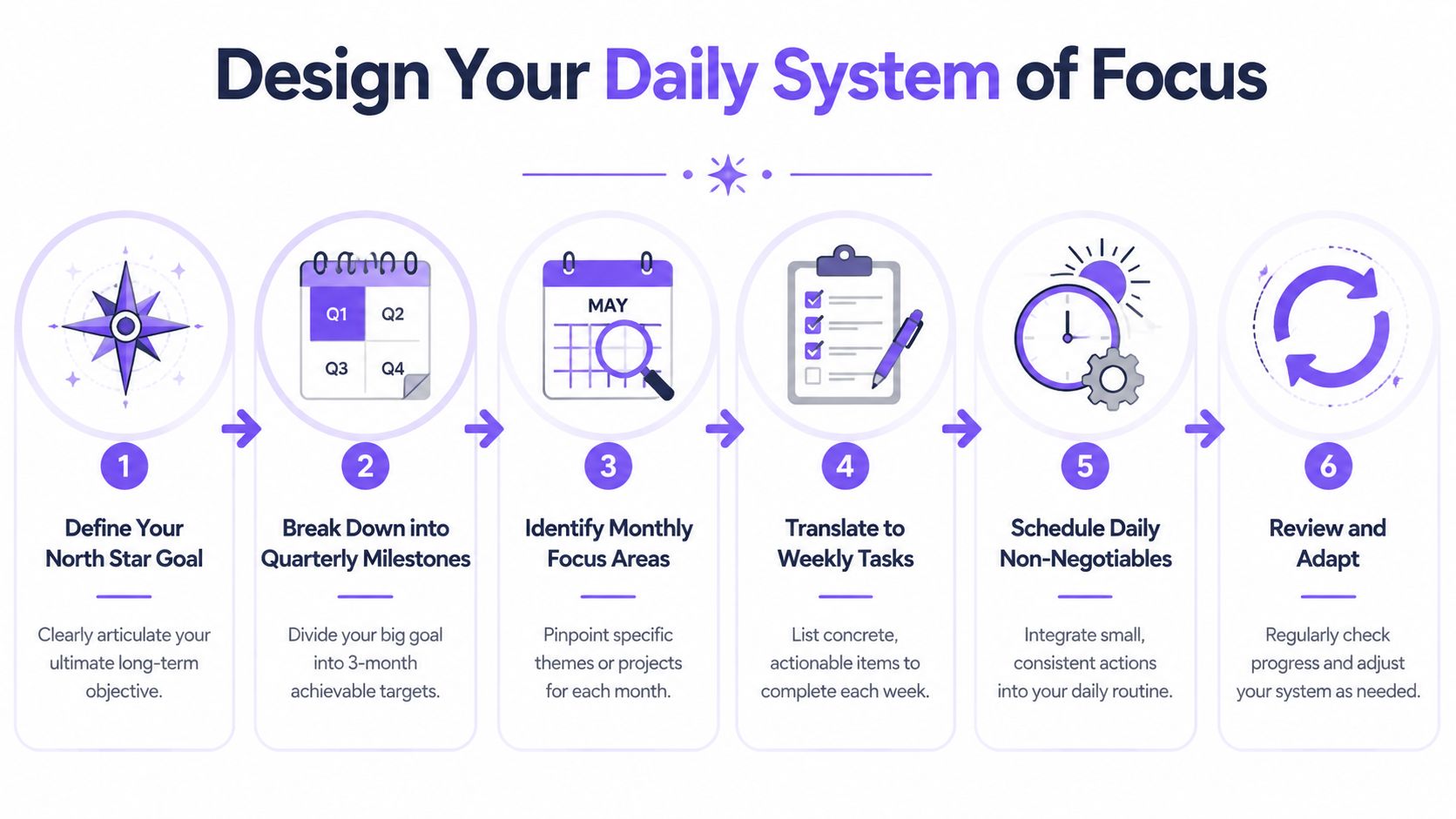
Build from the big picture down
A big goal gets less intimidating when you shrink it into layers. Think in horizons, not just urgency.
If your goal is to learn Spanish, your system might look like this:
North star goal
Hold a basic conversation comfortablyQuarterly milestone
Learn foundational vocabulary and speaking patternsMonthly focus
Practice food, travel, and daily routine languageWeekly task
Complete a few lessons, review flashcards, and say simple sentences out loudDaily essential
Do one short lesson with your morning coffee
This structure matters because attention likes clear edges. “Learn Spanish” is mentally heavy. “One lesson while the kettle boils” is light enough to begin.
Use process goals, not just outcome goals
Outcome goals tell you where you’re heading. Process goals tell you what to do today.
If your goal is to run a 5K, the outcome is the event. The process might be:
- Monday easy run
- Wednesday walk and mobility
- Friday short interval session
- Sunday longer slow run
That approach reduces emotional noise. You’re no longer waking up and asking, “Am I there yet?” You’re asking, “Did I do the next thing?”
A few design principles make daily focus easier:
Attach the habit to something stable
Put the new action after an existing routine, like meditation after brushing your teeth or language practice after coffee.Make the first step tiny
Open the document. Put on your shoes. Read one page. Tiny starts protect consistency.Decide the place in advance
A goal that lives nowhere usually happens nowhere. Choose the chair, the desk, the time window.
If your plan depends on remembering, it’s too fragile. If it has a cue, a time, and a place, it becomes much easier to repeat.
Protect your attention with structure
Digital distraction and productivity are often discussed separately, but they belong together under one skill: attention management. A good daily system doesn’t just schedule tasks. It reduces the number of times your mind gets pulled off course.
Try this simple pattern:
- Pick one meaningful task for the day.
- Choose one small version you can complete even when tired.
- Block a short focus window for it.
- Remove one obvious distraction before you begin.
- Mark the session complete when you’re done.
This is how to stay focused on goals in real life. Not through intensity, but through repeatable design.
Master Your Attention Not Just Your Time
Many people manage their calendar but not their attention. They plan a good day on paper, then spend it reacting. A message comes in. A tab stays open. One quick check turns into ten minutes of drift. By evening, they feel busy but strangely untouched by what mattered.
Time management helps. Attention management changes behavior.

Create focus on purpose
Motivation often feels like something you either have or don’t have. In practice, people can create the conditions that make motivation more likely. A quiet workspace helps. A single-task session helps. A visible reminder of why the task matters helps.
Start with a few simple boundaries:
- Silence nonessential notifications during your focus window
- Keep one active tab for the task you’re doing
- Put your phone out of reach if you’re doing mentally demanding work
- Use a short timer so the session has a beginning and an end
The timer matters because your brain relaxes when the task isn’t endless. A short sprint feels possible. Twenty focused minutes can carry more weight than a distracted hour.
If your mind often feels foggy before you even begin, this article on improving mental clarity and focus offers helpful ways to steady your thinking first.
Train depth and allow breaks
Focus isn’t only about saying no. It’s also about knowing when to pause well. People lose concentration faster when they try to grind through fatigue without recovery.
A healthier rhythm looks like this:
| When you notice | Try this instead |
|---|---|
| Restlessness | Stand up, breathe, and reset your posture |
| Urge to check your phone | Write the urge down and return to the task |
| Mental blur | Take a brief break, then restart with one small action |
Here’s a helpful visual reminder for building deeper work habits and reducing reactivity:
You don’t need a monk-like schedule. You need a few repeatable ways to stop your attention from being stolen all day long.
A focused life doesn’t eliminate distraction. It notices distraction sooner and returns faster.
That return is the skill. Every time you come back to the page, the practice, the walk, or the conversation, you’re strengthening the part of you that remembers what matters.
Fuel Your Progress with Mindful Reinforcement
Many people quit after a wobble because they assume consistency means never missing. That all-or-nothing mindset is one of the fastest ways to drain a goal of warmth and sustainability.
A more grounded approach treats progress as a pattern, not a performance. You don’t need constant inspiration. You need reinforcement that keeps the goal emotionally close.

Track progress so your brain can see it
Progress that stays invisible often feels unreal. That’s why even simple tracking can be powerful. A checkmark on a calendar, a short journal entry, or a weekly reflection creates evidence that your effort is leading somewhere.
An American Psychological Association summary of a meta-analysis of 138 studies found that frequently monitoring your progress toward a goal makes you significantly more likely to achieve it. It also found that the more frequent the monitoring, the greater the likelihood of success.
That matters because focus isn’t fed by pressure alone. It’s fed by feedback.
Useful things to track include:
- Completed actions such as workouts, study sessions, or writing blocks
- Patterns like what time of day you focus best
- Obstacles that keep interrupting your progress
- Emotional signals such as “I resist this when I’m tired” or “I start easily after a walk”
Use affirmations as anchors, not slogans
Affirmations work best when they support behavior. They shouldn’t feel fake or inflated. They should feel like steady reminders of identity and direction.
Examples:
- I return to what matters, even after distraction.
- Small steps count because they build trust with myself.
- I don’t need perfect conditions to begin.
These statements can help interrupt the old inner script that says, “I missed a day, so I’m failing.” They create a softer mental environment, and that softness often makes action easier.
If you want ideas for building that kind of reinforcement into your day, this collection of daily affirmations for motivation offers a good starting point.
Reset cue: Don’t ask, “Did I do it perfectly?” Ask, “What helped me stay connected, and what made it harder?”
Turn slip-ups into data
A missed day is information. A missed week is also information. Neither one needs to become identity.
When people review their progress with curiosity, they usually notice something practical. The task was too large. The timing was unrealistic. The environment was noisy. The goal started to feel emotionally distant.
That’s useful. It gives you something to adjust.
Try this short weekly review:
- What did I follow through on?
- When did focus feel easiest?
- What interrupted me most often?
- What’s one gentle improvement for next week?
This kind of reflection keeps your goal alive without turning it into a harsh scorecard.
What to Do When You Inevitably Lose Focus
You miss one day, then another. Your notes sit untouched. The goal that felt clear last week suddenly feels far away, and your mind starts building a case against you. Maybe you were never disciplined enough. Maybe you always do this.
That moment is more common than people admit. Research referenced by Indeed’s guide to staying focused on goals notes that a high percentage of people pursuing goals run into a serious setback early on. Losing focus is not unusual. What matters is having a way to return before a short drift turns into a long stop.
A lapse in focus works like missing a turn while driving. You do not abandon the trip because you took one wrong street. You pause, reorient, and get back on the road.
Use a simple reset ritual
When you notice you have drifted, keep the reset small and clear. Big promises made in frustration often create more pressure, and pressure makes it harder to begin again.
Try this:
Name what happened plainly
“I have not worked on this for six days.”Notice what pulled you off course
Was the step too big? Did your phone pull your attention in ten directions? Did stress make the task feel heavier than usual?Choose one restart action
Open the document. Do five minutes. Review one page. The goal is to restart contact, not to make up for everything at once.Add one support to the environment
Put the task where you can see it. Silence the loudest distraction. If your phone usually scatters your attention, use it on purpose. A tool like I Become can place a grounding affirmation on your Lock Screen so the device that often interrupts you can also remind you who you are trying to become.Begin before motivation catches up
Action often creates momentum. Waiting for the perfect mental state usually delays the return.
One gentle reset is often enough.
Missing a few days does not say anything final about your character. It only tells you that your system needs care.
Talk to yourself like someone worth helping
Many people lose focus twice. First in their behavior, then in the way they speak to themselves.
The second one hurts more. A harsh inner voice can make a small setback feel like proof. Then the brain starts protecting itself from shame by avoiding the goal altogether. That is why self-compassion matters here. It is not indulgent. It keeps the door open.
Try shifts like these:
“I ruined my streak.”
“I paused, and I can restart today.”“I can’t stay focused on anything.”
“I am still learning the conditions that support my focus.”“I should be further along.”
“I need the next clear step.”
If that feels unnatural at first, that is okay. Many people have spent years using criticism as fuel. It may feel familiar, but familiar is not always useful.
A kinder voice helps you return faster. Over time, that return becomes a skill. And for many people, that skill matters more than intensity, streaks, or perfect weeks.
Conclusion
Focus grows from clarity, structure, attention, reinforcement, and self-compassion. When your goal is meaningful, your next step is small, and your environment supports the work, staying steady becomes much more realistic.
You don’t need to become a different person overnight. You only need a clear compass and one action you can take today. Some days will feel smooth. Others won’t. Both count.
Keep returning. That’s the practice. That’s how to stay focused on goals in a way that lasts.
If you want gentle support for that daily return, I Become is worth exploring. It’s a thoughtful iOS affirmation app that helps you stay connected to your goals through personalized affirmations, Lock Screen widgets, and four practice modes: Read, Speak, Listen, and Write. If your phone usually pulls you away from yourself, this is a simple way to make it nudge you back. Download I Become from the App Store and build a steadier, kinder focus practice one day at a time.
Found this helpful? Share it with someone who might benefit.