
New Month, New Goals: Achieve Success
New month new goals - Ready for a new month new goals? Discover 8 actionable frameworks for setting and achieving meaningful goals in health, work & life. Start

The first day of the month has a special kind of energy. You open your notes app, stare at a fresh planner page, or promise yourself that this month will be different. You’ll be more focused. Calmer. Healthier. More consistent. That hope matters, but hope alone doesn’t carry you through the second week, the stressful Tuesday, or the evening when motivation disappears.
That’s where many individuals get stuck with new month new goals. They treat the month like a clean slate, but not like a system. A fresh start is helpful. A framework is what keeps it alive.
This is important because monthly goal-setting sits in a strange middle ground. It feels more manageable than a full year, but it can still turn into a mini version of the same old cycle: set too much, expect a personality transplant, fall behind, then give up. A Sundried survey of 4,000 people found that 43% expect to give up their New Year’s resolutions by February. A monthly reset can interrupt that pattern, but only if you use it wisely.
The strongest monthly plans combine action with mindset. You need structure for the work itself, and you need support for the thoughts that show up while you’re doing it. Daily affirmations can help close that gap. They won’t replace effort, but they can steady your attention, soften self-criticism, and make it easier to return to your plan when life gets messy.
Here are eight practical frameworks that work especially well when paired with I Become, so your goals don’t just live on a checklist. They start showing up in the way you think, speak, and act.
1. SMART Goals Framework with Monthly Affirmation Integration

Loose goals sound inspiring, but they’re hard to follow. “Be more confident” or “get healthier” can point you in the right direction, yet they don’t tell you what to do on Thursday morning.
SMART goals fix that. Make your goal specific, measurable, achievable, relevant, and time-bound. For a monthly plan, that might look like: “Practice speaking up once in every team meeting this month,” or “Read ten pages before bed at least five nights a week.”
Pair the goal with the belief you’ll need
Many individuals stop at the action plan. The missing step is mindset support.
If your monthly goal is to speak more confidently at work, your affirmation practice should match that challenge. Use phrases that reinforce identity and action, such as “My voice deserves space” or “I can speak clearly even when I feel nervous.” If you’re building a reading habit, your affirmations might focus on consistency and attention.
That pairing matters because written goals work better than vague intentions. Dr. Gail Matthews’ research at Dominican University found that people who write down their goals are 42% more likely to achieve them. Once your goal is written, affirmations help you keep showing up for it.
A useful pattern is simple:
- One outcome goal: What you want by month-end
- One process goal: What you’ll do weekly or daily
- One supporting affirmation: The thought you need when resistance shows up
Practical rule: If a goal can’t fit on one clear sentence, it probably isn’t ready yet.
What this looks like in real life
A student might set “Finish two assigned chapters each week” and pair it with affirmations about focus. A professional might choose “Volunteer to present one update this month” and use confidence-based reminders on your Lock Screen.
If you want help shaping your wording, try the daily affirmation generator and build statements that directly support the month’s top goals.
Keep the list short. One to three SMART goals per month is usually enough. More than that, and individuals often drift into planning as a substitute for action.
2. The 30-Day Challenge Method
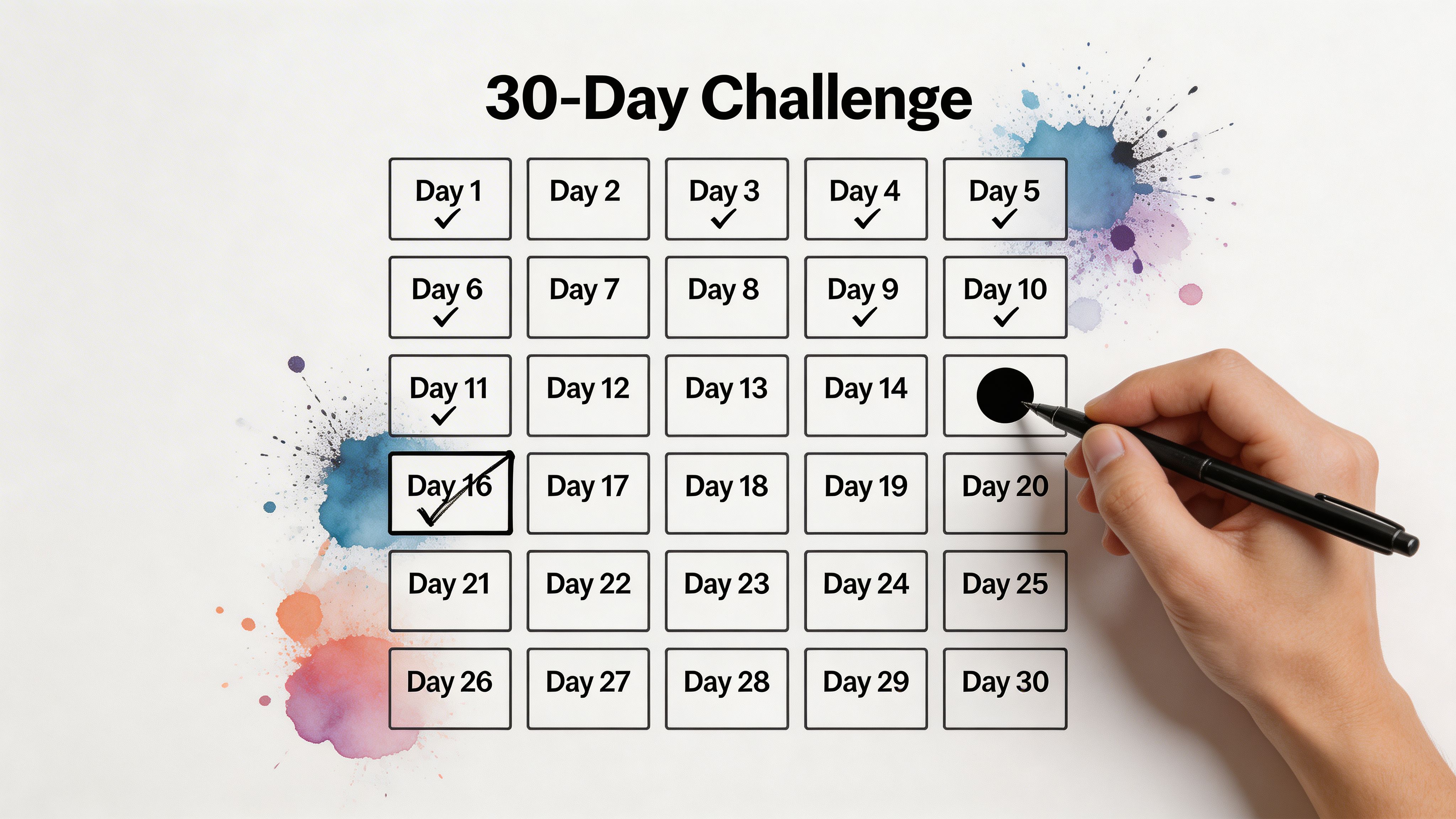
On the first day of a new month, motivation usually feels generous. By day nine, it has to compete with poor sleep, a packed schedule, and the voice that says skipping once does not matter. That is why the 30-day challenge method works well. It gives change a short runway and a clear finish line.
As noted earlier, long-term commitment drops quickly for many people. A 30-day challenge does not solve that by itself, but it does make follow-through easier to manage. You are not trying to redesign your whole life. You are practicing one repeatable behavior long enough to learn whether it fits.
Choose one behavior that can survive a normal week
This framework works best when the challenge is narrow, specific, and easy to spot in your day. Broad goals create confusion. Clear behaviors create evidence.
“Be more confident” is hard to measure. “Listen to a 5-minute confidence affirmation in I Become before logging into work” gives you a visible action. That matters because monthly goals often fail at the execution stage, not the intention stage.
A strong 30-day challenge has three parts:
- One repeated action: small enough to do on a busy day
- One cue: attached to an existing routine such as coffee, commuting, or brushing your teeth
- One mindset support: an affirmation in I Become that helps you stay steady when motivation dips
Examples:
- Calm challenge: Breathe for two minutes after waking up, then play a short I Become session during your morning routine.
- Confidence challenge: Start one conversation each workday and use Speak mode to rehearse self-trust statements beforehand.
- Self-kindness challenge: Write one compassionate sentence to yourself every night in Write mode before bed.
Miss one day, then continue the next day. Restarting the whole month usually feeds shame more than discipline.
Build for friction, not fantasy
Many people set challenges for their best-case schedule, then feel defeated when real life shows up. A better approach is to plan for the tired version of you, the distracted version, and the overbooked version.
That is where I usually ask one question: what is the minimum version of this challenge that still counts? If your original plan is 20 minutes of journaling, the minimum might be three sentences. If your plan is a long walk, the minimum might be ten minutes outside. Keeping a challenge alive at a smaller dose is often more useful than chasing a perfect streak for one week and quitting in the second.
I Become helps here because it connects the habit to identity. The challenge is the behavior. The affirmation is the thought that keeps the behavior from feeling forced. If you are building consistency, your statements might sound like, “I keep promises to myself,” or “Small steps still count.”
Track completion, then review what made it work
Use one reminder at the same time each day. Put the app widget where you will see it before the usual excuses start. Mark each completed day somewhere visible. Paper calendar, notes app, habit tracker. Any of them work.
At the end of the month, review more than the streak. Look at what made the challenge realistic. Time of day, cue, length, emotional resistance, and the affirmation you needed most all tell you something useful. That is why this method is more than a list of goal ideas. It is a framework for testing what you can sustain, with mindset support built into the plan.
3. Theme-Based Monthly Goal Setting
Some months don’t need a checklist. They need a center of gravity.
Theme-based planning works well when life feels scattered. Instead of chasing unrelated goals, you choose one guiding idea for the month, then let it shape your decisions. “Courage.” “Clarity.” “Calm.” “Connection.” A theme helps when you want cohesion, not just productivity.
Let one word organize the month
Say your theme is Courage. Your monthly actions might include speaking openly in a relationship, sharing an idea at work, and trying something that usually intimidates you. If your theme is Calm, your goals may be fewer but deeper: protect sleep, reduce overbooking, and practice a gentler inner voice.
This approach is especially useful for people who resist rigid planning or feel discouraged by all-or-nothing goal systems. The theme becomes a filter. When a new invitation, task, or distraction appears, ask whether it supports the month’s theme.
A strong affirmation practice makes themes more tangible. If your month is about Clarity, your affirmations can reinforce discernment, boundaries, and trust in your own judgment. If it’s about Connection, your statements might focus on vulnerability and presence.
What works and what doesn’t
Theme-based planning works when the theme is active, not decorative.
Use it well by:
- Choosing a lived theme: Pick something that can shape behavior, not just sound pretty in a journal.
- Limiting sub-goals: Three to five supporting actions are enough.
- Reflecting weekly: Ask how the theme affected your choices, not just your output.
It doesn’t work when the theme is vague and disconnected from action. “Glow up month” may feel fun, but “Month of steadiness” gives you a clearer behavioral direction.
I often find this method helps people who are rebuilding trust with themselves. It creates structure without the emotional weight of a long, demanding list.
4. The 80/20 Priority Principle for Monthly Goals
If your monthly plan has ten priorities, it probably has none.
The 80/20 principle helps you identify the small set of actions that will create the biggest shift. You don’t need to optimize every area of life each month. You need to know which efforts matter most right now.
Find the few goals that carry the month
Start with a brain dump. List everything you want to improve this month. Then get honest. Which two or three goals would make the biggest difference if you followed through?
For one person, that might be protecting sleep and reducing phone use at night. For another, it’s finishing one work project and practicing daily confidence affirmations before meetings. For a student, it may be attending class consistently and doing a short review block after dinner.
The trade-off is real. Choosing high-impact goals means letting lower-impact goals wait.
A crowded goal list often comes from anxiety, not ambition.
That’s why this framework is so effective for busy professionals and students. It cuts guilt-producing clutter. It helps you stop treating every nice idea as an urgent commitment.
Use affirmations on the pressure points
The highest-impact goals usually trigger the strongest resistance. If sleep is your priority, you may need affirmations about rest being productive. If boundaries matter most this month, you may need reminders that saying no is responsible, not selfish.
Try a simple review:
- High impact, manageable effort: Do these now.
- High impact, high effort: Break into smaller steps.
- Low impact, appealing but distracting: Park these for later.
The mistake people make is spending energy on goals that feel satisfying to plan but don’t meaningfully change daily life. Monthly success often comes from doing fewer things with more consistency, not doing more things with less focus.
5. Values-Based Goal Alignment Method
Some goals fail because they’re unrealistic. Others fail because they were never yours to begin with.
Values-based planning asks a harder question than “What do I want this month?” It asks, “What matters to me, and does this goal reflect it?” That question removes a surprising amount of noise.
Use values to sort signal from pressure
If you value health, your monthly goals may need to protect energy before they chase appearance. If you value family, the right goal might be one device-free dinner ritual instead of another professional certification. If you value creativity, progress may look like making space to write, sketch, or build, even when it doesn’t produce immediate results.
This method is especially helpful when you keep setting goals that look impressive but leave you drained. Monthly planning becomes less about performance and more about alignment.
A practical way to do this is to name three to five values, then test each goal against them. Ask:
- Is this goal rooted in my values or in comparison?
- Will this goal make my life feel more honest?
- Would I still want this if nobody saw it?
If the answer is no, it might not belong on this month’s list.
Build identity-level support
When motivation dips, values hold up better than mood. They remind you why the effort matters.
That’s where affirmations become more than encouragement. They reinforce identity. Someone who values presence might use statements about slowing down and giving full attention. Someone who values courage might repeat thoughts that support brave, imperfect action.
If you want to go deeper on this way of thinking, living with intention is a strong companion mindset for monthly planning.
What doesn’t work here is using values as decoration. If you say you value peace but pack your month with unnecessary obligations, your calendar is telling the truth louder than your journal is.
6. The Wheel of Life Monthly Assessment and Goal Setting
When people say they want a fresh start, they often mean one area of life feels neglected. The challenge is figuring out which area deserves attention first.
The Wheel of Life helps you see that clearly. Instead of setting random goals, you assess major life areas such as health, relationships, work, finances, personal growth, fun, and environment. Then you choose one area that needs care this month.
Use a simple score to direct your attention
Draw a circle or use a template. Rate each area based on your current satisfaction. Don’t overthink the numbers. The goal is honesty, not precision.
A low score in health may lead to goals around sleep, movement, or calmer mornings. A low score in relationships may point toward harder but more meaningful goals, like initiating one honest conversation a week or protecting time with someone you love. A low score in personal growth might suggest reading, therapy, journaling, or a skill-building practice.
This framework prevents tunnel vision. It also stops the common pattern of over-investing in one domain while another area is neglected.
Here’s a visual explanation of the exercise:
Match your affirmations to the area you’re repairing
If your weakest area is confidence at work, use affirmations that support competence and calm under pressure. If the issue is joy or recreation, your inner work may be permission-based. You may need reminders that rest, play, and pleasure belong in a healthy life.
This method works well for people who keep defaulting to the same type of goal every month. If you always choose productivity goals, the wheel may reveal that your true need is emotional balance, better relationships, or simple fun.
The point isn’t to fix every slice at once. It’s to choose one area, support it intentionally, and let that focused attention rebalance the whole.
7. The Two-Mountain Approach Internal Growth and External Achievement
You set a clear monthly goal. The plan makes sense. Then the moment of action arrives, and the primary obstacle is not the calendar or the checklist. It is the voice that says you are behind, not ready, or likely to fail.
That is why I like the Two-Mountain approach. It treats progress as two forms of work happening at the same time. One mountain is external achievement: finish the project, apply for the role, run the race, rebuild the routine. The other is internal growth: steadier confidence, better emotional regulation, more self-trust, less harsh self-talk.
A strong month usually requires both. External progress gives direction. Internal progress helps you stay with the goal when motivation dips or the work becomes uncomfortable.
Pair every outer goal with inner work
For each visible target, name the internal capacity it depends on.
If your outer goal is to lead a presentation, the inner goal may be speaking with composure when nerves spike. If you want to complete a certification, the inner goal may be staying consistent when self-doubt shows up halfway through. If you are working on healthier habits, the internal mountain may involve respect for your body instead of using criticism as fuel.
This approach closes a gap that many monthly goal plans miss. A good plan can still fall apart if the person carrying it is overwhelmed, ashamed, or chasing perfection. The task is not separate from the mindset. They affect each other every day.
Measure progress you cannot post online
External wins are easy to count. Internal wins need attention, or you will dismiss them even when they are changing your behavior.
Look for signs like these:
- Recovered faster: You had a hard day and returned to the goal the next day instead of quitting for the month.
- Spoke to yourself better: The inner dialogue shifted from judgment to coaching.
- Tolerated visibility: You took action before you felt fully confident.
- Stayed with the process: One imperfect week did not become a full reset.
These markers matter because they predict whether a goal will survive real life. In practice, I often see people abandon a useful plan because they only count outcomes and ignore the inner gains that make future follow-through more likely.
I Become fits best on the internal mountain. Use Read, Speak, Listen, or Write mode to reinforce the belief your outer goal demands. Someone building a business goal may need affirmations around resilience and self-trust. Someone pursuing a relationship goal may need language that supports honesty, calm, and worthiness. If you want more structure for that side of the work, how to develop a growth mindset offers a helpful foundation.
At the end of the month, review both mountains. Ask what you achieved, and also ask what became easier inside you. That second answer often explains whether next month’s goals will feel heavier or more possible.
8. Obstacle-Based Backwards Goal Planning
Many people start with the destination. A smarter approach starts with the derailers.
If you’ve set similar goals before and didn’t follow through, that history is useful. Don’t ignore it. Study it. The obstacle-based method begins by naming what usually gets in the way, then building goals that directly address those blocks.
Plan around the pattern, not the fantasy
Maybe your obstacle is perfectionism. You begin with energy, then stall because the plan isn’t flawless. Maybe it’s self-doubt. You avoid taking visible action because being seen feels risky. Maybe it’s comparison. The moment someone else seems ahead, your motivation collapses.
Those aren’t side issues. They are the work.
The research gap provided in the brief points to something important here. A lot of monthly goal content focuses on what to do, but rarely on why people abandon goals or how reset fatigue builds over time. Self-doubt and negative self-talk often drive that dropout pattern, especially when enthusiasm fades in the middle of the month. That’s exactly where affirmations can become practical, not fluffy.
Build anti-obstacle goals
If your obstacle is fear of failure, don’t just set a performance goal. Set a courage goal. Apply, submit, speak, or share before you feel fully ready.
If your obstacle is perfectionism, define “done” before the month begins. Create affirmations that support progress over polish. If comparison is the issue, reduce exposure to triggers and reinforce self-worth daily.
“What usually stops me?” is often a more useful planning question than “What do I want?”
A few examples:
- Fear of speaking up: Practice one short contribution in every meeting, then use Speak mode to rehearse stronger self-beliefs.
- All-or-nothing thinking: Set a minimum version of the habit so one hard day doesn’t end the month.
- Harsh self-criticism: Use Write mode to repeat compassionate, stabilizing thoughts after mistakes.
This framework is powerful because it replaces self-blame with design. You stop acting surprised by your patterns and start planning for them.
8-Strategy Monthly Goals Comparison
| Method | 🔄 Implementation Complexity | ⚡ Resource Requirements | 📊 Expected Outcomes ⭐ | 💡 Ideal Use Cases | Key Advantages |
|---|---|---|---|---|---|
| SMART Goals Framework with Monthly Affirmation Integration | Medium, structured setup and tracking | Moderate time to define metrics + daily affirmation routine | Clear, measurable progress; increased accountability ⭐⭐⭐⭐ | Skill-building, professional objectives, measurable habits | Precision in goals, easy progress tracking, affirmation alignment |
| The 30-Day Challenge Method | Low, time-boxed, single focus | Daily commitment + streak tracking | Habit initiation and momentum; short-term wins ⭐⭐⭐ | Habit formation, routine establishment, quick behavior shifts | Simple, motivating, natural reset every month |
| Theme-Based Monthly Goal Setting | Low–Medium, choose theme and align tasks | Reflection time + flexible daily practices | Cohesive focus across areas; improved decision simplicity ⭐⭐⭐ | Creative projects, multi-area focus, reduced decision fatigue | Encourages cohesion, flexible sub-goals, reduces cognitive load |
| The 80/20 Priority Principle for Monthly Goals | Medium, requires prioritization analysis | Time to assess impact vs effort; selective focus | High-impact results with less effort; efficient outcomes ⭐⭐⭐⭐ | Busy professionals, limited-time users, ROI-driven goals | Maximizes impact, minimizes wasted effort, accelerates results |
| Values-Based Goal Alignment Method | Medium, needs deep self-reflection | Introspection and periodic reassessment | Greater intrinsic motivation and meaningful progress ⭐⭐⭐⭐ | Long-term change, identity-driven goals, avoiding misaligned targets | Increases authenticity, sustained motivation, better alignment |
| The Wheel of Life Monthly Assessment and Goal Setting | Medium, evaluate 8 domains and rotate focus | Assessment time + monthly planning per domain | More balanced life improvements; prevents neglect ⭐⭐⭐ | Full wellbeing, coaching, users wanting balance | Visual overview, prevents tunnel vision, encourages rotation |
| The Two-Mountain Approach: Internal Growth and External Achievement | High, dual tracking of internal + external goals | Ongoing effort on mindset work + outcome tasks | Sustainable achievements with deeper meaning; integrated growth ⭐⭐⭐⭐ | People seeking both performance and personal growth | Aligns mindset with action, prevents hollow success |
| Obstacle-Based Backwards Goal Planning | High, identify root obstacles first | Emotional work, time for analysis and targeted practice | Reduced repeated failures; stronger resilience and problem-solving ⭐⭐⭐⭐ | Users with recurring blocks, saboteurs, or limiting beliefs | Targets root causes, creates durable change, incorporates affirmations |
Your Best Month Starts With a Single Thought
New month new goals can be a healthy ritual, but only when it’s grounded in reality. A new month isn’t a command to become perfect. It’s an invitation to begin again with more honesty, more structure, and more kindness than you had before.
That’s why framework matters. SMART goals help when you need clarity. A 30-day challenge helps when you need momentum. Themes help when life feels fragmented. The 80/20 principle helps when your ambitions are competing with your capacity. Values-based planning helps you stop chasing goals that were never really yours. The Wheel of Life helps you choose the right area to focus on. The Two-Mountain approach helps you respect internal growth alongside visible progress. Obstacle-based planning helps you work with your patterns instead of pretending they won’t show up.
What tends not to work is trying to do all of them at once. Pick one framework for this month. Keep it simple enough that you can follow through when energy is low. The true test of a monthly goal system isn’t how exciting it feels on day one. It’s whether it still supports you on day seventeen.
That’s also where mindset becomes practical. Individuals often don’t quit because they forgot what they wanted. They quit because their inner dialogue turned against them. One missed day becomes “I always fail.” One awkward attempt becomes “I’m not the kind of person who can do this.” One slow week becomes “I’ve ruined the month.” Those thoughts shape behavior fast.
Affirmations can interrupt that spiral. Not by pretending everything is easy, but by giving you something steadier and kinder to return to. A well-chosen affirmation reminds you that effort counts, that inconsistency isn’t identity, and that you can restart without shame. When paired with real action, it becomes a support system for the middle of the month, not just the beginning.
So start smaller than your ego wants and more consistently than your mood prefers. Write the goal. Choose the framework. Decide what thought you want to practice when resistance arrives. Then repeat it until it starts to feel familiar.
Your best month probably won’t come from one giant breakthrough. It will come from a few clear decisions, repeated with care. If you’re ready to support both your goals and your mindset, download the I Become app from the App Store and choose the affirmations that can guide your next month with confidence, calm, and self-trust.
If you’re ready to turn good intentions into a steady daily practice, I Become can help. The app gives you personalized affirmations, Lock Screen widgets, notifications, and four practice modes. Read, Speak, Listen, and Write. It’s a simple way to keep your new month new goals connected to the mindset that helps them stick. Download it from the App Store and begin your month with thoughts that support the person you’re becoming.
Found this helpful? Share it with someone who might benefit.