
Communication Issues in Relationships: A Guide to Connect
Struggling with communication issues in relationships? Learn to identify destructive patterns, use evidence-based strategies, and build deeper connection.
Ultimately, you ask a simple question.
“Did you call the landlord?”
Your partner sighs. “Why are you on my case the second I walk in?”
You feel your chest tighten. “I’m not on your case. I just can’t rely on you.”
A tiny moment turns into a heavy silence, then a full argument. Nobody feels understood. Both of you leave the conversation thinking the same thing. That’s not what I meant.
If that feels familiar, you’re not broken, and your relationship isn’t automatically doomed. Many people dealing with communication issues in relationships aren’t struggling because they don’t care. They’re struggling because stress, old habits, fear, and misread signals keep getting in the way of what they wish to say.
That matters because poor communication isn’t a small side issue. According to relationship statistics summarized by South Denver Therapy, poor communication contributes to as many as 70% of divorces, and 94% of unhappy couples name it as the main reason for their dissatisfaction. Those numbers can feel sobering, but they also tell us something hopeful. Communication is one of the clearest places to work if you want your relationship to feel safer, warmer, and more connected.
If your mind tends to spiral after conflict, this guide on how to calm anxious thoughts can help you settle your body before the next hard conversation.
That Feeling of Talking Past Each Other
Most communication breakdowns don’t begin with cruelty. They begin with different meanings attached to the same moment.
One person asks a question and means, “Can we handle this together?”
The other person hears, “You failed again.”
One person gets quiet to avoid making things worse.
The other person experiences that silence as abandonment.
That’s why so many couples say they keep having “the same fight” in different costumes. The surface topic changes. Dishes, money, sex, time, family, text messages. Underneath, the same fears keep showing up. Do I matter to you? Am I safe with you? Will you meet me halfway?
Communication trouble often looks like anger on the outside, but underneath it’s usually hurt, fear, shame, or loneliness.
A helpful way to think about it is this. Conversation is like tossing a ball back and forth. In healthy moments, the ball moves cleanly. In tense moments, both people throw extra things with it. Old resentment. Defensive tone. Assumptions. Half-healed wounds. Soon, no one is catching the actual message.
What readers often get confused about
People often assume that if they love each other, communication should feel natural. It often doesn’t.
Skills like listening without interrupting, naming emotions clearly, staying grounded during criticism, and repairing after conflict are learned behaviors. If nobody modeled them well for you, you may be trying to build a bridge with tools you were never given.
That isn’t a character flaw. It’s a place to begin.
Why We Really Misunderstand Each Other
Some couples argue loudly. Others stay polite and distant. Both can be struggling with the same root problem. It doesn’t feel emotionally safe to tell the truth.

A quiz analysis summarized by Oliver Drakeford Therapy described this as a “Comfort Crisis.” In that data, 75% reported significant communication challenges, 46.7% rarely or never felt comfortable expressing emotional needs, and 49% felt completely disconnected.
That helps explain why couples often fight about small things with big emotion. The argument isn’t only about what happened today. It’s also about everything that didn’t feel safe enough to say last week.
The real issue is often hidden
A common example:
| What’s said | What may be meant underneath |
|---|---|
| “You’re always on your phone.” | “I miss you and I don’t know how to ask for attention without feeling needy.” |
| “You never help around here.” | “I feel alone in this relationship.” |
| “Forget it.” | “I don’t believe this conversation will go well, so I’m protecting myself.” |
When you only respond to the top line, the conversation stays shallow and reactive. When you get curious about the deeper line, the tone can change.
We all bring a communication blueprint
Your “blueprint” is the private set of rules you learned about conflict, affection, and emotional expression.
Maybe you grew up in a house where people shouted, then acted normal an hour later. Maybe nobody raised their voice, but nobody communicated openly either. Maybe your past relationships taught you that opening up leads to rejection. Those lessons don’t disappear when love begins.
They show up in small moments:
- One partner pursues. They want to talk things through right away.
- The other partner withdraws. They need time to calm down before they can think clearly.
- Both feel threatened. One feels abandoned. One feels overwhelmed.
Neither person is necessarily wrong. They’re often protecting themselves in different ways.
Practical rule: If a reaction feels bigger than the moment, there’s probably an older fear attached to it.
A better question than “Who started it?”
Try asking:
- What was I feeling before I got sharp?
- What did I hope my partner would understand without me saying it?
- What did I assume their behavior meant?
- What need was underneath my reaction?
That shift matters. Blame keeps couples stuck at the level of behavior. Self-awareness helps them move toward the need beneath it.
The Four Destructive Communication Patterns
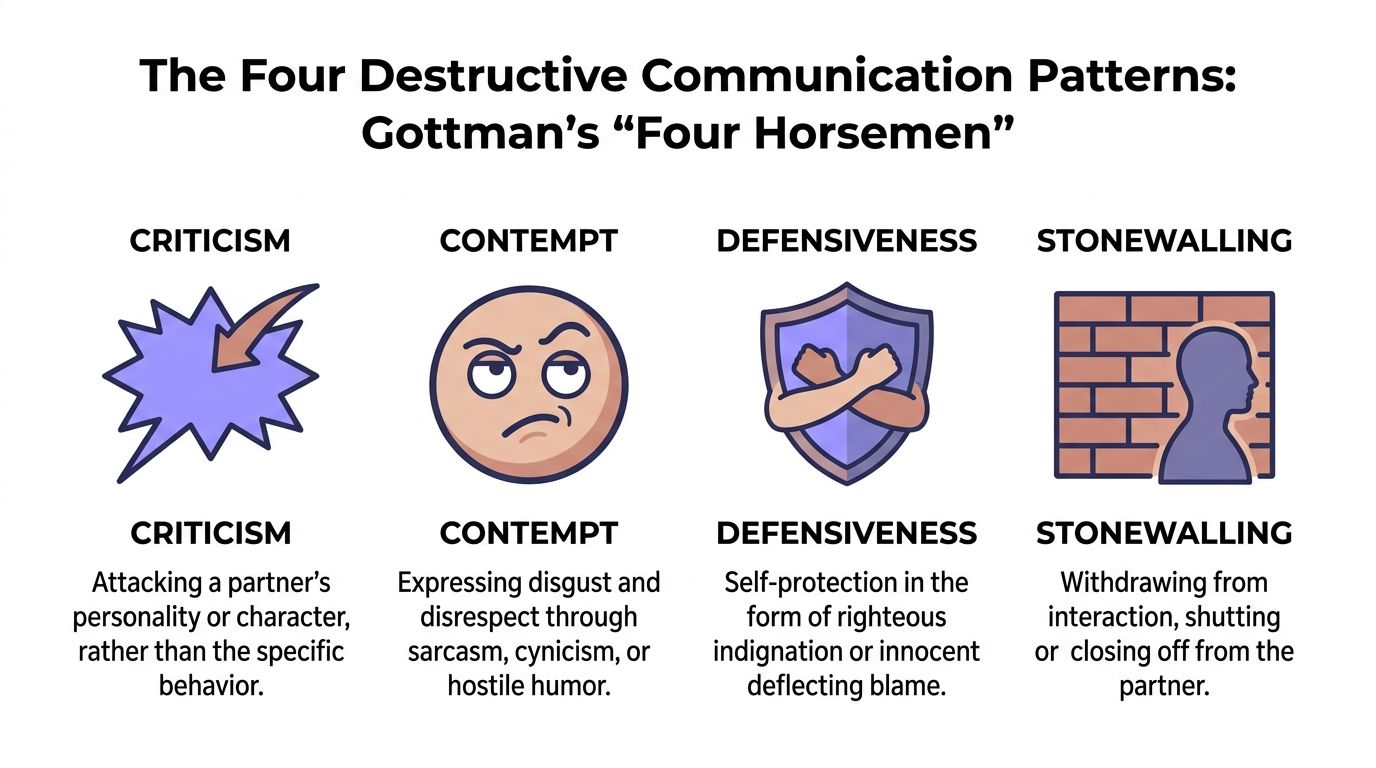
Some relationship habits are so common that researchers can spot them as warning signs. The best-known framework comes from Gottman’s work on the Four Horsemen. According to the Gottman Institute’s overview of these patterns, their research can predict divorce with 94% accuracy, and 69% of couples show no improvement after two years if these patterns aren’t addressed.
That doesn’t mean one harsh conversation decides your future. It means repeated habits matter.
Criticism
Criticism attacks character instead of naming a specific behavior.
It sounds like this:
- “You always forget everything.”
- “You’re so selfish.”
The problem isn’t bringing up an issue. Healthy couples do that. The problem is turning a complaint into a verdict about who the other person is.
A softer alternative sounds more like: “I felt stressed when the bill got missed. Can we make a plan together?”
Contempt
Contempt is sharper. It carries disgust, superiority, mockery, or eye-rolling energy.
Examples include:
- Sarcastic jabs
- Hostile humor
- Talking down to your partner
- Acting like their feelings are ridiculous
Contempt is especially corrosive because it tells the other person, I’m above you. It doesn’t just criticize behavior. It attacks dignity.
Defensiveness
Defensiveness often feels justified from the inside.
You hear feedback, and before you even think, your mind starts building a case. That’s not fair. You do it too. You don’t understand. I had a reason. Defensiveness can sound responsible on the surface, but it usually blocks accountability.
A quick comparison helps:
| Pattern | How it sounds | Healthier response |
|---|---|---|
| Defensiveness | “I only did that because you were nagging me.” | “I can see why that upset you. My part in it was...” |
| Criticism | “You never care.” | “I felt unimportant when that happened.” |
Stonewalling
Stonewalling is shutting down, going blank, leaving emotionally, or becoming unreachable in the middle of conflict.
Sometimes it looks cold from the outside. Inside, it often feels more like overwhelm. The nervous system is flooded, and the person can’t process clearly enough to stay engaged.
That’s why forcing a conversation in that moment rarely helps.
When someone is flooded, “talk it out right now” can feel like asking a phone with no battery to keep running apps.
The antidotes are small but powerful
You don’t need perfect scripts. You need better defaults.
- For criticism: Use a gentle startup and name one issue.
- For contempt: Speak with respect, especially when you’re frustrated.
- For defensiveness: Look for your slice of responsibility.
- For stonewalling: Take a break and return when your body is calmer.
The key is noticing the pattern while it’s happening. Once you can name it, you’re no longer trapped inside it.
Exploring Hidden Barriers to Connection
Not every communication problem comes from laziness, selfishness, or lack of love. Sometimes the barrier is neurological, and that changes the kind of support a couple needs.

For example, Dr. Jessica Higgins’ discussion of ADHD and intimate relationships notes that a partner “zoning out” may reflect executive function difficulty rather than defiance. That distinction matters. If one person sees forgetfulness as “You don’t care,” and the other person experiences it as “My brain dropped the thread again,” the same event can create pain on both sides for very different reasons.
Why generic advice can fall flat
Standard communication advice often says things like “just listen better” or “be more present.” That may help some couples, but it can miss the reality of ADHD and other forms of neurodivergence.
A person might deeply care and still struggle to:
- Track a long conversation without drifting
- Remember verbal agreements
- Pause before blurting out a reactive comment
- Switch attention quickly when their partner needs emotional presence
That doesn’t erase impact. It does change the interpretation.
A more compassionate frame
Instead of asking only, “Why won’t you do this?” ask, “What makes this hard for you?”
That question opens the door to practical adaptation. Maybe the couple needs shorter conversations, written follow-ups, fewer layered requests, or agreed pause words when one person gets overloaded. For some couples, healing also involves separate work around trust and repair. If that’s your situation, this piece on how to rebuild trust in a relationship may help.
Some relationships don’t improve because the people aren’t trying. They stay stuck because they’re using tools that don’t fit the way their minds work.
When advice finally matches reality, many couples feel relief before they feel progress. Relief matters. It lowers shame, and lower shame makes learning possible.
Practical Strategies for Clearer Communication
Insight helps, but most couples need language they can use at 8:30 p.m. when they’re tired, hungry, and one text message away from another misunderstanding. The good news is that communication skills can be practiced in very concrete ways.
Research summarized in this PMC review on couple communication found that when couples experience less negative communication than usual, they’re more satisfied with their relationship, and negative behaviors like criticism and hostility predict relationship dissolution over time. So the work isn’t abstract. Reducing negative patterns changes the emotional climate.

Practice active listening
Active listening means listening to understand, not listening to prepare your rebuttal.
Try this sequence:
- Pause your reply. Don’t jump in with correction.
- Reflect back what you heard. “You felt dismissed when I looked at my phone.”
- Check accuracy. “Is that right?”
- Validate the feeling, even if you see it differently. “I get why that hurt.”
Notice what active listening is not. It’s not agreeing with every detail. It’s showing your partner that their inner experience landed somewhere.
A before-and-after example:
- Before: “That’s not what happened.”
- After: “I can hear that you felt alone in that moment.”
That one shift often lowers the temperature fast.
Use I statements that name the need
When people are upset, they usually lead with accusation because accusation feels strong. The problem is that it also triggers defense.
A cleaner formula is:
I feel [emotion] when [specific behavior] because [need or meaning].
Examples:
- “I feel anxious when plans change last minute because I need more predictability.”
- “I feel hurt when I’m interrupted because I want to feel heard.”
This keeps the focus on your lived experience instead of turning your partner into the problem.
Try this sentence starter: “What I need most in moments like this is...”
That line slows your brain down enough to speak from vulnerability instead of attack.
Make repair attempts early
A repair attempt is any small move that says, “I care more about connection than winning.”
It might be:
- A pause: “I’m getting reactive. Can we restart?”
- A soft touch: a hand on the shoulder if that feels welcome
- A little honesty: “I know my tone got harsh.”
- A bit of humor: gentle, not mocking
- A clear reset: “We’re on the same team. Let me try again.”
Later, if you want a visual walkthrough of healthy communication habits in action, this short video can be useful:
A simple conversation reset
When a talk starts going sideways, use this mini-structure:
| Step | What to say |
|---|---|
| Slow down | “Can we take this one piece at a time?” |
| Name the emotion | “I’m feeling defensive.” |
| State the issue clearly | “The real issue for me is feeling left out of decisions.” |
| Invite partnership | “Can we solve this together?” |
That’s not fancy. It’s effective because it replaces chaos with clarity.
Build a Mindset for Connection with Daily Affirmations
Knowing what to say and saying it in a heated moment are two different things. Most communication habits are tied to older mental loops.
If you tend to get defensive, your inner script may be: Criticism means I’m failing.
If you shut down, your script may be: Conflict isn’t safe.
If you become sharp, your script may be: If I don’t come in strong, I won’t be heard.
This is where mindset work matters. Not as a replacement for skill, but as support for it.
Why affirmations can help communication
A thoughtful affirmation practice can interrupt reflexive thinking and create a new internal starting point. You’re not pretending everything is fine. You’re rehearsing a healthier belief often enough that it becomes easier to access under stress.
Some examples tied to common patterns:
- For defensiveness: “I can hear feedback without losing my worth.”
- For criticism: “I can express frustration with kindness.”
- For stonewalling: “I can pause, breathe, and return to this conversation.”
- For fear of vulnerability: “My needs matter, and I can share them calmly.”
- For anxious overthinking: “I don’t need to assume the worst to protect myself.”
Make the practice concrete
Affirmations work best when they’re connected to a real behavior.
Try a rhythm like this:
- Choose one communication pattern you want to change.
- Write one belief that supports the opposite behavior.
- Repeat it daily, especially before predictable stress points.
- Use it as a cue in real time during conflict.
For example, if your habit is interrupting, your affirmation might be: “I feel secure enough to listen fully before I respond.” Then your behavioral cue becomes: Take one breath before speaking.
Consistency matters more than intensity
A small daily practice often works better than waiting for a dramatic breakthrough. You’re building familiarity. You’re teaching your nervous system that a new response is possible.
If you want ideas you can adapt, these relationship-strengthening affirmations offer a helpful starting point.
Repetition is how old reactions got wired in, and repetition is often how new ones get built.
The deeper truth is simple. People rarely communicate above the level of safety they feel inside themselves. When your inner voice gets kinder, steadier, and less threatened, your outer voice usually follows.
Your Path Forward to Deeper Connection
Communication issues in relationships can feel painfully personal, but they’re often painfully patterned. That’s good news, because patterns can be noticed, interrupted, and changed.
You don’t have to fix everything this week. Start smaller. Notice the hidden need beneath one argument. Catch one defensive reply before it comes out. Replace one accusation with an honest feeling. Return after one timeout instead of staying shut down all night.
Progress usually looks ordinary while it’s happening. A softer tone. A cleaner apology. A better question. A little more honesty and a little less armor.
That’s how deeper connection gets built. Not through perfect communication, but through repeated moments of courage, repair, and practice. If you stay gentle with yourself and steady in the work, your conversations can begin to feel less like battlefields and more like bridges.
If you want support turning these ideas into a daily practice, I Become is a simple iOS app designed to help you gently rewire your thoughts through affirmations. You can practice in Read, Speak, Listen, or Write mode, use widgets and notifications as quiet reminders throughout the day, and build a mindset that supports calmer, clearer, more connected communication. Download it from the App Store and let one small daily ritual support the relationship you’re trying to build.
Found this helpful? Share it with someone who might benefit.