
Achieve Closure in Relationships: Heal & Move On
Find closure in relationships, even without answers. Get practical steps for healing, setting boundaries, and moving forward with peace and clarity.
You wake up and reach for your phone before your feet even touch the floor. Not because you need the weather or your calendar, but because some part of you still hopes there will be a message. An explanation. A softening. Anything that turns a confusing ending into a clean one.
Later, you tell yourself you're fine. Then a song plays in the grocery store, or a memory pops up, or you notice their name still sitting in your search bar. Your mind starts working again. What did they mean by that last conversation? Why did things shift so fast? Was it something you missed, or something you should've said?
If this sounds familiar, you're not failing at moving on. You're having a human response to an unfinished story.
The Lingering Echo of an Unfinished Story
Some relationship endings are clear. Many aren't. They trail off through mixed signals, awkward silence, ghosting, half-hearted check-ins, or a breakup talk that leaves you with more questions than peace.
That's why closure in relationships can feel so hard to find. Your heart may know it's over, but your mind keeps circling back, trying to complete the picture.
In the United States, the number of single adults grew by more than 10 million between 2017 and 2022, and nearly 40% of emerging adults reported one or more breakups over a 20-month period, according to Stanford sociologist Michael Rosenfeld's analysis and related summary data. This kind of pain is personal, but it isn't rare.
A lot of people get stuck in the same loop:
- Replaying conversations and trying to decode hidden meaning
- Checking social media for signs that explain what happened
- Comparing the present to the past and wondering if the connection was ever real
- Blaming themselves because self-blame feels easier than uncertainty
Sometimes readers land here after weeks of heartbreak. Sometimes after months. Sometimes after a relationship that ended long ago but never settled inside them.
You can miss someone and still know they weren't right for you.
That tension confuses people. They think healing should look neat. It usually doesn't. It often looks like remembering, grieving, slipping backward, then slowly choosing yourself again.
If you're trying to loosen your grip on the past, these moving on relationship quotes can help put language to feelings that are hard to name. Sometimes a single sentence can calm the nervous system enough to help you breathe.
The first kindness is this. Stop treating your longing for answers as weakness. Your mind is trying to create order from ambiguity. That impulse makes sense.
What Relationship Closure Truly Means
Closure isn't a perfect final conversation. It isn't hearing exactly the right words from the other person. And it isn't getting a version of the story that suddenly erases your pain.
Psychologically, the need for closure is a cognitive-motivational construct that combines an urgency to reach an answer quickly and a permanence tendency to hold onto that answer once it's found, as described in this explanation of closure psychology. That helps explain why unresolved endings can lead to rumination. The mind wants finality.
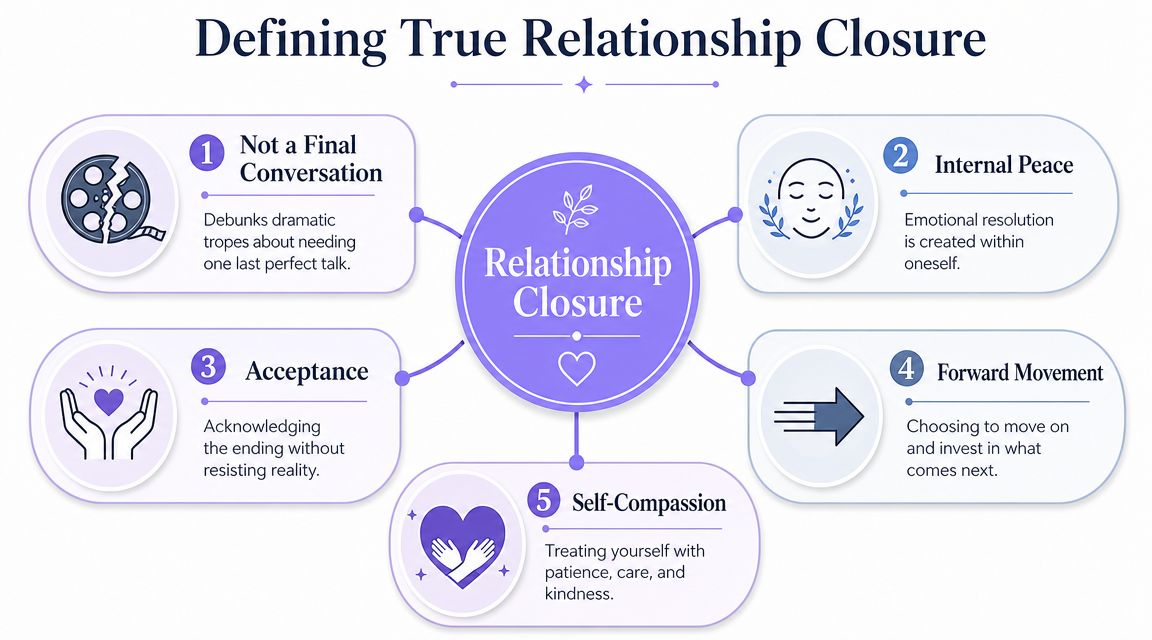
Closure is more like shelving a book
Think of a relationship as a book you once lived inside. Closure doesn't mean pretending the story was meaningless. It means reaching a point where you can place that book back on the shelf without needing to reread the ending every night.
That usually includes four inner shifts:
| Part of closure | What it means in real life |
|---|---|
| Acceptance | You stop arguing with the fact that the relationship ended. |
| Sense-making | You form a grounded story about what happened, even if some details remain unknown. |
| Emotional softening | The intensity begins to ease, even if sadness still visits. |
| Forward movement | Your energy starts returning to your own life. |
This is why closure in relationships is often misunderstood. People think closure means certainty. Often, it means enough understanding to stop chasing certainty.
What closure is not
A lot of pain comes from aiming at the wrong target. Closure is not:
- An apology requirement from the other person
- A mutual agreement about what the relationship meant
- Proof that you were lovable
- A dramatic final scene where everything suddenly makes sense
If you've dealt with long-standing tension, emotional distance, or mixed messages, this can overlap with broader communication issues in relationships. Sometimes the breakup only magnifies patterns that were already there.
Practical rule: Closure begins when you stop asking, “How do I get them to explain it?” and start asking, “What do I need in order to live with peace?”
That question changes everything. It moves closure from their hands back into yours.
Why Your Healing Journey Needs Closure
Some people hear the word closure and think it sounds optional, almost indulgent. But unresolved endings can occupy a surprising amount of mental space. They pull attention away from the present, strain your energy, and keep your emotional system on alert.
A 2025 longitudinal study found that people with higher need for closure reported greater relationship commitment across multiple studies, and need for closure was also positively linked to willingness to sacrifice for the relationship, including an estimate of B = .339, p = .002 and an association between need for closure and commitment of B = .165, 95% CI [.080, .250], p < .001, according to the study in the Journal of Social and Personal Relationships. The same work found this was mainly a between-person pattern, meaning people who are more dispositionally closure-seeking tend to be more committed on average over time.
Why the lack of closure can feel so destabilizing
Your desire for resolution isn't merely sentimental; it's intricately linked to how you bond.
If you were invested, your system likely organized around the relationship. You made plans, adjusted behavior, overlooked discomfort, or gave more of yourself because the connection mattered. When that bond ends without a clear emotional landing, the part of you that values commitment doesn't just switch off.
That's why you may notice:
- Mental overwork because your mind keeps trying to solve the ending
- Emotional whiplash when one memory brings tenderness and the next brings anger
- Difficulty being present with friends, work, rest, or new possibilities
- A stalled sense of self because so much energy is still turned backward
Closure protects your attention
Healing isn't only about feeling better. It's about getting your attention back.
When people don't have support, they often keep carrying grief alone and interpreting that ongoing pain as a personal flaw. In reality, many benefit from structured help, especially when heartbreak overlaps with bereavement, shock, or complicated loss. If you want a grounded resource, Interactive Counselling's Grande Prairie services offer support that can be relevant when relationship loss feels heavy and hard to process.
Unresolved grief doesn't always look like crying. Sometimes it looks like compulsive checking, chronic self-questioning, or emotional numbness.
Closure matters because your life deserves your presence. Not just the part of you that loved. The part of you that still wants to create, trust, laugh, and begin again.
The Two Paths to Peace Internal vs External Closure
When people talk about closure, they're often talking about two very different things without realizing it. One depends on another person. The other depends on your own inner work.
That distinction can spare you a lot of pain.
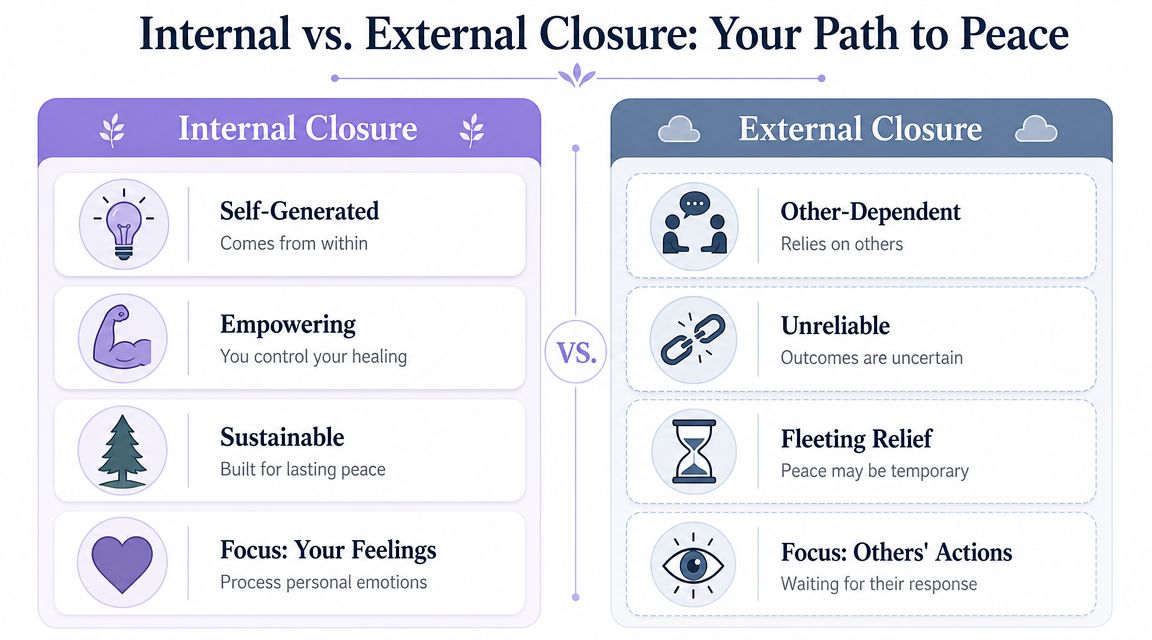
External closure
External closure is the peace you hope to receive from someone else. It usually sounds like this:
- If they explain it, I can let go.
- If they apologize, I can heal.
- If we talk one last time, I'll finally understand.
Sometimes a conversation does help. But it's unpredictable. The other person may be defensive, vague, avoidant, cold, or unable to offer the clarity you want. They may not even understand themselves well enough to tell the truth in a useful way.
And even if they do answer, your nervous system may still want more. One explanation can turn into five follow-up questions.
Internal closure
Internal closure is different. It says, “I may never receive a satisfying ending from them, but I can still create a stable ending inside myself.”
That doesn't mean pretending you don't care. It means refusing to make your peace dependent on their emotional maturity.
Here's the difference side by side:
| Path | What it depends on | Common result |
|---|---|---|
| External closure | Their honesty, timing, willingness, and insight | Temporary relief or renewed confusion |
| Internal closure | Your boundaries, reflection, acceptance, and self-trust | Slower, steadier peace |
Which path serves you now
A simple test can help. Ask yourself, “If they never answer me in the way I want, do I still want to heal?” After a long pause, the answer for many is yes.
That's the turning point in closure in relationships. You stop waiting to be emotionally released and start participating in your own release.
The moment you stop negotiating for peace is often the moment peace becomes possible.
Internal closure doesn't require agreement. It requires courage. It asks you to grieve what happened, accept what didn't happen, and build a life that isn't organized around one person's silence.
A Practical Toolkit for Creating Your Own Closure
Closure becomes real not as an idea, but as a practice. If you've been asking how to move on when you never got the answers you wanted, start here.
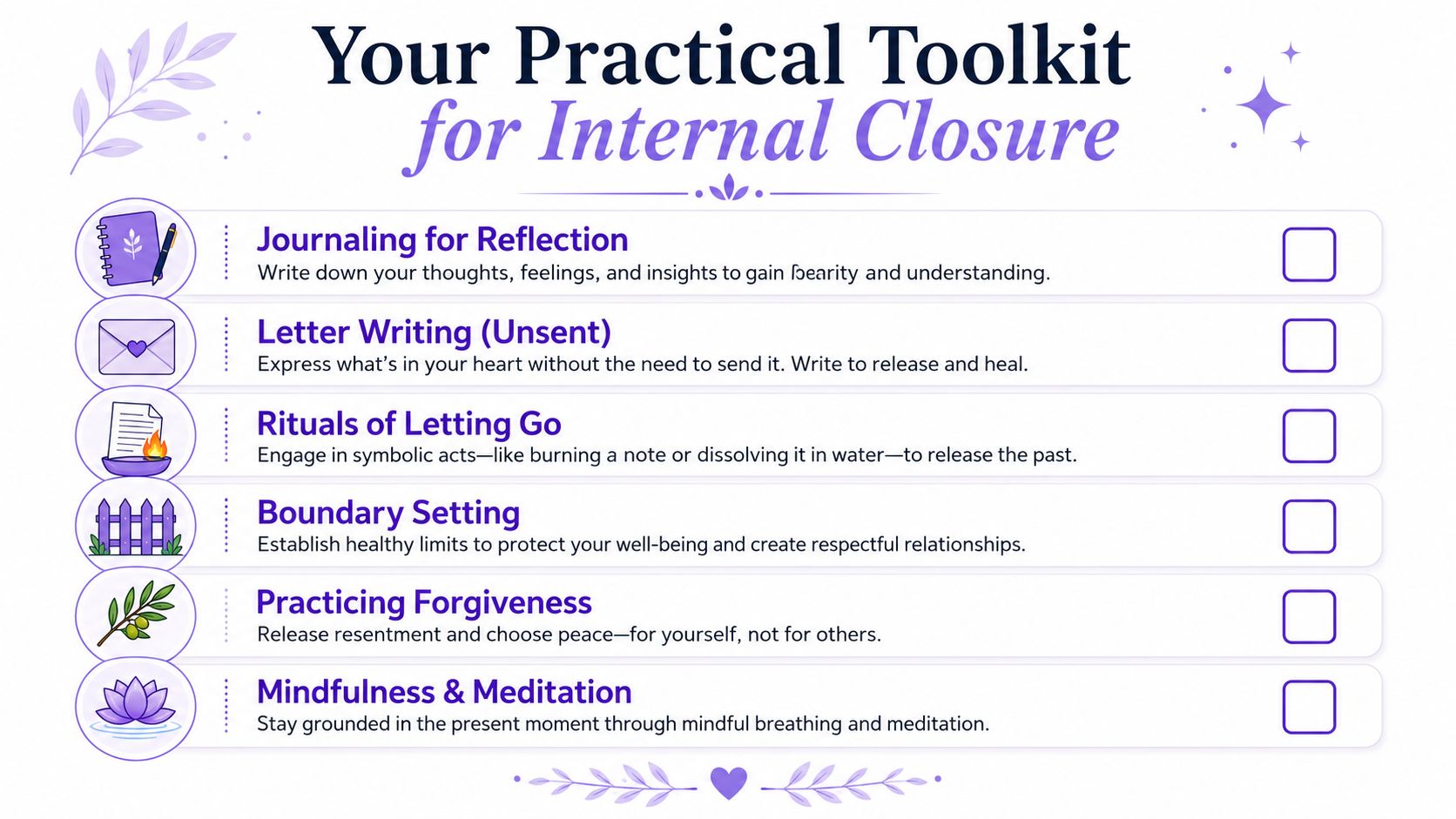
Write the story in a way your mind can hold
Rumination is often a sign that your brain is trying to organize a painful event. Journaling helps because it gives the experience a container.
Try these prompts, slowly and sincerely:
What happened, without editing it for fairness?
Write the timeline as plainly as you can.What hurt the most?
Not the whole breakup. The sharpest part.What am I still hoping they will say?
This question often reveals the unmet need beneath the obsession.What did this relationship teach me about my boundaries, needs, and patterns?
This shifts the focus from blame to learning.What is true now?
Keep this one grounded in the present tense.
If you freeze when journaling, use sentence starters. “I'm still carrying…” “I wish I had said…” “I can accept…” “I'm ready to release…”
Have the final conversation on paper
A lot of people don't need contact. They need expression.
Write an unsent letter with three parts:
What I wanted from you
Say the thing you were always trying to reach.What I didn't receive
Name the disappointment directly.What I'm giving myself now
This is the repair. Safety. Respect. Honesty. Space. Dignity.
You can keep the letter, tear it up, delete it, or place it somewhere private. The point isn't performance. The point is completion.
Say the unsaid. Then stop asking your silence to carry all the weight.
If the breakup involved ghosting and you're still tempted to reopen contact, a practical read like BetterDatingAI's dating help can help you think more clearly about what response you're seeking and whether reaching out serves your healing.
Reduce information loops
One of the most effective boundary strategies after a breakup is to reduce access points that keep your attachment system activated. Guidance from Dr. Alexandra Solomon on getting closure after a breakup recommends cutting or tightly limiting contact and cleaning up digital ties such as unfollowing, removing location access, and eliminating payment-app or camera visibility.
That may look like:
- Unfollowing or muting their accounts so your nervous system stops getting surprise jolts
- Removing digital visibility like shared albums, location sharing, and casual app access
- Deleting the draft messages you reread but never send
- Asking mutual friends for one boundary such as not updating you unless it's necessary
People often resist this because it feels harsh. Usually it's kind. You're not punishing them. You're protecting your recovery.
Build a small ritual of release
Closure responds well to ritual because the body often needs something tangible.
You might try:
- A candle ritual where you read your unsent letter aloud and then put it away
- A walk without your phone where you choose one sentence to leave behind
- A box of reminders stored out of sight until your system feels steadier
- A playlist shift where you retire songs tied to the relationship for a while
Choose something simple enough that you'll commit to it. Healing practices don't need to be dramatic to matter.
Use self-compassion when the mind loops back
Even after good progress, you'll have moments of relapse. A date on the calendar. A dream. A lonely evening. That doesn't erase your healing.
Try this three-line reset:
- This is a moment of pain.
- Pain after loss is human.
- I can be gentle with myself right now.
That's closure in relationships in its most practical form. Not forcing yourself to be over it. Meeting yourself kindly each time your mind reaches for the old story.
Rewire Your Thoughts with Daily Affirmations
Closure isn't a single breakthrough. It's repetition. You journal once, then your thoughts wander back. You set a boundary, then your heart flares up on a random Tuesday. This is why affirmations can help after the deeper reflective work is underway.
They give your mind a sentence to return to when it wants to reopen the wound.

What affirmations can do after heartbreak
A good affirmation doesn't deny reality. It doesn't say, “I'm completely over this” when you're clearly not. It offers a steadier thought that your nervous system can practice believing.
Examples that support internal closure:
- I don't need every answer to choose peace.
- Their silence is not a measure of my worth.
- I can grieve what happened and still move forward.
- I release the need to keep revisiting this story.
- I am safe to begin again.
If you want more ideas, these affirmations for emotional healing can help you build a set that feels believable and supportive.
How to make the practice stick
Affirmations work best when they're specific and repeated in daily life, not only during emotional emergencies.
A simple routine can look like this:
| Time | Practice |
|---|---|
| Morning | Read one affirmation out loud before checking messages |
| Midday | Repeat a grounding phrase when you notice rumination starting |
| Evening | Write one sentence about how you honored your healing that day |
The power is in consistency. You're not trying to hypnotize yourself into forgetting. You're training your attention to stop feeding the same painful loop.
Choose affirmations that feel one step steadier than your current thought, not ten steps beyond it.
That's how new beliefs take root. Gently. Repeatedly. Without force.
The Beginning of Your Next Chapter
Closure doesn't ask you to erase the relationship or pretend it didn't matter. It asks you to place it in your life truthfully, with compassion, and without letting it govern your present.
The more helpful question isn't “How do I get them to finally explain themselves?” It's “How do I stop living in the echo of what happened?” As discussed by Abby Medcalf in her guidance on closure, the essential work is internal acceptance and meaning-making. True closure is something you give yourself.
That can be disappointing at first. Most of us would rather receive a clean ending than build one. But there's also something immensely freeing in it. Your healing no longer waits for someone else's timing, insight, or remorse.
When you practice this kind of closure in relationships, you begin to trust yourself again. You learn that even if a story ended badly, you can still write the final page with dignity.
If you're helping a younger person build healthier inner dialogue after loss or stress, this guide to positive self-talk for students offers a thoughtful starting point. The language is simple, but the principle applies at any age. What we repeat internally shapes how we recover.
Healing may not feel neat. It may come in layers, pauses, and small brave decisions. Still, every time you choose a boundary, write the truth, resist the checking, or speak to yourself kindly, you're turning toward your next chapter.
You don't need one perfect moment of closure. You need enough self-trust to stop abandoning yourself in the search for it.
If you want gentle support while you practice new thoughts each day, download I Become from the App Store. It's a simple iOS affirmation app designed to help you rewire your inner dialogue through daily affirmations, Lock Screen widgets, and four practice modes you can use: Read, Speak, Listen, and Write. If you're healing from heartbreak and trying to create steadier inner closure, it can become a calm, repeatable ritual you return to every day.
Found this helpful? Share it with someone who might benefit.