
How to Be a Better Person: A Practical Guide for 2026
Want to be a better person but don't know where to start? This evidence-based guide offers a real plan for mindset, habits, and tracking your growth.
Some days, the wish to be a better person shows up subtly.
It might sound like, “I want to be more patient with my family.” Or, “I’m tired of reacting from stress.” Or, “I know who I want to be, but I’m not living like that consistently.” The hard part isn’t caring. The hard part is that “better person” feels so broad that it can leave you stuck before you begin.
That stuck feeling is common. You want real change, not a burst of motivation that disappears by next week. You want something steady. Something that fits inside a normal life, with work, errands, deadlines, and a mind that doesn’t always cooperate.
The good news is that growth doesn’t have to start with a dramatic reinvention. It can start with one small repeatable action, done with honesty and patience.
Your Journey to Becoming a Better You
A lot of people think personal growth begins with a big decision. In everyday life, it usually begins with a small moment of discomfort.
You snap at someone you love. You avoid a hard conversation. You promise yourself you’ll be calmer tomorrow, then repeat the same pattern. After a while, you start asking a deeper question: not “How do I fix this one bad day?” but “How do I become someone I respect more consistently?”
That question matters. It means you’re paying attention.
The encouraging part is that meaningful improvement isn’t rare or reserved for a few unusually disciplined people. Gallup’s 2024 global study found that 33% of adults worldwide are thriving, and that figure reflects an upward trend over more than a decade. Gallup also noted that this progress is tied strongly to psychological factors such as optimism and a sense of freedom, not only material conditions.
That matters because it shifts the story. Personal growth isn’t just about having perfect circumstances. It’s also about how people build inner stability, hope, and direction over time.
You don’t need a brand-new personality. You need a way to practice your values on ordinary days.
If you’ve been waiting to feel fully ready, you can stop waiting. Most change begins before confidence shows up. A kinder life is often built by someone who is still impatient sometimes. A calmer life is built by someone who still gets overwhelmed. A more honest life is built by someone who is still learning how to tell the truth gently.
Here’s a simple way to approach it:
- Better doesn’t mean flawless. It means more aligned with your values.
- Growth doesn’t mean constant progress. It means returning after you drift.
- Change doesn’t start with intensity. It starts with repetition.
That’s the path ahead. Not pressure. Practice.
The Foundation of Change Your Mindset
Before habits help you, your mindset has to stop working against you. Many people try to improve themselves while secretly running on self-disgust. That approach can create short bursts of effort, but it rarely creates a stable life.
If your inner voice says, “I should be further along,” “Why am I still like this?” or “Other people can do this, so what’s wrong with me?” then your first task isn’t trying harder. It’s learning how to relate to yourself with more honesty and less punishment.
Start with a kinder definition of better
“Better” is a dangerous word when it’s vague. If you don’t define it, your brain fills in the blank with perfection.
A healthier definition is personal and specific. Maybe being better means:
- You pause before reacting
- You tell the truth more clearly
- You follow through on small promises
- You speak to yourself with more respect
- You show more care in everyday interactions
That list will look different for each person. What matters is that your definition reflects your values, not someone else’s image.

When readers struggle with this, I often suggest finishing one sentence: “A better version of me is someone who regularly…” That wording helps because it pulls you away from fantasy and into behavior.
If you want help shaping that outlook, this guide on how to develop a growth mindset offers a useful companion perspective.
Accept the real pace of growth
One of the biggest reasons people quit is simple. They expect inner change to happen much faster than it does.
Psychology Today’s discussion of character development makes this point clearly: virtuous habits form slowly, much like mastering a complex skill. Becoming a better person isn’t an overnight shift. It’s a long process of practice, correction, and repetition.
That idea can feel disappointing at first. It’s freeing.
If growth is slow by nature, then slow progress isn’t proof that you’re failing. It’s proof that you’re doing real work. The same patience you’d offer someone learning an instrument belongs here too.
Practical rule: judge yourself less by how inspired you feel and more by whether you returned to the practice.
Replace intensity with steadiness
People often overcorrect when they want to change. They create a strict routine, promise total consistency, then crash as soon as life becomes messy.
A steadier approach works better. Think in terms of minimum actions you can do even on a difficult day.
Here’s a useful comparison:
| Approach | What it sounds like | What it usually creates |
|---|---|---|
| Intensity | “I’m changing everything starting Monday” | Pressure and rebound |
| Steadiness | “I’ll practice one small value daily” | Trust and momentum |
Steadiness might look small from the outside. Inside your life, it changes everything. It teaches your mind that growth is safe, repeatable, and possible.
Build self-compassion without making excuses
Some people hear “be kind to yourself” and worry it means lowering standards. It doesn’t. Self-compassion isn’t pretending your behavior doesn’t matter. It means telling the truth without attacking yourself.
Try the difference:
- “I handled that badly. I’m terrible at this.”
- “I handled that badly. I want to repair it and practice a different response next time.”
Only one of those responses leaves room for growth.
If you want to be a better person, don’t ask, “How can I become perfect?” Ask, “How can I become more honest, more responsible, and more consistent, while still being human?” That question gives you something solid to build on.
Building Your Daily Rituals for Growth
A good ritual doesn’t ask you to become a new person by breakfast. It gives your current self a few reliable actions that shape the day in a better direction.
That matters because personal growth often breaks down in the gap between intention and real life. You mean well, but then the alarm rings late, your inbox explodes, and the whole day feels reactive. Daily rituals help by removing guesswork.
A simple visual checklist can make this feel more concrete.
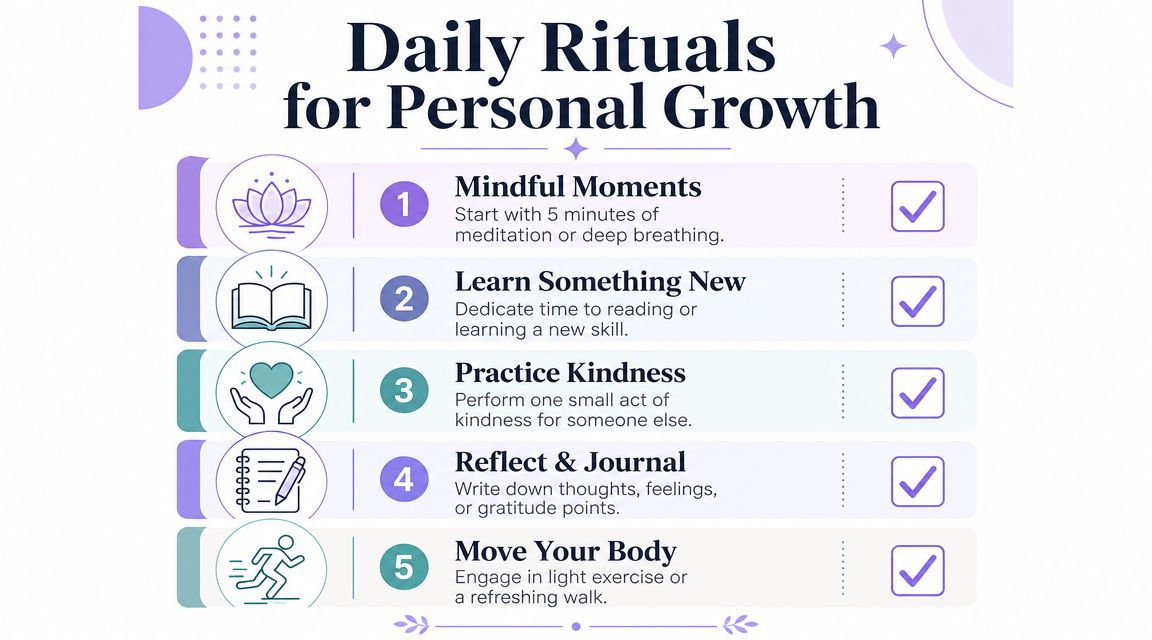
Why tiny habits matter
Shawn Achor’s positive psychology work, summarized in this article on his framework, argues that 75% of long-term success is predicted by optimism and social support. The encouraging part is that these qualities can be strengthened through very small daily actions, including a 2-minute gratitude practice or sending a brief positive message to a friend.
That’s useful because many people assume change requires long, ideal routines. It often starts with something much smaller. A ritual you’ll do beats a perfect ritual you keep postponing.
Small actions count twice. They improve your day, and they teach your brain that you are someone who shows up.
If mornings are chaotic, use this morning ritual builder to sketch a routine that fits the life you have, not the life you imagine on your most organized day.
A realistic morning rhythm
Try this sequence before checking messages if possible:
Wake and breathe
Sit up and take a few slow breaths. Don’t aim for mystical calm. Aim to arrive in your own day before the world rushes in.Name one intention
Keep it behavioral. “Today I’ll respond more patiently.” “Today I’ll speak directly.” “Today I’ll notice when I tense up.”Practice brief gratitude
Achor highlights the value of a short gratitude habit. Write down a few things you appreciate, or speak them out loud while you get ready.Create one social gesture
Send a warm text. Thank someone. Encourage a friend. Being a better person isn’t only inward. It shows up in contact.
A morning ritual like this doesn’t need to be long. It needs to be repeatable.
Here’s a short version for very busy days:
- One breath before your feet hit the floor
- One sentence intention while brushing your teeth
- One grateful thought during coffee or tea
- One kind message before opening work apps
That’s enough to shape the tone of the day.
A short video can also help if you want an easy reset during a break or commute.
An evening ritual that helps you grow
Evening habits matter because they turn experience into learning. Without reflection, days blur together and you miss the evidence that you’re changing.
Try this simple closing routine:
| Evening practice | What to ask |
|---|---|
| Review one moment | When did I act like the person I want to be? |
| Notice one miss | Where did I react instead of respond? |
| Choose one repair | Do I need to apologize, clarify, or reset tomorrow? |
| End with one kind thought | What did I do today that deserves credit? |
This kind of reflection keeps you grounded. It prevents two common mistakes: pretending everything is fine, and deciding one hard moment means you’ve made no progress.
Make your rituals friction-free
The easier a habit is to begin, the more likely you are to keep it. That’s why setup matters.
Reduce friction in plain ways:
- Place cues where you already look. Keep a notebook on your bedside table, not buried in a drawer.
- Attach habits to existing routines. Reflect while making tea, or do gratitude while waiting for your commute to start.
- Shrink the action. If journaling feels heavy, write one sentence.
- Use language you believe. Forced positivity rarely sticks. Honest encouragement does.
Some days your ritual will feel powerful. Some days it will feel ordinary. Both count. The point isn’t to feel transformed every time. The point is to practice becoming the kind of person you trust.
The Art of Empathetic Communication
You can do a lot of inner work and still hurt people with your words. That’s why growth has to leave your head and enter your conversations.
A common pattern goes like this. Someone tells you they’re upset. You interrupt to defend yourself, explain your intention, or fix the problem too quickly. You may mean well, but the other person walks away feeling unseen.
Empathetic communication starts with a different move. You slow down long enough to understand what the other person is saying.
A before and after example
Before:
Your partner says, “You haven’t really been present this week.”
You answer, “That’s not fair. I’ve been busy for us. I’m doing my best.”
Nothing outrageous happened there. But the conversation closes. Your response protects you before it understands them.
After:
Your partner says, “You haven’t really been present this week.”
You answer, “It sounds like you’ve felt alone, even though I’ve been around. Is that what you mean?”
That second response doesn’t admit guilt for everything. It makes space. It tells the other person, “I’m trying to get you right before I react.”
Listening well often means delaying your defense by one sentence.
That one sentence can change the emotional direction of an entire conversation.
What active listening sounds like
Empathy becomes practical when you can hear it. Try phrases like these:
“What I’m hearing is…”
This helps you paraphrase instead of assume.“Tell me more about that part.”
This invites detail instead of shutting things down.“I can see why that landed badly.”
This validates impact without making the exchange combative.“I need a minute, but I want to come back and talk well.”
This is much healthier than speaking from overwhelm.
If communication is a recurring stress point in your life, this article on communication issues in relationships can help you spot patterns that keep conversations tense.
How to give feedback without attacking
Being a better person doesn’t mean avoiding hard truths. It means delivering them in a way that protects dignity.
A useful structure is simple:
- Describe the behavior
- Name the impact
- Ask for a change
For example: “When meetings start and the plan changes without warning, I get confused about what you need from me. Could we agree on the key priority first?”
That lands differently from, “You’re always chaotic.”
How to receive feedback without collapsing
Receiving feedback is its own skill. Some people get defensive. Others spiral into shame. Neither response helps.
Try this instead:
| If you hear | Try saying |
|---|---|
| Something surprising | “I didn’t realize that came across that way.” |
| Something painful | “I want to sit with that instead of reacting too fast.” |
| Something useful | “Thank you for telling me directly.” |
You don’t have to agree with every criticism. But if your goal is to be a better person, you do need the ability to stay open long enough to learn.
Empathy isn’t softness without boundaries. It’s the discipline of treating another person’s experience as real, even when it’s uncomfortable for you.
Reinforce Your New Self with I Become
Wanting to change is important. Remembering to practice change every day is harder.
That’s where structure helps. A good system takes your values out of the abstract and puts them somewhere visible. It turns “I want to be more patient” into a daily action you can repeat when your mind is busy or stressed.
Move from intention to written practice
One reason people drift from their goals is that good intentions stay mental. They never become concrete enough to guide behavior when the day gets full.
Dr. Gail Matthews’ goal research found that people who write down their goals and share their progress with a friend are 76% more successful in achieving them. That’s a strong reminder that active engagement matters. Writing creates clarity. Accountability helps you return when motivation fades.
If your aim is personal growth, don’t settle for a vague goal like “be kinder.” Write a version you can practice:
- I pause before answering when I feel irritated
- I speak to myself respectfully after mistakes
- I listen fully before giving advice
- I tell the truth clearly and calmly
These statements are useful because they describe repeatable behavior.
Use the four practice modes with purpose
I Become includes Read, Speak, Listen, and Write modes. Each mode can support a different part of identity change.
Here’s a practical way to use them:
| Mode | Best use | Example |
|---|---|---|
| Read | Quick resets during the day | Read one grounding statement before a meeting |
| Speak | Building emotional conviction | Say an affirmation aloud before a hard conversation |
| Listen | Gentle reinforcement during transitions | Play affirmations while commuting or walking |
| Write | Deepening clarity and commitment | Write a statement linked to the habit you’re building |
If you’re trying to be a better person in relationships, your statements might be about patience, honesty, or warmth. If you’re trying to become more grounded, they might focus on calm, self-respect, and follow-through.
Choose affirmations that describe who you are practicing becoming, not who you’re pretending to be.
That means your words should feel believable enough to repeat, while still stretching you toward growth.
Make reminders visible and share progress
The app’s Lock Screen widgets and notifications help because they place your practice where your attention already goes. That matters on busy days, when you’re least likely to remember the values you care about.
A useful setup could look like this:
- Morning widget with one identity-based statement
- Midday notification for a short reset before stress builds
- Evening writing session to reflect on how you lived the day
- Weekly check-in shared with a trusted friend
That final piece matters. If Matthews’ findings show anything, it’s that accountability supports follow-through. A simple screenshot, message, or quick note to a friend can make your practice more real.
Used well, a tool like this doesn’t replace inner work. It supports it. It gives your better intentions a place to live each day.
Tracking Progress and Navigating Setbacks
One of the hardest parts of self-improvement is this question: How do I know if it’s working?
If you only measure progress by mood, growth can feel invisible. Some days you’ll feel calm and capable. Other days you’ll feel reactive and discouraged. Neither feeling tells the full story.
That’s why it helps to track progress in two ways at once. Look for qualitative signs in your behavior and simple measurable signs in your consistency.

Track what changed in real life
Start with questions that make growth visible. As the day concludes, write a few lines about moments that matter.
Useful prompts include:
- When was I more patient than usual today?
- Did I repair anything instead of avoiding it?
- What triggered me, and how did I respond?
- Where did I act in line with my values?
- What felt slightly easier than it used to?
These questions work because they focus on behavior, not self-image. They help you notice the small shifts that usually go unrecognized.
Use active practice, not passive exposure
There’s another reason tracking matters. It pushes you to distinguish between consuming self-help content and practicing change.
The emerging data referenced in this summary of affirmation-related findings points to a key pattern: speaking or writing affirmations outperforms passive reading by 35%, and the same source notes that 52% of users quit because they see no visible results. The lesson is practical. Active participation tends to make progress easier to notice.
A streak tracker can help here. Not because a number defines your worth, but because consistency leaves evidence. If you’ve spoken, written, or reflected for several days in a row, you have proof that you’re engaging the process instead of only thinking about it.
Growth becomes easier to trust when you can point to behavior, not just hope.
Treat setbacks as information
Individuals often turn one bad day into a verdict about who they are. That habit causes more damage than the bad day itself.
A setback usually means one of a few things:
| What happened | Better interpretation |
|---|---|
| You skipped your practice | Your system needs to be simpler |
| You reacted badly | A trigger caught you before awareness did |
| You avoided reflection | You may be tired, discouraged, or afraid of honesty |
| You lost momentum | You need a restart ritual, not self-criticism |
That distinction matters. A setback is data. It tells you where your routine is fragile, where your emotions rise fast, or where your standards may be unrealistic.
Create a restart ritual
When people fall off, they often wait for a perfect Monday, a new month, or a fresh wave of motivation. That delay keeps the gap alive.
A restart ritual should be small enough to do on the same day you notice you’ve drifted. For example:
Admit it plainly
“I’ve been off track for a few days.”Drop the drama
Don’t turn it into a character judgment.Return to the smallest version
One written reflection. One spoken affirmation. One honest check-in.Review the obstacle
Was the habit too long, poorly timed, or emotionally loaded?
This is how sustainable people grow. Not by never slipping, but by learning how to return quickly and gently.
If you want to be a better person for the long run, measure progress in patterns. Look at how often you come back, how you reflect, and whether your daily actions are moving closer to the person you want to become.
Your First Step on a Lifelong Journey
Becoming a better person isn’t a finish line you cross once. It’s a way of living with more awareness, more courage, and more responsibility.
Some days that will look like patience. Some days it will look like apologizing. On other days it may look like catching an old pattern a little earlier than you used to. That still counts.
The deeper shift is this. You stop asking whether you’ve become perfect, and you start asking whether you’re practicing what matters. That question is kinder, more honest, and far more useful.
You don’t need to transform your whole life this week. You need one clear value, one small ritual, and a willingness to return when you drift. That’s how people change in ways that last.
If you’ve read this far, you already care. That care matters. It means there’s something in you that wants to live with more intention. Trust that impulse. Give it structure. Let it become visible in your words, your habits, and your relationships.
Then begin today, not someday.
If you want a simple way to turn this into a daily practice, download I Become from the App Store. It helps you build an affirmation ritual that fits real life with Read, Speak, Listen, and Write modes, gentle reminders, Lock Screen widgets, and streak tracking that makes progress easier to see. If you’re ready to be a better person through small, steady action, I Become is a practical place to start.
Found this helpful? Share it with someone who might benefit.