
Find Your Areas of Strength: A Guide to Self-Belief
Discover your areas of strength with our step-by-step guide. Turn insights into powerful affirmations and build lasting confidence with the I Become app.
You might know this moment well. Someone praises the way you handled a hard conversation, solved a messy problem, or stayed calm when everything felt rushed. Instead of letting the compliment land, you brush it off. You say, “I just got lucky,” or “Anyone would’ve done that.”
That habit runs deep for a lot of people. We’re often taught to fix what’s wrong before we learn to trust what’s already working. So we get very skilled at spotting flaws, but not always at recognizing our own areas of strength.
The gentle shift is this. Your areas of strength are not ego. They’re not proof that you’re better than anyone else. They’re the parts of you that feel natural, energizing, and reliable. When you notice them, name them, and return to them often, self-belief starts to feel less forced and more honest.
Beyond "What Are You Good At?"
If “strengths” sounds a little too polished or corporate, it helps to bring it back to real life. An area of strength might be your ability to listen without rushing people. It might be how you organize chaos, notice patterns, stay steady under pressure, or make others feel welcome.
Those qualities matter because they shape how you move through your day. They affect how you work, relate, recover, and make decisions. They also give you something solid to stand on when self-doubt gets loud.

Why strengths matter more than most people think
A lot of personal growth advice begins with fixing weaknesses. That can be useful in small doses, but it often leaves people feeling like they are a list of problems to solve. Strengths work differently. They give you energy.
Gallup research shows that people who use their strengths every day are 6 times more likely to be engaged in their work, according to Gallup strengths data summarized here. Even if your life doesn’t revolve around work, the principle still matters. When you spend more time acting from what comes naturally to you, you usually feel more present, capable, and connected.
Practical rule: A strength is not just something you can do. It’s something you can do that also gives you energy.
What readers often confuse
Many people mix up skills, performance, and strengths.
Here’s a simple way to separate them:
| Term | What it means | Example |
|---|---|---|
| Skill | Something you’ve learned to do | Writing reports |
| Performance | How well something turned out | The report was clear and useful |
| Strength | A natural pattern in how you think, feel, or act | You organize ideas clearly and communicate calmly |
You can be skilled at something that drains you. You can also have a strength that hasn’t been fully developed yet. That’s why “What am I good at?” isn’t always the best question.
A better question is, “Where do I feel most like myself?”
That question is softer. It invites honesty instead of pressure.
Uncovering Your Unique Strengths
Finding your areas of strength doesn’t require a perfect personality test result or a dramatic breakthrough. It often starts with paying attention to ordinary moments. The clues are usually already there, scattered through your week.
VIA Character Institute research involving over 1.5 million people shows that individuals who know and use their top strengths can achieve up to 30% higher goal attainment rates and report higher life satisfaction, according to VIA Character Institute’s strengths research overview. That matters because self-awareness isn’t just nice to have. It helps you build a life that fits you better.
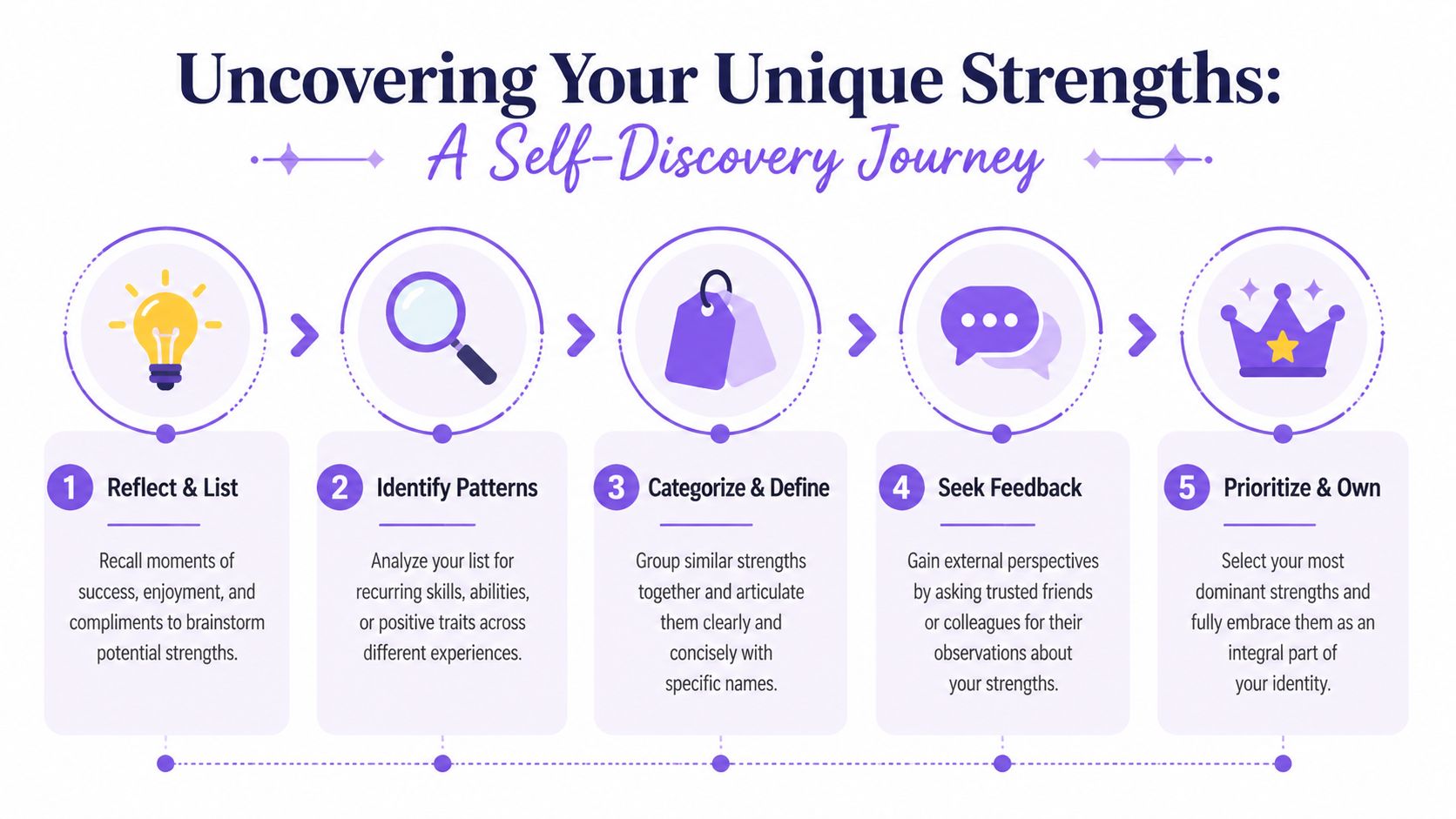
Try the flow state journal
Think about moments when you lose track of time in a good way. Not because you’re numb or distracted, but because you’re absorbed.
Flow often points toward strength. If something consistently pulls you in, there’s a good chance it matches a natural ability or style of thinking.
Use these prompts in a notebook:
- Recall one recent moment of ease: What were you doing when you felt focused, alert, and fully there?
- Notice the energy pattern: Did the activity leave you drained or more alive afterward?
- Name the hidden quality: Was the strength creativity, empathy, problem-solving, patience, leadership, or something else?
You may write, “I thought I loved planning events, but what I really love is creating calm and clarity for other people.” That’s useful. It moves you from surface activity to deeper strength.
Some strengths are easy to miss because they feel ordinary from the inside.
Build a compliment collector
Compliments can feel awkward, especially if you’re used to downplaying them. Still, they’re data. When different people notice the same quality in you, pay attention.
For one week, collect compliments without arguing with them. Don’t decide yet whether they’re “true enough.” Just record them.
Try a page with these three columns:
| What someone said | What situation it was about | Possible strength underneath |
|---|---|---|
| “You explain things so clearly” | Helping a friend make a decision | Clarity |
| “I felt better after talking to you” | A stressful phone call | Emotional steadiness |
| “You always notice what others miss” | Group project review | Attention to detail |
Patterns matter more than single comments. If several people experience you as grounding, thoughtful, or resourceful, that’s worth exploring.
Revisit childhood clues
Before you learned what looked impressive, what drew you in?
Childhood interests can uncover strengths that got buried under responsibility, comparison, or busyness. Maybe you loved arranging your room, inventing stories, helping classmates, asking endless questions, or practicing one thing over and over.
Write freely for ten minutes using these prompts:
- What did I naturally enjoy before I worried about being good at it?
- What role did I often play around others?
- What came easily to me that others seemed to find harder?
This exercise isn’t about becoming your younger self again. It’s about remembering parts of you that were visible before self-judgment got louder.
A gentle filter
If your list starts getting long, ask of each item:
- Does this feel natural?
- Does this help me or others in meaningful ways?
- Do I feel more like myself when I use it?
If the answer is yes, you’re likely looking at a real area of strength.
Validating Your Strengths with Real-World Evidence
Self-reflection is powerful, but it’s not always enough to quiet imposter syndrome. Sometimes your mind replies with, “That sounds nice, but where’s the proof?” That’s where evidence helps.
In workplace settings, strengths-based support is tied to stronger commitment, and organizations report 15 to 25% improvements in retention when people are helped to focus on strengths, according to this strengths and retention discussion. On a personal level, the same idea applies. When you validate your strengths with specific examples, you’re more likely to trust them and stay connected to them.
Start an evidence log
Choose one possible strength from your notes. Then list moments from your life that support it. Keep it plain and factual.
If your strength is “calm under pressure,” your evidence log might include:
- You stayed composed during a family emergency and handled the next steps.
- A classmate came to you before a presentation because you help people settle.
- At work, you helped untangle a last-minute issue without making everyone panic.
That’s enough. Your evidence doesn’t need to sound impressive. It only needs to be real.
Small proof counts: A strength is still a strength when it shows up in everyday moments.
Ask for specific feedback
Generic questions often lead to generic answers. “What am I good at?” can make people go blank. A better approach is to ask for one remembered moment.
You can send a short message like this:
- To a friend: “I’m reflecting on my strengths. Can you remind me of a time when I helped you in a way that stood out?”
- To a colleague: “I’m trying to get clearer on how I work best. When have you seen me add value naturally?”
- To a family member: “When do you think I seem most confident or most like myself?”
Specific stories are more useful than labels. “You’re kind” is lovely, but “You stayed with me when I was overwhelmed and helped me sort my thoughts” gives you something you can trust.
Turn vague praise into usable evidence
When someone responds, pull out the hidden pattern.
| Feedback you receive | The likely strength |
|---|---|
| “You make hard things feel manageable” | Reassurance, clarity, steadiness |
| “You always ask the question no one else asks” | Insight, curiosity, discernment |
| “You helped us finish without taking over” | Collaboration, leadership, restraint |
This process does something important. It moves strength from a fuzzy identity statement into lived memory. Once you’ve seen your strengths in action, your inner critic has less room to argue.
Crafting Affirmations That Resonate
A lot of affirmations fail for one simple reason. They’re too far away from what you currently believe.
If you’re overwhelmed and doubtful, saying “I am wildly successful in every area of life” may not feel supportive. It may feel fake. Your mind pushes back because the statement has no roots.
Personal affirmations work better when they’re built from something true. A simple formula helps:
[Specific strength] + [real evidence] = believable affirmation
Use evidence, not wishful thinking
Start with one strength from your evidence log. Then attach a concrete memory to it.
Here are a few examples:
Generic: “I am confident.”
Better: “I am growing in confidence because I’ve already handled hard conversations with honesty.”
Generic: “I am creative.”
Better: “I am creative, and I’ve shown it when I found a simple solution others hadn’t seen.”
Generic: “I am worthy.”
Better: “I am worthy of care, and the way I support others reflects the depth I bring to relationships.”
The second version gives your mind something to hold onto. It feels grounded.
Keep the language gentle
You don’t need to force a dramatic tone. Soft affirmations can be powerful.
Try these sentence starters:
- I am someone who...
- It is safe for me to trust my...
- I already carry the strength to...
- I’ve seen myself...
- More and more, I allow...
If you want more inspiration, this words of affirmation list for everyday encouragement can help you find language that sounds natural instead of overly polished.
“A believable affirmation should feel like a bridge, not a leap.”
Match the affirmation to how you practice
Some people connect most through reading. Others need to hear the words aloud, write them by hand, or listen until the message feels familiar. That difference matters.
A 2026 meta-analysis found that affirmation practice modes like speaking and listening can boost retention by up to 40% compared to just reading, according to this summary of affirmation practice modes. That suggests a simple lesson. Don’t only choose the best words. Choose the mode that helps those words settle in.
Here’s a quick guide:
- Read when you want a calm reset
- Speak when you want conviction and presence
- Listen when you’re tired or emotionally full
- Write when you want depth and reflection
A strong affirmation doesn’t try to overpower your doubt. It meets you where you are and repeats the truth with patience.
Bringing Your Strengths into Daily Life with I Become
Insight is helpful, but practice is what changes self-perception. You can identify your areas of strength beautifully and still forget them by lunchtime if nothing reminds you to return.
That’s part of why daily tools matter. Google Trends data from 2025 showed a 45% year-over-year increase in searches for “affirmations for self-confidence,” summarized in this discussion of the growing demand for practical affirmation tools. People aren’t only looking for encouraging words. They’re looking for ways to remember them consistently.

Turn your strengths into a living practice
A simple routine offers assistance. Instead of waiting until you’re discouraged, create small moments that bring your strengths back into awareness before self-doubt takes over.
A practical rhythm looks like this:
Choose one strength theme at a time
Don’t work on everything at once. Pick one area, such as steadiness, creativity, courage, or self-trust.Write two to five personalized affirmations
Use the formula from above. Keep them specific and believable.Place them where life already happens
The easier they are to see, the less effort your practice requires.Repeat in more than one mode
Seeing, saying, hearing, and writing each reinforce the message in different ways.
Why I Become fits this process so well
I Become is useful because it turns your strengths practice into something visible and repeatable, especially on busy days when reflection gets pushed aside. Instead of storing affirmations in a forgotten notes app, you can build a rhythm around them.
Features that support this especially well include:
- Personalized affirmations: You can focus your practice around the exact qualities you want to strengthen.
- Lock Screen and Home Screen widgets: Your reminders appear in the spaces you already check.
- Four practice modes: Read, Speak, Listen, and Write give you more than one way to let an affirmation sink in.
- Streaks and routine support: A little continuity helps your practice feel real, even when sessions are short.
If you want ideas for making the habit stick, this guide to building a daily practice that feels sustainable pairs well with a strengths-based routine.
A simple weekly rhythm
You don’t need a long morning ritual. A few minutes is enough if you keep returning.
Here’s one gentle example:
| Day | Practice |
|---|---|
| Monday | Read your strength affirmations before checking messages |
| Tuesday | Use Speak mode and say one affirmation out loud three times |
| Wednesday | Listen during a walk, commute, or reset break |
| Thursday | Write one affirmation by hand and add a fresh piece of evidence |
| Friday | Revisit your strongest statement and notice how it feels now |
| Weekend | Keep one widget visible and read it without pressure |
This works because it removes the feeling that growth must be dramatic. It becomes part of the texture of daily life.
What to do when you feel resistance
Some days, affirmations can feel tender. You might read a statement and hear an inner voice saying, “Not true.” Don’t fight that voice harshly. Adjust the wording until it feels honest enough to stay with.
For example:
- Instead of “I am fearless”, try “I can meet discomfort with growing courage.”
- Instead of “I never doubt myself”, try “I’m learning to trust my strengths even when doubt appears.”
That small shift changes everything. You’re not trying to dominate yourself into confidence. You’re teaching your mind a kinder way to interpret who you are.
A sustainable practice is one you can return to on ordinary days, not only inspired ones.
A few grounded ways to use the app through the day
People often assume affirmation practice belongs only in the morning. It doesn’t. Strength reminders can help most in the exact moments when old patterns return.
Try using your affirmations:
- Before a meeting or class: Read a statement tied to calm, clarity, or self-trust.
- After a mistake: Listen to an affirmation that reflects resilience rather than perfectionism.
- During a commute: Use Speak or Listen mode instead of scrolling.
- Before sleep: Write one line that reflects the strength you used that day.
That makes your areas of strength feel less like abstract traits and more like relationships you’re building with yourself.
Sustaining Momentum When Self-Doubt Creeps In
Even with a good practice, some days will feel shaky. You might forget your affirmations, question your progress, or slip back into old habits of minimizing yourself. That doesn’t mean the practice isn’t working. It means you’re human.
When self-doubt shows up, make the next step smaller. Read one affirmation instead of ten. Revisit your evidence log instead of trying to generate fresh insight. Listen instead of speaking if speaking feels too exposed.
A helpful reset is to return to facts. Not every thought deserves equal authority. If your mind says, “I’m not capable,” answer with one remembered example that says otherwise.
If imposter feelings are part of your pattern, this reflection on overcoming imposter syndrome at work can support the same strengths-based approach you’re building here.
You do not need to feel certain to practice self-belief. You only need to return.
Your areas of strength won’t erase every difficult emotion. They give you a steadier place to stand inside those emotions. Over time, that changes how you speak to yourself, how you recover from setbacks, and how willing you are to be seen as you are.
Becoming is not a one-time realization. It’s a daily act of remembering.
If you’re ready to turn self-awareness into a steady habit, download I Become from the App Store. It’s a gentle way to practice personalized affirmations through widgets, daily reminders, and Read, Speak, Listen, and Write modes, so your areas of strength stay close enough to shape how you see yourself every day.
Found this helpful? Share it with someone who might benefit.