
A Gentle Guide to Overcoming Imposter Syndrome at Work
Feel like you don't belong at work? Learn how to start overcoming imposter syndrome at work with our gentle guide to building real confidence and self-belief.
It all starts by gently recognizing that nagging feeling for what it is: a common psychological pattern, not a judgment on your actual abilities. Once you understand that this sense of being a "fraud" is a shared human experience, you can start separating the feeling from the facts. This is the first real step toward building the kind of self-belief that sticks.
That Quiet Feeling You Don’t Belong (And Why It’s So Common)
Have you ever felt it? That quiet, persistent voice in the back of your mind whispering that you’re not qualified and it’s only a matter of time before you’re found out. That’s the chill of imposter syndrome, and if you've felt it, I want you to know you are in incredibly good company. It's surprisingly common, especially among compassionate, high-achieving people.
Let's look at what this feeling really is. We're going to move past a simple definition and get to its emotional roots. The goal isn't to dismiss the feeling—it’s very real—but to stop seeing it as a true measure of your skills.
Acknowledging its presence without judgment is where the real work begins. You're not alone in this, and this is where your path to quiet confidence starts.
You Are Far From Alone
This feeling of being an "imposter" is one of the professional world's most widely shared secrets. Research shows just how many of us are silently wrestling with these feelings of self-doubt. In the United Kingdom, for example, recent data revealed that a staggering 50% of all adults have experienced imposter syndrome.
Certain fields, particularly those built on expertise and care, see even higher rates. Take the social care sector, where 60% of staff report feeling like they don't belong. The numbers also point to a clear gender gap, with 54% of women experiencing imposter syndrome compared to 38% of men. You can see more on these dynamics in this insightful report on social care trends.
This data really puts things into perspective.
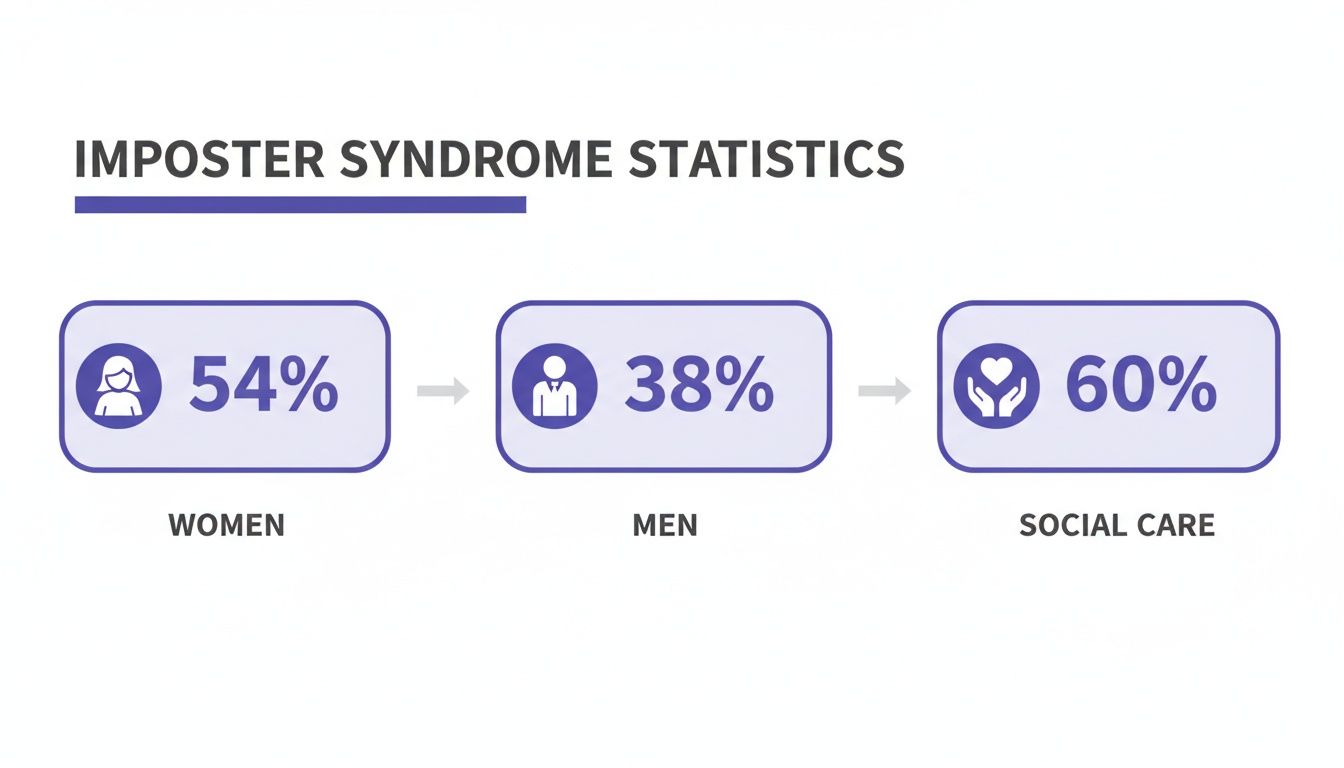
What feels like a deep, personal failing is actually a widespread professional challenge. It’s not just you.
Common Workplace Triggers
These feelings rarely just appear out of nowhere. More often than not, they’re sparked by specific situations at work that push us just outside our comfort zone. Pinpointing these triggers is a huge part of learning to manage your response.
You might notice that voice gets louder when you're:
- Starting a new job. The pressure to prove yourself in a new environment is a classic trigger for feeling like an outsider.
- Getting a promotion. Instead of celebrating, you might be questioning if you really deserved it, even though you clearly earned it.
- Leading a big project. Suddenly, all eyes are on you. It can feel incredibly exposing, making you worry that one small mistake will reveal you as a fraud.
- Receiving praise or an award. For someone with imposter syndrome, praise can cause a spike of anxiety—the feeling that you've just fooled everyone again.
The internal monologue that follows these triggers can be relentless. It’s easy to get caught in a loop of self-doubt. Let's break down what that looks like and how you can gently reframe it.
Imposter Syndrome Triggers vs. Reality
| Imposter Thought | A Kinder Reality |
|---|---|
| "They're all going to find out I don't know what I'm doing." | "I'm learning and growing. It's okay not to have all the answers right now." |
| "I just got lucky with that project. It wasn't about my skill." | "I worked hard and made smart decisions. Luck may have played a part, but my effort was the foundation." |
| "Everyone else here is so much smarter and more qualified than me." | "I bring a unique perspective and set of skills. I was hired for a reason." |
| "I can't ask for help, or they'll think I'm incompetent." | "Asking for help is a sign of strength and collaboration. Smart people ask questions." |
Seeing these thoughts written down helps expose them for what they are—distortions, not facts.
The core of imposter syndrome is a profound disconnect between your external achievements and your internal feeling of competence. You chalk your successes up to luck, timing, or simply pulling the wool over everyone's eyes.
But here’s the truth: this feeling isn't a sign of weakness. More often than not, it's a sign that you are growing, stretching your skills, and taking on new challenges.
The process of quieting that inner critic begins with this simple acknowledgment. It's about learning to hold space for the feeling without letting it write your story. By building a daily practice of gentle self-correction and intentional thought, you can start to rewire those deep-seated patterns.
This is where a dedicated tool can be a game-changer. An affirmation app like I Become helps you gently rewire your thoughts by building a new inner dialogue based on self-worth and capability. Simply reading, speaking, listening, or writing affirmations like, "I am worthy of my success," creates a powerful new mental habit.
Ready to start believing in yourself? Download I Become from the App Store and begin your journey of self-improvement today.
The Hidden Roots of Workplace Self-Doubt

That nagging feeling that you’re a fraud, just waiting to be exposed? It doesn’t just materialize out of thin air. Think of it as a deep root system, fed by a mix of our own personalities, our pasts, and often, the very environment we work in every day. Getting to the bottom of why you feel this way is the first, most compassionate step you can take toward finally feeling at home in your own success.
Imposter syndrome often takes hold in people who are incredibly conscientious and detail-oriented. You probably hold yourself to an impossibly high standard—a trait that can be both a superpower and a secret source of pain.
Perfectionism is one of the most common culprits. When you're a perfectionist, anything short of flawless can feel like a complete and utter failure. This creates a terrible trap where a 99% win is completely overshadowed by the 1% that wasn’t perfect, reinforcing that quiet, persistent thought: "See? You're not really good enough."
How Your Workplace Shapes Your Self-Perception
It’s not all in your head. Your work environment can either be a healing balm for these feelings or the very thing that magnifies them. A company that prioritizes psychological safety—where asking for help or admitting a mistake isn't a career-ender—is a powerful antidote. On the flip side, a cutthroat, ultra-competitive culture is practically a breeding ground for self-doubt.
Think about whether any of these sound familiar:
- A "Hustle" Culture: When the pressure is always on to be "on," your sense of worth gets tangled up with your productivity. One slow day can feel like concrete proof that you’re falling behind and don't belong.
- Lack of Constructive Feedback: Without regular, balanced check-ins, your mind will fill in the blanks. And it usually doesn't fill them with praise. If you only hear from your manager when something is wrong, it’s natural to assume you’re underperforming the rest of the time.
- Poorly Defined Roles: When you're not totally sure what you’re supposed to be doing or what success even looks like, you're left guessing. That constant uncertainty is the perfect recipe for feeling like you have no idea what you're doing.
This isn't just about feelings; it has a real-world impact. Research from a recent report on imposter syndrome prevalence is telling: 61% of workers struggling with these feelings are worried about making mistakes, and 30% regularly doubt their own contributions. It’s a direct line to burnout and a major reason people start looking for the exit.
The Paradox of High Achievement
It sounds backward, I know, but high achievement itself can pour fuel on the imposter syndrome fire. Instead of building your confidence, each new success can actually dial up the pressure. With every promotion or project win, that fear of being "found out" just gets louder. You might find yourself thinking, "Well, I got away with it this time, but they'll figure me out on the next one."
It’s a draining cycle: you work yourself to the bone to prove you belong, you hit the goal, and then you immediately write it off as luck or a fluke. This stops you from ever truly internalizing your accomplishments, leaving you right back where you started.
This pattern is especially common if you’ve learned to tie your self-worth to your output. It's an exhausting way to live, feeling like you’re only as good as your last deliverable. Breaking this cycle means shifting your entire mindset from one of proving to one of simply being. A great place to start is by exploring our guide on how to develop a growth mindset.
Pinpointing these roots—whether in your personality, your workplace, or the weight of your own success—is incredibly empowering. It helps you stop blaming yourself and start addressing the real causes with clarity and kindness.
This is where gentle, consistent practice can make all the difference. By consciously choosing to feed yourself thoughts that build you up, you can start to lovingly rewrite those old, tired narratives. You can make this practice feel almost effortless with a tool like the I Become app. Weaving affirmations like, "My worth is not defined by my productivity," into your morning coffee routine or your commute can help you build an entirely new foundation of self-belief.
Ready to start that gentle journey? Download I Become from the App Store and find the affirmations that speak directly to the roots of your self-doubt.
Rewire Your Inner Critic with Daily Affirmations
That little voice in your head? It's telling a story. And when you're dealing with imposter syndrome, that story is often one of self-doubt, convincing you that you’re a fraud who’s about to be found out. It can feel like you’re trapped, forced to listen to a narrator you can't stand.
But here’s a powerful truth I’ve seen change everything for people: you hold the pen. You can become the editor of your own thoughts. A conscious, daily practice of affirmations is how you gently, but firmly, start rewriting the script.
This isn't about slapping a layer of positivity over real feelings of inadequacy. It’s about choosing to plant and nurture thoughts that actually serve you, creating a kinder, more supportive inner world. This whole idea is backed by the science of neuroplasticity—your brain's incredible ability to forge new pathways. With consistency, you can literally rewire your brain to default to self-compassion.
Why This Practice Truly Works
Let's be honest, your inner critic has had years of practice. That negative feedback loop is a well-worn, automatic path in your brain. To build a new road, you need a practice that is just as consistent, but infinitely more compassionate.
That's where daily affirmations come in. They work by introducing new, constructive thoughts into your mental space.
Every time you repeat an affirmation, you’re casting a vote for a new belief about yourself. At first, it might feel awkward, even like you're lying to yourself. But with each repetition, you’re strengthening a new neural pathway, making it easier and more natural for your brain to choose self-belief over self-criticism.
The goal isn't to get into a shouting match with your inner critic. It's about gently offering an alternative. Instead of wrestling with the thought, "I don't belong here," you can simply introduce a new one: "I bring a unique and valuable perspective to my team."
Think of it like tending a garden. You're not just yanking out weeds all day; you're actively planting the flowers you want to see bloom.
Creating a Soothing Daily Ritual
For affirmations to stick, they can’t feel like another chore on your to-do list. The secret is to weave them into your day in a way that feels grounding and personal. You don’t need a ton of time—just a few intentional moments are all it takes.
The visual identity of an app like I Become is designed with this in mind. Its icon is a simple, calm reminder of the focus you’re trying to cultivate.
This gentle design reflects the entire purpose of the app: to give you a peaceful space for reflection and growth. A dedicated tool makes the practice incredibly simple and removes the guesswork, allowing you to focus on what matters.
Making Affirmations Specific to Your Work Life
Generic affirmations are a fine starting point, but the real magic happens when you get specific. Pinpoint the exact moments at work when that voice of doubt gets the loudest.
What does that look like in practice?
- Before a big presentation: Instead of spiraling, your go-to thought becomes, "I speak with confidence and clarity."
- After getting tough feedback: You reframe it with, "I welcome feedback as a powerful tool for my growth."
- When you catch yourself comparing: You ground yourself with, "My journey is my own. I am exactly where I need to be."
- That nagging "I fooled them" feeling: You counter it with, "I am competent and capable in my role. I've earned my success."
Finding the words that click for you is a personal journey. If you’re feeling stuck, you can explore hundreds of ideas with a great daily affirmation generator to discover what truly resonates.
The I Become app not only lets you choose from curated lists but also allows you to create your own affirmations. From there, it helps you turn this from a simple thought into a multisensory experience with four different practice modes:
- Read: Silently absorb your affirmations while you have your morning coffee.
- Speak: Give them power by saying them out loud in the car on your way to the office.
- Listen: Let the words wash over you through your headphones during a lunchtime walk.
- Write: Physically type them into the app, a proven method for deepening mental retention.
This approach creates a full-bodied practice that reinforces these new, empowering beliefs from every angle. It’s a gentle, supportive way to start dismantling imposter syndrome right at the source—your own mind.
Ready to build that foundation of self-belief, one thought at a time? Download I Become from the App Store and begin your journey today.
Practical Ways to Build Confidence Every Day
Real, lasting confidence isn't something you’re born with—it’s something you build. It’s not about grand, sweeping gestures, but the small, quiet habits you practice every single day.
Let’s walk through a few simple, powerful routines you can start weaving into your workday. These aren’t just theories; they are concrete actions designed to build a solid foundation of self-assurance, one day at a time.
Keep a Running List of Your Wins
That little voice in your head is an expert at one thing: erasing your wins. It dismisses your successes as "just luck" or tells you the task was "too easy." Your job is to fight back with facts.
Start what some people call an 'accomplishment log' or a 'kudos file.' It can be a simple note on your phone, a private document, or even a physical journal. The medium doesn't matter, but the habit does.
So, what do you track?
- A piece of positive feedback you got from a manager.
- The email where a client said, "Thank you!"
- That tough problem you finally cracked.
- A moment you went out of your way to help a teammate.
Writing it down makes it real. It creates a tangible record that your inner critic can't argue with. The next time you feel that wave of doubt before a big presentation, open your log. Remind yourself of what you’ve already achieved.
See "Not Knowing" as an Opportunity
Imposter syndrome turns every knowledge gap into a catastrophe. It convinces you that not knowing something is proof you don’t belong. The antidote is to intentionally shift from a 'know-it-all' mindset to a 'learn-it-all' one.
Think about this scenario: You’re in a meeting and someone mentions a project management tool you’ve never heard of.
- The Imposter Reaction: Immediate panic. You freeze up, nod along, and just hope nobody calls on you. Your inner monologue is brutal: "Everyone else knows what that is. I'm so far behind."
- The 'Learn-It-All' Response: Genuine curiosity. You make a mental note. Maybe you speak up and say, "That sounds really useful. Could you drop a link in the chat? I'd love to check it out."
That simple pivot doesn’t signal incompetence; it signals confidence. You’ve just turned a moment of potential shame into a proactive step toward growth.
True confidence isn’t about having all the answers. It’s about having the courage to seek them out. It’s about being comfortable with the beautiful, human process of learning.
Learn to Say "Thank You"
Does a compliment make you want to crawl under your desk? If your first instinct is to deflect praise with "Oh, it was a team effort" or "It was nothing, really," you’re actively training your brain to believe you're not worthy of your own success.
Learning to accept a compliment is a skill, and like any skill, it gets easier with practice. Here's a simple script. The next time your boss says, "Fantastic work on that report!" just pause, breathe, and say:
"Thank you. I’m really proud of how it turned out."
That’s it. It’s a small change, but it’s powerful. You validate the person giving the compliment, and more importantly, you give yourself permission to own your achievement. This is a core part of building a daily practice of self-worth that actually lasts.
Cultivating these new thought patterns can feel much more intentional with a little daily support. The I Become app is designed to help you build this new mental muscle with affirmations like, "I accept compliments with grace," or "I celebrate my progress, big and small."
Making these statements a small part of your morning or evening routine helps solidify these healthier ways of thinking. Download I Become from the App Store to find affirmations that feel true to you and support your journey.
Find Your Allies Through Connection and Support
That nagging feeling of being a fraud can be incredibly isolating. It’s so easy to convince yourself that you’re the only person in the room—the only one on the team—who secretly feels like they don't have a clue.
But here’s a truth I've seen play out time and time again: you don't have to carry that weight alone. In fact, trying to do so only makes it heavier.
The most powerful antidote I've found for imposter syndrome isn't just "thinking positively." It's genuine human connection. Loneliness is a magnifying glass for self-doubt, but finding your people gives you the perspective you need to see yourself—and your talents—clearly.
Why a Sense of Belonging Is Non-Negotiable
We’re all wired for connection. When we feel like we don't quite fit in at work, it’s like a wound that deepens those feelings of not being good enough. This is especially true for women, people of color, and anyone from an underrepresented group who might already be used to being "the only one" in the room.
This isn't just a feeling; it’s a well-documented phenomenon. Research consistently shows that minority groups and high-achieving professionals are among the most vulnerable to imposter syndrome, drawing a direct line between experiences of discrimination and feelings of inadequacy. A startling KPMG study found that a staggering 75% of female executives have battled imposter syndrome during their careers.
The good news? Supportive relationships are a game-changer. Studies show that something as simple as having a friend at work significantly lowers feelings of being an imposter, particularly for women. You can read more about the workplace toll of imposter syndrome here.
When you don’t see people who look like you in leadership, it’s much easier for that inner critic to whisper, “See? You don’t belong here.” Building your own support system isn't just a nice-to-have; it's a radical act of professional resilience.
Identifying Your Support System
Finding your allies isn’t about climbing a ladder. It’s about mindfully seeking out people who genuinely see you, value what you bring to the table, and make you feel safe enough to be yourself. This network usually includes a mix of people.
- Mentors: These are the seasoned guides who have walked a similar path. A great mentor doesn't just offer advice; they’re the ones who remind you of your own strengths when you’ve forgotten them.
- Peers: Think of these as your comrades in the trenches. They get the day-to-day grind of your role and can offer a level of empathy and "me too" validation that is incredibly grounding.
- Allies: An ally might not share your job title or background, but they use their influence to lift you up. They’re the ones who make sure you get credit for your ideas, amplify your voice in meetings, and champion your work when you’re not in the room.
This isn't about transactional networking. It’s about cultivating real human connections rooted in mutual respect. It’s about finding the people who help you feel more like yourself, not less.
How to Practice Gentle Vulnerability
I know, the thought of telling a colleague you feel like a fraud can be terrifying. The fear of being judged or seen as incompetent is completely real. But the key is to choose your person wisely and to open up in a way that builds a bridge, not a cry for help.
Start small, with someone you already have a bit of a rapport with—a work friend, a trusted peer. You don't have to spill your deepest insecurities all at once.
Try testing the waters over a coffee. You could say something like: "I've been wrestling with a bit of that 'imposter' feeling on this new project. Do you ever get that?"
This approach is beautiful because it does two things:
- It normalizes the experience by calling it "that 'imposter' feeling," suggesting it's a known thing.
- It creates an opening for them to share, turning a moment of your vulnerability into a moment of shared experience.
Nine times out of ten, the response you'll get is a sigh of relief and some version of, "Oh my god, all the time!" And just like that, the weight on your shoulders gets a little lighter. You realize you’re not the only one.
This support system becomes your external mirror, reflecting your true worth back at you when your internal one is clouded with doubt. As you build this external support, you can also strengthen your inner world. Weaving personalized affirmations into your routine can be a powerful and loving practice. The I Become app helps you focus on thoughts that reinforce your belonging, such as "My voice is valuable and deserves to be heard" or "I am supported by those around me."
Ready to feel more connected and confident? Download I Become from the App Store and discover affirmations that remind you that you belong.
Your Journey Toward Self-Belief and Inner Peace

Let’s be clear: this journey to quiet imposter syndrome isn't about finding a magic cure that banishes self-doubt for good. That’s an impossible standard. The real win is something much quieter and far more powerful—it’s learning to meet those familiar, shaky moments with grace instead of fear.
Think of it less as a battle to be won and more as a practice of self-compassion. You’re learning to gently turn down the volume on that harsh inner critic and listen, really listen, to your own quiet wisdom. Every time you catch a negative thought, acknowledge a small win, or have an honest chat with a colleague, you're rewiring your brain for self-trust.
It’s an Ongoing Practice, Not a Finish Line
Of course, moments of doubt will still creep in. That’s just part of being human, especially when you’re pushing yourself to grow. But the difference now? You’re not facing them empty-handed. You have real, practical tools to see those feelings for what they are: just passing clouds, not a permanent weather forecast.
You know how to spot your triggers, you have scripts ready for those tough conversations, and you’ve felt the incredible strength that comes from connection. Most importantly, you’re starting to believe that your worth isn’t measured by your last success and that asking for help is a true sign of strength. This is how lasting self-belief is built.
This whole journey is about gently, consistently, and patiently guiding yourself back to what’s true: you are worthy and you are capable. It’s choosing to believe in yourself, even when a part of you isn’t so sure.
To help keep these new, healthier thoughts front and center, you might find a daily companion like the I Become app incredibly helpful.
Weaving a simple affirmation like, “I embrace my journey with patience and self-love,” into your morning routine can make all the difference. It’s a small, gentle nudge that reminds you of the person you are becoming.
Your beautiful journey toward inner peace is already underway. Take the next step with hope. Download I Become from the App Store and keep nurturing the capable, confident person you truly are.
Frequently Asked Questions About Imposter Syndrome
As you start to tackle that nagging feeling of being a fraud, a lot of questions are bound to pop up. That’s completely normal. Let’s walk through some of the most common ones I hear and get you some real, practical answers.
Is Imposter Syndrome a Real Medical Condition?
This is a big one. While the feeling of being an imposter is incredibly real and can honestly be crushing, it’s not officially classified as a mental disorder. Think of it more as a psychological experience—a pattern of persistent self-doubt where you're always afraid of being found out.
That said, it very often travels with friends like anxiety and depression. If those feelings start to feel like too much to carry on your own, please know that talking to a mental health professional is a sign of incredible strength.
Will Telling My Boss Harm My Career?
I get this question all the time, and it’s such a valid fear. The honest answer? It really depends on your manager and your company’s culture. If you’re in a supportive, psychologically safe workplace, being vulnerable can actually build a ton of trust and open the door for some great mentorship.
You don’t have to declare, "I have imposter syndrome!" You could try framing it this way: "I'm focusing on building my confidence in [specific area] and would really value your feedback as I grow."
If you’re not sure how your boss will react, start smaller. Confide in a trusted colleague or mentor first. Just having one person in your corner can give you the courage you need to navigate the next step.
How Long Does It Take to Overcome This Feeling?
It's tempting to look for a finish line, but overcoming imposter syndrome is more of a journey than a race. For most of us, the goal isn't to silence self-doubt forever—that's probably not realistic. The real win is learning to manage it so it no longer calls the shots.
By consistently using the strategies we've talked about, like keeping a "win file" and leaning on your support system, you'll start to notice a real shift. The voice of that inner critic gets quieter, and the voice of self-compassion gets a whole lot louder. Over time, you learn to trust yourself again.
A daily affirmation practice can be a powerful and gentle anchor on this journey. With I Become, you can weave supportive thoughts into your daily routine to reinforce your true skills and worth.
Ready to start believing in yourself? Download I Become from the App Store and begin building that inner confidence today.
Found this helpful? Share it with someone who might benefit.