
Self Defeating Behaviors: End the Cycle, Rewire Your Mind
Understand your self defeating behaviors. Get practical, evidence-based steps to break the cycle and rewire your thoughts for personal growth.
You sit down to do something that matters. Send the application. Start the workout. Have the honest conversation. Open the document you’ve been avoiding for a week.
Then something small happens. You check your phone. You decide you need a better plan first. You tell yourself you work better under pressure. Hours pass, your mood dips, and the very thing you care about starts to feel heavier than before.
That experience can feel personal, almost embarrassing. It’s easy to turn it into a character judgment. “Why do I keep doing this?” “What’s wrong with me?” “Why can’t I just follow through?”
But self defeating behaviors are far more common than shame would have you believe. In a 2024 meta-analysis on self-injurious behaviors among adolescents with depression, lifetime prevalence was 52%, and in studies from 2023 to 2024 it rose to 59%. Those numbers point to something important. Harmful patterns aren’t rare quirks. They’re part of a broader human struggle, especially under stress.
That doesn’t mean every act of procrastination is self-harm, or that all forms of self-sabotage look dramatic. Many of them look ordinary. Overcommitting. Pulling away from support. Picking fights before intimacy deepens. Setting impossible standards, then collapsing under them.
If any of that feels familiar, you’re not broken. You may be caught in a pattern your mind learned for a reason.
That Familiar Feeling of Getting in Your Own Way
You might know this pattern by its everyday version.
You care about your work, so you keep revising instead of submitting. You want a calmer relationship, so you stay silent until resentment spills out sideways. You promise yourself this week will be different, then one rough day convinces you to quit the whole routine.
Self defeating behaviors often don’t look reckless from the outside. They can look careful, productive, responsible, even thoughtful. That’s part of why they’re so confusing. The behavior usually offers some kind of short-term relief while subtly undermining what matters most.
When protection starts to cost you
A person who procrastinates may not be lazy. They may be trying to avoid the discomfort of possibly doing something imperfectly.
A person who overthinks every decision may not be indecisive. They may be trying to stay safe from regret, judgment, or disappointment.
A person who pushes people away may not want less love. They may be trying to avoid the pain of feeling unwanted first.
You can know what would help and still struggle to do it. That’s not hypocrisy. It’s a sign that different parts of you are pulling in different directions.
The hard part is that these patterns often create the very outcomes you fear. Avoiding the project creates last-minute stress. Refusing help creates more isolation. Harsh self-criticism drains the energy needed to change.
Curiosity works better than blame
Many people try to solve self defeating behaviors by becoming stricter with themselves. More pressure. More shame. More internal yelling.
That approach usually backfires.
A better starting point is a gentler question: What is this behavior trying to protect me from?
That question doesn’t excuse the pattern. It helps you understand it. And understanding gives you leverage.
If you can see the behavior as a learned response rather than a fixed identity, change becomes possible. Not instantly. Not perfectly. But in a real, practical way.
What Exactly Are Self Defeating Behaviors
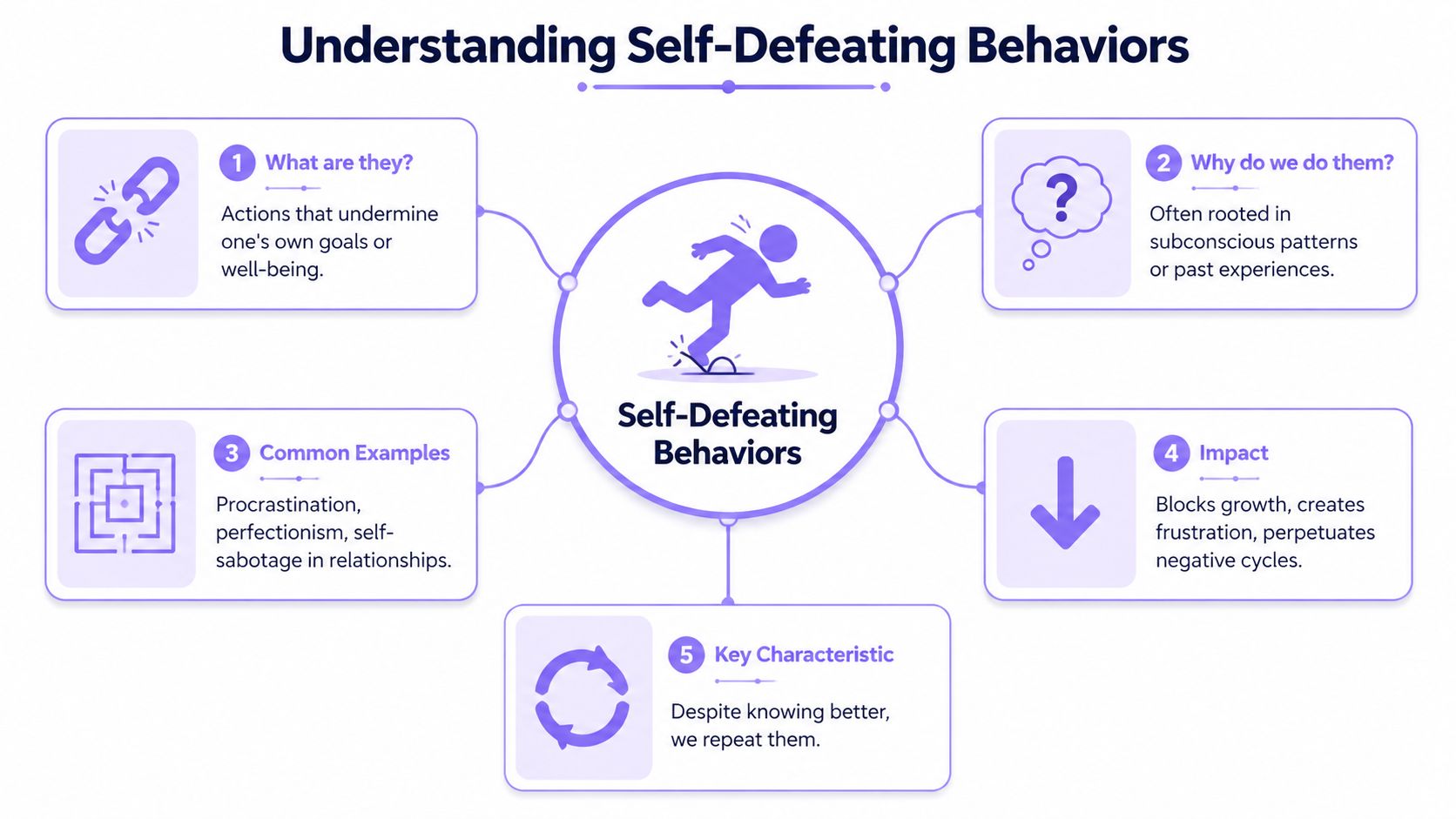
Self defeating behaviors are actions, habits, or mental patterns that work against your own goals, well-being, or values. They often give relief in the moment, but they make life harder over time.
A simple way to think about them is this: they’re like taking a path through the woods that used to lead somewhere useful, but now keeps bringing you back to the same stuck place. The path feels familiar, so your mind keeps choosing it, even when it no longer helps.
What makes a behavior self defeating
A behavior becomes self defeating when it repeatedly blocks something you want. That could be peace, connection, confidence, health, progress, or rest.
Common examples include:
- Procrastination: Delaying important action until stress becomes overwhelming
- Perfectionism: Making the standard so high that starting or finishing feels impossible
- Negative self-talk: Using criticism as if it will motivate you, when it usually drains you
- People-pleasing: Abandoning your needs to avoid conflict or rejection
- Withdrawing from support: Pulling back when help would make healing easier
- Preemptive quitting: Giving up early so failure feels chosen instead of painful
Why they can feel so irrational
It's common for individuals to get stuck because they assume, “If I know better, I should do better.” But self defeating behaviors don’t come from lack of intelligence. They usually come from learned coping.
At some point, the pattern likely did something useful for you.
Maybe perfectionism helped you earn praise. Maybe staying quiet reduced conflict. Maybe procrastination protected you from the vulnerable feeling of trying wholeheartedly and not succeeding.
That’s why these behaviors can feel so stubborn. They’re not random glitches. They’re old strategies.
Practical rule: Don’t ask only whether a behavior is harmful. Ask what job it’s been doing for you.
The difference between identity and pattern
This distinction matters. You are not “a procrastinator” in some permanent sense. You may have a procrastination pattern. You are not “too needy” or “too weak.” You may have learned ways of coping that now keep you smaller than you want to be.
Patterns can be changed. Character labels usually keep people stuck.
If you picture a deep groove in a dirt road, that’s helpful. Water naturally runs through the groove that’s already there. But with time, support, and repetition, a new path can be formed. The old groove may still exist, but it doesn’t have to control where you go next.
The Hidden Reasons We Sabotage Ourselves
The brain doesn’t always care most about your long-term goals. Often, it cares most about immediate safety.
That’s why self defeating behaviors can feel automatic, especially when life is uncertain, emotionally loaded, or personally meaningful.

Your brain under threat
According to this explanation of the neuroscience of getting in your own way, when you face uncertainty, the amygdala can trigger a stress response that temporarily knocks the prefrontal cortex off balance. The prefrontal cortex helps with planning, perspective, and self-control. At the same time, the dopamine system pushes you toward immediate relief, such as avoidance or distraction.
In plain language, your inner alarm system gets loud, and your inner planner gets quiet.
That helps explain why you can sincerely care about a future outcome and still choose the smaller comfort of scrolling, delaying, numbing out, or backing away. Your brain is leaning toward what feels safer right now.
Why short-term relief is so persuasive
Short-term relief is powerful because it works fast.
If you avoid the hard email, anxiety drops for a moment. If you criticize yourself first, you may feel oddly prepared for other people’s judgment. If you don’t try fully, you don’t have to face the full sting of possible failure.
The problem is that relief teaches the pattern to repeat.
A useful analogy is a smoke alarm that goes off every time you make toast. After a while, you don’t stop making toast because it’s dangerous. You start changing your behavior to avoid the alarm. Self defeating behaviors often work the same way. They become ways of managing internal alarm, not signs that the goal itself is wrong.
Fear isn’t always about failure
Many readers understand fear of failure. Fewer realize that fear of success can show up too.
Success can bring visibility, expectation, change, and vulnerability. If part of you equates safety with staying unnoticed, then growth can feel threatening, even when you consciously want it.
That’s why people sometimes sabotage good opportunities, healthy relationships, or moments of momentum. The nervous system may read expansion as risk.
Here’s a short visual explainer if you learn better by listening and watching.
Old conclusions can shape new choices
Self defeating behaviors also grow from faulty cognitive conclusions, the meanings you learned to attach to experiences.
You might unconsciously conclude:
- If I make mistakes, I lose love
- If I rest, I’m falling behind
- If I ask for help, I’m a burden
- If I hope too much, I’ll be crushed
- If I get close, I’ll be hurt
Those beliefs often sit below conscious awareness. But they can drive everyday decisions with surprising force.
Self sabotage often makes sense when you understand the fear it’s trying to manage.
When you see that, self-compassion gets easier. You’re not looking at a moral failure. You’re looking at a nervous system and a belief system doing their best with outdated instructions.
Common Self Defeating Patterns You Might Recognize
Some self defeating behaviors are easy to spot. Others wear disguises.
They can look like ambition, independence, self-protection, or high standards. That’s especially true for people who are capable and driven. A pattern can produce good results in one area while causing quiet damage in another.
Recent research described in this piece on self-defeating behaviors in adults noted that 37% of students and professionals derailed positive habit streaks with self-criticism after minor slips. That finding helps explain why high-achievers can stay outwardly functional while privately trapped in harsh, repeating cycles.
Common behaviors and their hidden drivers
| Behavior | What It Looks Like | Potential Underlying Fear / Belief |
|---|---|---|
| Procrastination | Delaying meaningful action until pressure is intense | “If I delay, I can avoid discomfort for now” |
| Perfectionism | Endless revising, overpreparing, difficulty finishing | “Mistakes will expose me” |
| Negative self-talk | Using harsh inner language after small setbacks | “Criticism keeps me in line” |
| People-pleasing | Saying yes when you mean no, avoiding honest limits | “If I disappoint people, I’ll lose connection” |
| Social withdrawal | Pulling back when stressed or ashamed | “It’s safer not to be seen” |
| Refusing help | Insisting on handling everything alone | “Needing support means weakness” |
| Preemptive quitting | Stopping before effort is fully tested | “If I quit first, failure hurts less” |
Patterns that often get praised
Perfectionism is a good example. In many settings, it gets rewarded. People may compliment how thorough, prepared, or conscientious you are.
But inside, perfectionism often feels like tension. You can’t begin until you feel ready. You can’t finish because it’s never good enough. You can’t enjoy the result because your mind has already moved to what wasn’t perfect.
People-pleasing can be similar. Others may see you as generous and easygoing. But if your kindness is built on self-erasure, it becomes a form of self-betrayal.
The high-achiever trap
Some of the most outwardly successful people live with intense self defeating behaviors.
They hit deadlines, build routines, and appear disciplined. Yet one missed day can trigger a spiral of self-attack. They may turn a tiny slip into a sweeping verdict about their worth.
That’s why shame-based motivation is so unstable. It can produce bursts of effort, but it rarely creates peace.
A few signs this might be happening:
- You treat small mistakes as proof of deeper failure
- You only feel safe when you’re performing well
- You rest physically, but your mind keeps punishing you
- You keep raising the bar once you reach it
- You struggle to receive encouragement without dismissing it
If a habit depends on self-criticism to survive, it usually won’t survive stress.
Recognizing your pattern isn’t about collecting flaws. It’s about learning the shape of your own stuck places so you can respond with more skill and less blame.
How to Gently Identify These Patterns in Your Life
You don’t need a dramatic breakthrough to notice self defeating behaviors. You need a softer kind of attention.
The goal isn’t to catch yourself doing life wrong. It’s to become a reliable observer of what happens just before you get pulled off course.

Look for the trigger pattern
According to this article on eliminating self-defeating behaviors, these patterns are often linked to specific times, places, or people. In other words, the behavior may not be random at all. It may be connected to a repeatable stress setup.
A simple awareness audit can help.
Try tracking these three categories for a week:
- Temporal triggers: When does the pattern show up most? Late at night, before meetings, on Sundays, after work?
- Environmental triggers: Where does it happen? At your desk, in bed, in the kitchen, during your commute?
- Social triggers: Who tends to be involved, directly or indirectly? A parent, partner, manager, friend, or even a memory of someone’s voice?
Ask better questions
Instead of “Why am I like this?” try questions that create insight.
Write down a few responses to prompts like these:
- What was I about to do when I veered off course?
- What feeling showed up first?
- What story did my mind tell me in that moment?
- What did the behavior help me avoid?
- What did it cost me afterward?
These questions help reveal the hidden exchange. Most self defeating behaviors offer immediate comfort and delayed pain.
Notice the faulty conclusion
Once you spot a repeating trigger, look underneath it for the belief attached to it.
For example:
- You avoid sending your work. The belief might be, “If it’s not excellent, I’ll be judged.”
- You cancel plans after a difficult week. The belief might be, “People don’t want me in this state when I’m struggling.”
- You stop a healthy streak after missing one day. The belief might be, “If I’m not consistent, I’ve failed.”
That belief is often the underlying pattern.
Reflection prompt: “What conclusion have I been treating as truth, even though it may only be an old fear?”
A notebook works well for this. So does a simple note on your phone. Keep it plain. You’re not writing a report. You’re gathering clues.
The more clearly you see your personal pattern, the less mysterious it becomes. And what’s less mysterious is usually less powerful.
Practical Strategies to Break the Cycle for Good
Lasting change usually doesn’t come from one dramatic promise. It comes from repeated, gentle interruptions.
If self defeating behaviors are learned responses, then the work is to teach your mind and body a different response. Not through force. Through practice.
Reframe the thought before it hardens
When a familiar thought appears, don’t argue with it endlessly. Translate it.
“I’m already behind” might become, “I’m feeling overwhelmed, and my mind is predicting disaster.”
“I ruined the streak” might become, “I had one interruption, and now shame wants to turn it into a full stop.”
That shift matters because it separates what happened from the meaning your fear assigned to it.
This is especially important after random setbacks. Psychological research discussed in this study on just-world beliefs and self-defeating responses to misfortune suggests that some people, especially those with low self-esteem, may turn bad luck into self-punishment because it feels easier to believe they caused the pain than to accept that unfair things happen. If that pattern sounds familiar, practice saying, “This was painful, but it doesn’t prove I deserved it.”
Interrupt the pattern physically
Some patterns need a mental response. Others need a body-level interruption first.
Try one of these when you notice the loop starting:
- Stand up and change rooms: A small environment shift can break autopilot.
- Name five concrete things you see: This pulls your attention back to the present moment.
- Set a tiny entry point: Open the document. Put on your shoes. Write one sentence.
- Use a timed pause: Sit with the urge for a few minutes before acting on it.
These aren’t glamorous tools. They work because they reduce the gap between awareness and action.
Replace, don’t just remove
A lot of people try to stop self defeating behaviors by eliminating the old habit without building a new one. That leaves an empty space, and old patterns rush back in.
Choose a replacement that meets the same need in a healthier way.
| Old pattern | Hidden need | Gentler replacement |
|---|---|---|
| Procrastination | Relief from overwhelm | Work for a short, defined burst |
| Self-criticism | Desire for control | Use a calm corrective statement |
| Withdrawal | Protection from exposure | Reach out to one safe person |
| Perfectionism | Safety from judgment | Submit the solid version, not the flawless one |
Build a response plan for unfair days
Some of the hardest moments aren’t caused by your mistakes. They’re caused by disappointment, rejection, bad timing, or plain bad luck.
Those are the days when self defeating behaviors often flare up.
Create a short script for those moments:
- Name it: “This feels unfair, and I’m activated.”
- Normalize it: “Anyone would feel shaken by this.”
- Refuse the false conclusion: “A setback is not evidence that I should punish myself.”
- Choose one stabilizing action: drink water, take a walk, message a trusted person, or return to one tiny task
If negative thought spirals are a major part of your pattern, this guide on how to change negative thought patterns offers useful next steps.
Change tends to stick when it feels doable enough to repeat. That’s why small experiments often beat big declarations. A calmer inner voice. A smaller first step. A quicker recovery after a wobble. Those are not minor wins. They are the new pattern forming.
How Daily Affirmations Gently Rewire Your Brain
Affirmations are often misunderstood. People hear the word and imagine forced positivity or unrealistic statements pasted over real pain.
Used well, affirmations are something quieter. They are repeated, intentional thoughts that help you practice a different inner direction.
Why repetition matters
Self defeating behaviors become familiar partly because they’ve been rehearsed. The mind has practiced certain conclusions so many times that they feel like facts.
Affirmations give you a way to rehearse something else.
Not magic. Not denial. Practice.
If your old pattern says, “I always mess things up,” a more grounded affirmation might be, “I can recover from mistakes without attacking myself.” If your mind jumps to “I’m behind again,” you might practice, “I can return to this moment without making it mean everything.”
The goal is credibility. An affirmation should feel like a step toward truth, not a sentence your nervous system instantly rejects.
What makes an affirmation effective
The best affirmations are:
- Specific enough to matter: “I can take one small step” is often more believable than sweeping declarations
- Emotionally relevant: Use words that speak to the fear underneath your pattern
- Repeated consistently: A new mental pathway strengthens through regular use
- Connected to real moments: Practice them when triggers tend to show up
That last point is important. An affirmation is strongest when it meets you near the pattern, not only after the damage is done.
A repeated compassionate thought can become a new default, especially when practiced in the exact moments old stories used to take over.
Good examples for self defeating behaviors
Here are a few affirmations that fit common patterns:
- For procrastination: “Starting small is still starting.”
- For perfectionism: “Done with care is enough for today.”
- For self-criticism: “I can correct myself without hurting myself.”
- For people-pleasing: “My needs matter, even when someone is disappointed.”
- For setbacks: “This pain is real, and it doesn’t define my worth.”
If you want a deeper look at why this practice works, the article on the science of affirmations is a helpful companion read.
Make the practice easy enough to keep
The biggest challenge with any mindset tool is consistency. Insight helps, but repetition changes things.
That’s where structure matters. A simple system can support the daily practice of reading, speaking, listening to, or writing affirmations so they become part of ordinary life instead of another task you forget. For many people, using an app can make that easier because reminders, widgets, and guided formats reduce friction and help the practice show up exactly when it’s needed.
You don’t have to wait until you fully believe a new thought to begin practicing it. Often belief grows after repetition, not before.
Embracing Imperfect Progress on Your Journey
Healing self defeating behaviors rarely looks tidy.
You notice a pattern. You interrupt it once. You forget the next three times. Then you catch it earlier. Then you respond with a little less shame. Then one day you realize a moment that used to derail you now passes with less force.
That is progress.
A kinder measure of growth
Many people judge change too harshly. They think progress means never struggling with the pattern again.
A healthier measure is this: How quickly do I notice it, and how gently can I return?
That question leaves room for real life. Stressful weeks happen. Old triggers resurface. Hard seasons can make old strategies feel tempting again. None of that cancels the work you’ve done.
What to remember on difficult days
When you slip into an old loop, try to hold onto a few truths:
- Setbacks are information: They show you where support is still needed
- Shame slows learning: A kinder response helps you recover faster
- Small returns matter: One grounded choice can shift the next hour
- Practice beats intensity: Consistency usually changes more than dramatic effort
If you’re building a steadier mindset routine, this guide on building a daily practice can help you make it sustainable.
You don’t need to become a different person overnight. You need repeated moments of meeting yourself differently.
Self defeating behaviors can feel old, powerful, and strangely personal. But they are patterns, not prophecies. They can be understood. They can be interrupted. They can be replaced.
And every time you choose awareness over autopilot, or kindness over inner punishment, you are doing more than coping. You are rewiring the path.
If you want gentle support as you build that new path, I Become can help. The iOS app makes daily affirmation practice simple with personalized statements, Lock Screen widgets, reminders throughout the day, and four practice modes: Read, Speak, Listen, and Write. If you’re ready to work with your mind more compassionately and consistently, download I Become from the App Store and begin with one small thought you’d like to practice today.
Found this helpful? Share it with someone who might benefit.