
A Morning Routine for Girls That Changes Everything
Create a personalized morning routine for girls that boosts confidence and reduces stress. This step-by-step guide covers habits, time-blocking, and mindset.

Your alarm goes off. You snooze it. Then you check your phone “for one second,” and suddenly your brain is full of other people’s opinions before your feet even hit the floor. Now you’re rushing, annoyed, and already behind. That kind of morning doesn’t just waste time. It steals your energy.
A good morning routine for girls isn’t about becoming some flawless, hyper-disciplined version of yourself. It’s about making your mornings work for you. Calm instead of chaotic. Intentional instead of reactive. Supportive instead of punishing.
You do not need a two-hour aesthetic ritual. You need a routine that helps you feel steady, clear, and confident when the day starts asking things from you.
The Magic of a Morning You Control
Most bad mornings follow the same script. You wake up half-panicked, move too fast, and spend the next hour reacting. The problem isn’t that you need more discipline. The problem is that your morning currently belongs to your alarm, your notifications, and your stress.
A better morning changes your whole tone. When you start with a few intentional actions, you feel like you’re leading the day instead of chasing it. That shift matters more than people think.

A lot of women already feel this in real life. A survey of working women found that over 90% report that their morning beauty and self-care regimen boosts their mood and energy, and 9 in 10 say it enhances their daily confidence, according to YouGov’s morning routine findings. That doesn’t mean you need a complicated beauty routine. It means the way you begin your morning affects how you carry yourself all day.
Why control matters more than perfection
You don’t need a Pinterest-worthy routine. You need a repeatable one.
If your current morning routine for girls is built around pressure, it won’t last. If it’s built around support, it probably will. That’s the standard I want you to use from now on. Not “Is this impressive?” but “Does this help me feel like myself?”
A strong morning doesn’t need to look productive from the outside. It needs to feel grounding on the inside.
What a good morning actually does
A useful routine should help you do a few simple things:
- Wake up fully instead of stumbling through the first hour.
- Lower mental noise before school, work, or social stress starts.
- Create confidence through small promises you keep.
- Protect your mood so one annoying text doesn’t ruin everything.
That’s the true magic. Not perfection. Not aesthetics. Control.
When you reclaim your morning, you stop handing the first part of your day to chaos. And once you feel that difference, it’s very hard to go back.
Designing Your Personalized Morning Routine
Copying someone else’s routine is one of the fastest ways to quit. Her life isn’t your life. Her energy isn’t your energy. Your morning routine for girls should fit your actual schedule, your stress level, and the kind of person you want to become.
Start with one question. What do you want your mornings to give you? More calm? More confidence? Less anxiety? More focus before class? More energy before work? Pick one main result. That’s your anchor.
Start with your why
If you don’t know why you’re doing a routine, every step feels random. If you do know why, even a short routine feels meaningful.
Write one sentence and keep it simple:
- For calm: “I want my mornings to feel less rushed.”
- For confidence: “I want to start the day feeling steady and capable.”
- For focus: “I want to stop giving my brain to my phone first thing.”
That sentence will help you choose habits that match your real need.
Build from three buckets
I like a simple menu. Pick one thing from each category and stop there.
Mind
This segment focuses on clearing mental clutter. Think journaling, affirmations, breathing, quiet reflection, or writing one intention for the day.Body
This is your physical wake-up call. Water, stretching, washing your face, getting dressed, light movement, or stepping into daylight all count.Soul
This is the part that makes the morning feel like yours. Music, gratitude, reading a page or two of something encouraging, or sitting in silence with your drink.
Practical rule: If your routine has too many steps, it becomes a performance instead of support.
That’s not just my opinion. Expert analysis says overly complex routines can decrease productivity by up to 30 to 50% through distraction and procrastination, while simple intention-setting can create meaningful mindset gains in just 3 minutes, as explained in this Med School Insiders breakdown of morning routine mistakes.
Keep it light enough to repeat
The biggest mistake girls make is building a routine for their ideal life instead of their real one. They create a long checklist, miss one step, then feel like the whole thing failed.
Use this filter instead:
- Can I do this on an average weekday?
- Would I still do it if I slept badly?
- Can I finish it without feeling rushed?
If the answer is no, trim it down.
If you want help turning vague goals into an actual plan, use this morning ritual builder for personalized habit ideas. It’s a smart way to avoid overcomplicating things before you’ve even started.
Sample Routines for Every Schedule
You do not need “more time” as much as you need a plan for the time you already have. Most girls get stuck because they’re trying to invent a routine while they’re half awake. That’s unnecessary. Pick a template, test it for a week, and adjust.
Research summarized by Naturepedic says an optimal average morning routine length is 30 minutes, which gives enough space to fully wake up and include habits like drinking water (60%), stretching (38%), and limiting phone scrolling, according to these healthy morning habit findings. That doesn’t mean 30 minutes is mandatory. It means 30 minutes is a strong middle ground if you have it.
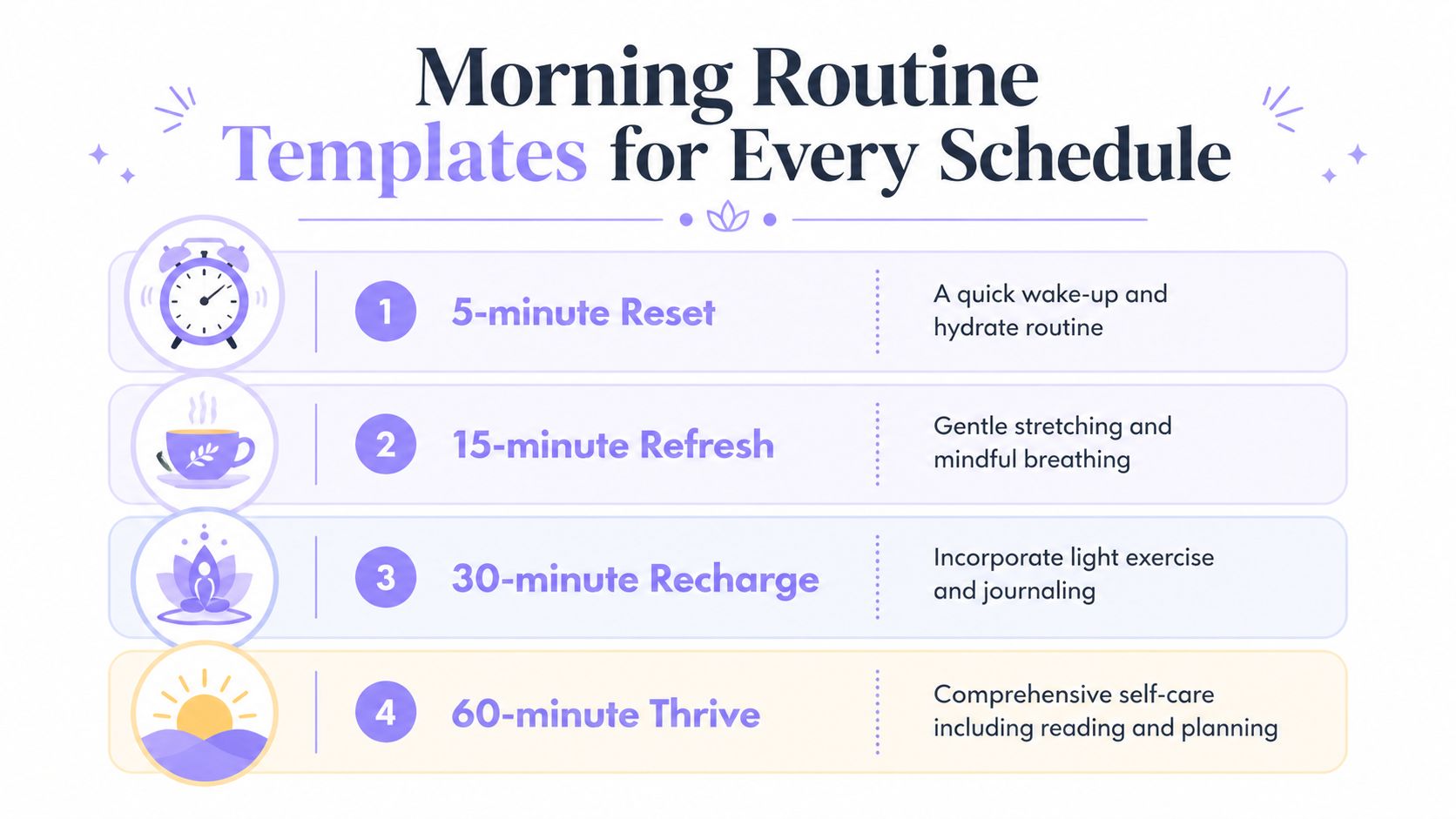
Your Morning Routine Blueprint
| Time | The 5-Minute Reset | The 15-Minute Energizer | The 30-Minute Foundation |
|---|---|---|---|
| Minute 1-5 | Water, open curtains, one deep breath cycle, say your intention out loud | ||
| Minute 6-10 | Water, wash face, stretch, no phone | ||
| Minute 11-15 | One short journal prompt or affirmations, get dressed | ||
| Minute 16-20 | Water, light movement, shower or skincare | ||
| Minute 21-25 | Affirmations or journaling, simple breakfast | ||
| Minute 26-30 | Review your day, get ready without rushing |
The 5-minute Reset
This is for the mornings when life is loud and time is tight. Keep it tiny.
- Drink water immediately so your body gets a clear wake-up signal.
- Stand and stretch for a moment instead of curling back into bed.
- Choose one sentence for the day like “I move calmly today” or “I can handle what’s in front of me.”
This routine works because it’s too small to argue with. On hard mornings, that matters.
The 15-minute Energizer
This one is ideal for school mornings, internship days, or any day when you want to feel awake without doing too much.
Try this order:
- Hydrate and wash your face
- Do a few minutes of gentle movement
- Sit still long enough to set your mind
- Get dressed before touching your phone
That last part is underrated. Once you’re physically ready, your brain catches up faster.
Your routine should help you enter the day with less negotiation.
The 30-minute Foundation
If you can give yourself half an hour, this is the sweet spot. It’s long enough to support your body and your mindset, but short enough to sustain.
A balanced version could look like this:
- Body first with water, fresh air, and light stretching
- Mind next with journaling, affirmations, or breathwork
- Practical finish with breakfast, clothes, and a quick look at your day
The 60-minute Deep Dive
This is not for every day. It’s for slower mornings, weekends, or seasons when you need more care.
Use the extra time for things that fill you up:
- Longer movement such as a walk, yoga flow, or workout
- Quiet reflection with journaling or reading
- Intentional planning so your day doesn’t feel scattered
- Unrushed self-care that helps you feel put together
The point of these templates isn’t to trap you. It’s to remove decision fatigue. Start with one. Make it yours. Then let consistency do the heavy lifting.
Mastering Your Mindset with Daily Affirmations
Here’s my strongest opinion in this whole guide. The missing piece in most morning routine for girls content is mindset. Plenty of routines tell you to hydrate, stretch, and do skincare. Fine. Helpful, even. But if your inner voice is harsh, panicked, or doubtful, you can do all the “healthy” things and still start the day feeling shaky.
That’s why affirmations matter. They interrupt the script you’ve been repeating without noticing. They give your mind something better to practice.

Why affirmations deserve a spot in your morning
A lot of popular routine content skips this entirely, and that’s a mistake. There’s clear demand for a more supportive approach. Searches for “morning affirmations for girls anxiety” saw a 45% spike, yet only 12% of popular online routines mention gratitude or positive statements, based on this cited analysis of routine content trends.
That gap says a lot. Girls don’t only need routines that make them look put together. They need routines that help them feel safe, capable, and grounded.
What to say when your brain goes negative fast
The best affirmations are believable, specific, and emotionally useful. Don’t force dramatic lines that make you roll your eyes. Start with statements that calm you down and move you forward.
Try themes like these:
For anxious mornings
“I don’t need to rush to be okay.”
“I can move through this day one step at a time.”For confidence
“I trust myself to handle what comes up.”
“I am allowed to take up space and speak clearly.”For self-worth
“My value is not based on how perfect I look today.”
“I bring something good into every room I enter.”For discipline without pressure
“I keep simple promises to myself.”
“Consistency matters more than intensity.”
If you talk to yourself badly before breakfast, the rest of the routine has to fight uphill.
A short guided practice can help if you’re not used to this yet.
Make the practice easier, not more dramatic
Affirmations work better when they’re built into your real life. Read them while your water is warming. Say them while brushing your hair. Write one down before checking messages.
If you want a starting point, this collection of morning affirmations for building a gentler start gives you language you can borrow and adapt. That’s useful because failure at mindset work isn't typically due to dislike. Instead, it often stems from not knowing what to say, leading to skipping it.
Here’s a simple morning affirmation flow that fits normal life:
- Read one affirmation slowly
- Say it out loud once or twice
- Write a short version in your notes or journal
- Repeat it during one routine action, like getting dressed or making tea
Keep your affirmations connected to action
This matters. An affirmation should not be a magic spell. It should be a direction.
If your affirmation is “I move calmly today,” prove it by not grabbing your phone immediately. If it’s “I trust myself,” prove it by making one clear decision without spiraling. If it’s “I deserve care,” prove it by eating something before you leave.
That’s how mindset starts changing. Not because you said pretty words once, but because you paired those words with behavior.
How to Stay Consistent When You Feel Like Quitting
You are not bad at routines. You probably just made one that was too big, too rigid, or too dependent on perfect energy. That’s why consistency falls apart.
The answer is not to shame yourself harder. The answer is to lower the friction and keep the habit alive.

One thing that helps a lot is making the start automatic. In a study on morning habit formation, people who had to complete a simple task like taking a photo to dismiss their alarm reached a 94.2% success rate in starting their next activity, outperforming a control group, according to the PMC study on wake-up task behavior change. The lesson is practical. Don’t rely on sleepy willpower. Create a small action that gets you moving.
Drop the all-or-nothing attitude
Missing one morning does not mean you “ruined” your routine. It means you had one off day. Girls quit because they turn a small break into a whole identity story.
Use these rules instead:
Never miss twice in a row
One missed day is life. Two starts becoming a pattern.Keep a bare minimum version
If you can’t do the full routine, do the tiny one. Water, one stretch, one affirmation. Done.Measure return speed
Don’t obsess over streak perfection. Pay attention to how quickly you come back.
Reset rule: Your routine is still yours, even after a messy morning.
Make the first minute ridiculously easy
The hardest part of any routine is beginning. So remove choices.
Good examples:
- Put your water where you can reach it immediately
- Lay out clothes or skincare the night before
- Choose one fixed affirmation for the week
- Stack your new habit onto brushing your teeth or opening the curtains
Habit stacking is particularly effective. You’re not creating a whole new life at 7 a.m. You’re attaching one supportive action to something you already do.
Expect seasons, not perfection
Some weeks you’ll have exams, work deadlines, low energy, cramps, family stress, or just a rough mood. Your routine should bend without breaking.
That means having layers:
| Kind of morning | What counts |
|---|---|
| Bare minimum | Water, one breath cycle, one affirmation |
| Normal weekday | Water, movement, mindset, get ready |
| Slower morning | Full routine with journaling or reading |
If you want a realistic way to build consistency without turning your life upside down, this guide on building a daily practice that survives real life is worth reading.
The girls who stay consistent are not the girls with perfect self-control. They’re the girls who know how to restart quickly, adapt honestly, and keep going without drama.
Your First Step to a Brighter Morning
The best morning routine for girls is not the prettiest one. It’s the one you’ll stick to, the one that helps you feel more like yourself when the day begins.
Keep the formula simple. Know why you want a routine. Pick a few habits that support your mind, body, and mood. Make it small enough to repeat. Then protect the mindset piece, because that’s usually the part that changes everything.
You do not need to earn a calm morning. You’re allowed to create one.
What to remember
- Personal beats perfect
- Simple beats complicated
- Consistent beats intense
- Mindset matters just as much as the physical steps
Your mornings are not a test. They’re a chance to care for yourself before the world gets loud. That’s why this matters. A supportive morning routine isn’t vanity, and it isn’t laziness. It’s self-respect in practice.
Start tomorrow with something small. Drink the water. Open the curtains. Say the kind sentence. Stretch for a minute. That is enough to begin.
You do not need a whole new personality. You need a better first half hour.
And once that half hour starts feeling steadier, the rest of your day often follows.
If you want a gentle tool to support your morning mindset, download I Become from the App Store. It helps you build a real affirmation practice with personalized statements, Lock Screen widgets, and simple ways to read, speak, listen to, or write your affirmations, so your mornings feel encouraging from the very first minute.
Found this helpful? Share it with someone who might benefit.