
10 Life-Changing Journal Prompts Adults
Discover 10 powerful journal prompts adults. Unlock self-reflection, build confidence, and manage anxiety for transformative journaling.

Feeling the pull to understand yourself better, but staring at an empty notebook feels more intimidating than inspiring? That’s the gap most advice skips. People talk about journaling as if the hard part is buying a notebook or finding the right pen, when the actual challenge is knowing what to do once you sit down.
A journal becomes useful when it gives your mind somewhere to go. It’s not just a place to record events. It’s a place to notice patterns, challenge old stories, calm your nervous system, and practice new ways of thinking. That’s why journal prompts adults use need more than vague questions. They need structure. They need a purpose.
That matters because journaling still isn’t a default habit for much of the population. Only about 8% of people currently keep a journal or diary, while another 22% have done it in the past, according to Habitbetter’s journaling research. In other words, many people are curious about journaling, but far fewer have found a way to make it stick.
The blank page isn’t the enemy. The lack of a method is.
These ten approaches are designed for real adult life. Some are better for confidence. Some help when anxiety is loud. Some are ideal if you’re trying to shift your mindset and want support from digital tools like affirmations, reminders, widgets, or a simple streak-based routine. Use them in a notebook, in your notes app, or alongside an app like I Become.
If you’ve tried journaling before and drifted away, start small. If you’ve never started, start gently. The point isn’t to become a perfect journaler. The point is to create a practice that helps you live differently.
1. Gratitude and Affirmation Pairing
A plain gratitude list can feel nice, but it often stays at the surface. Pairing gratitude with an affirmation gives the entry more direction. You’re not only naming what’s good. You’re also telling your mind what that good thing means about you and your life.
Start with three things you’re grateful for. Then write one affirmation under each that turns the observation into a belief you want to strengthen. If you’re grateful for your body carrying you through a long day, the paired affirmation might be, “My body is strong and capable.” If you’re grateful for a friend who checked in on you, try, “I deserve meaningful relationships.”
How to make it feel real
This method works best when the affirmation grows directly from the evidence in front of you. That keeps it from sounding like empty positivity. You’re not forcing yourself to believe something random. You’re building on what already happened.
- Grateful for support: “My friend listened when I was overwhelmed.” Affirmation: I’m worthy of care and connection.
- Grateful for effort: “I finished a task I’d been avoiding.” Affirmation: I can follow through, even when things feel heavy.
- Grateful for rest: “I gave myself a quiet evening.” Affirmation: Rest is productive for me too.
Practical rule: Don’t write a gratitude item without asking, “What does this reveal that I want to remember about myself?”
This is also a strong morning ritual. Write your gratitude pairings before the day speeds up, then repeat one of the affirmations later using I Become’s Write mode or Read mode. The journal gives you the raw material. The app helps you return to it when your mood shifts.
What works and what doesn’t
What works is specificity. “I’m grateful for today” is too vague to anchor anything. “I’m grateful that I stayed patient during a difficult conversation” gives you something solid to build on.
What doesn’t work is turning this into pressure. You don’t need dramatic gratitude. Small things count. Warm coffee. A completed errand. A calm commute. A decent night of sleep. Consistency matters more than depth every single day.
2. Mindset Shift Documentation
When a recurring thought keeps running your life, journaling needs to do more than help you vent. It needs to help you intervene. That’s where mindset shift documentation is useful.
Write down one limiting belief exactly as it appears in your mind. Don’t soften it. Then answer three follow-up prompts: Where did I learn this? What evidence challenges it? What belief would better support the life I’m trying to build?
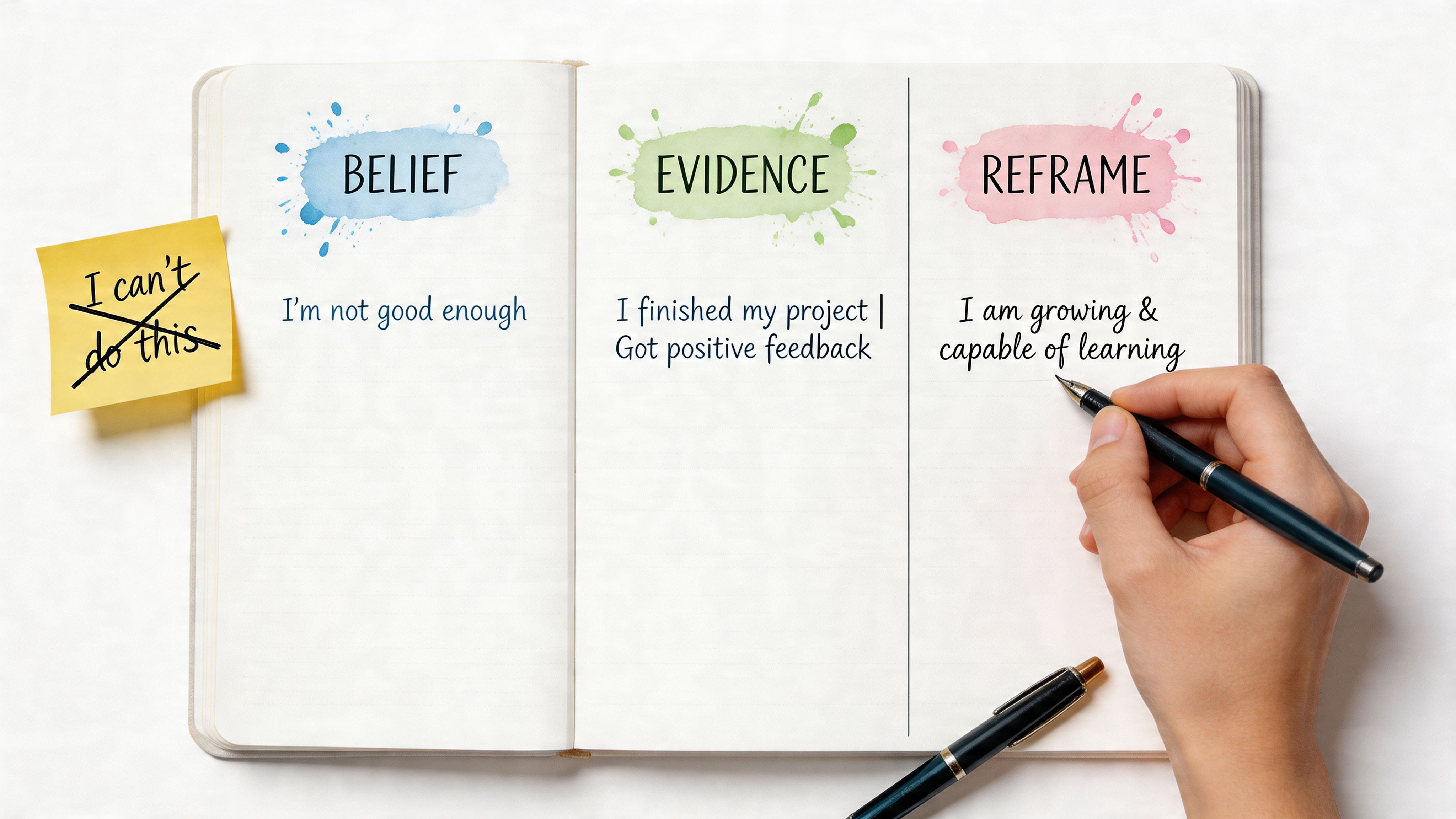
A simple example looks like this. “I’m not good enough.” Then: I learned this in environments where praise was rare and mistakes got more attention than effort. Evidence against it: I’ve completed hard projects, people trust me, and I’ve handled things I once thought I couldn’t. Reframe: “I’m capable and worthy, even while I’m still growing.”
The key is honest evidence
The middle step matters most. If you jump straight from self-criticism to a shiny affirmation, your brain may reject it. The bridge is evidence. It helps the new belief land.
You can do the same with fears about speaking up, dating, parenting, money, or visibility at work. If growth mindset is part of what you’re building, this guide on how to develop a growth mindset pairs well with this kind of reflection.
Most mindset work fails because people try to replace a thought before they’ve actually examined it.
Use one limiting belief per session. More than that usually turns into spiraling. Better to work thoroughly with one statement than skim five and change none of them.
Good reframes feel grounded
Good reframes aren’t overly polished. They feel believable enough to practice.
- Old story: “I always fail when I try something new.”
- Grounded challenge: “I’ve struggled before, but I’ve also learned quickly in unfamiliar situations.”
- New affirmation: I can grow through discomfort and learn as I go.
That’s the standard. Not perfect. Just more true, more useful, and more life-giving than the thought you started with.
3. Morning Intention Setting with Lock Screen Integration
A lot of people journal in the morning and then forget what they wrote by lunch. That’s not a character flaw. It’s just what happens when reflection has no visible reminder attached to it.
Morning intention setting solves that when you connect the journal entry to something you’ll see later. Write one to three intentions in the morning, then match them to an affirmation you place where your attention naturally goes, such as your phone’s Lock Screen. If your intention is “I’ll stay calm in today’s meeting,” your visible affirmation might reinforce steadiness, confidence, or self-trust.
A short routine that fits real life
Keep this quick. Write your intentions before checking messages if you can. They should be specific enough to guide behavior, but simple enough to remember.
For example, instead of “be better today,” try these:
- For work stress: I respond thoughtfully instead of rushing.
- For self-care: I protect my energy by taking one real pause today.
- For confidence: I speak clearly and trust my perspective.
If you want support shaping the ritual itself, the I Become morning ritual builder can help you make the habit easier to repeat.
A quick visual can also help bring this method to life:
Why this method sticks better
What helps here is frequency of contact. You set the intention once in your journal, then your phone brings it back into awareness during the day. That repeated exposure matters because AI-based tools and digital support are already part of many adults’ daily rhythms. A 2025 Menlo Ventures survey found 61% of U.S. adults had used AI tools in the past six months, with nearly one in five using them daily, according to Menlo Ventures’ report on consumer AI.
The lesson isn’t “use more tech.” It’s “use tech on purpose.” Let your journal define the intention. Let the digital tool help you remember it when your attention gets pulled elsewhere.
4. Confidence Building Through Evidence Logging
Confidence doesn’t grow because you repeat bold statements while ignoring your actual life. It grows when you collect proof that you can trust yourself. Evidence logging is one of the most practical journal prompts adults can use for that reason.
Before you go to bed, write down three moments that showed competence, courage, kindness, restraint, or follow-through. They don’t need to look impressive from the outside. In fact, this method works better when you stop waiting for dramatic wins.
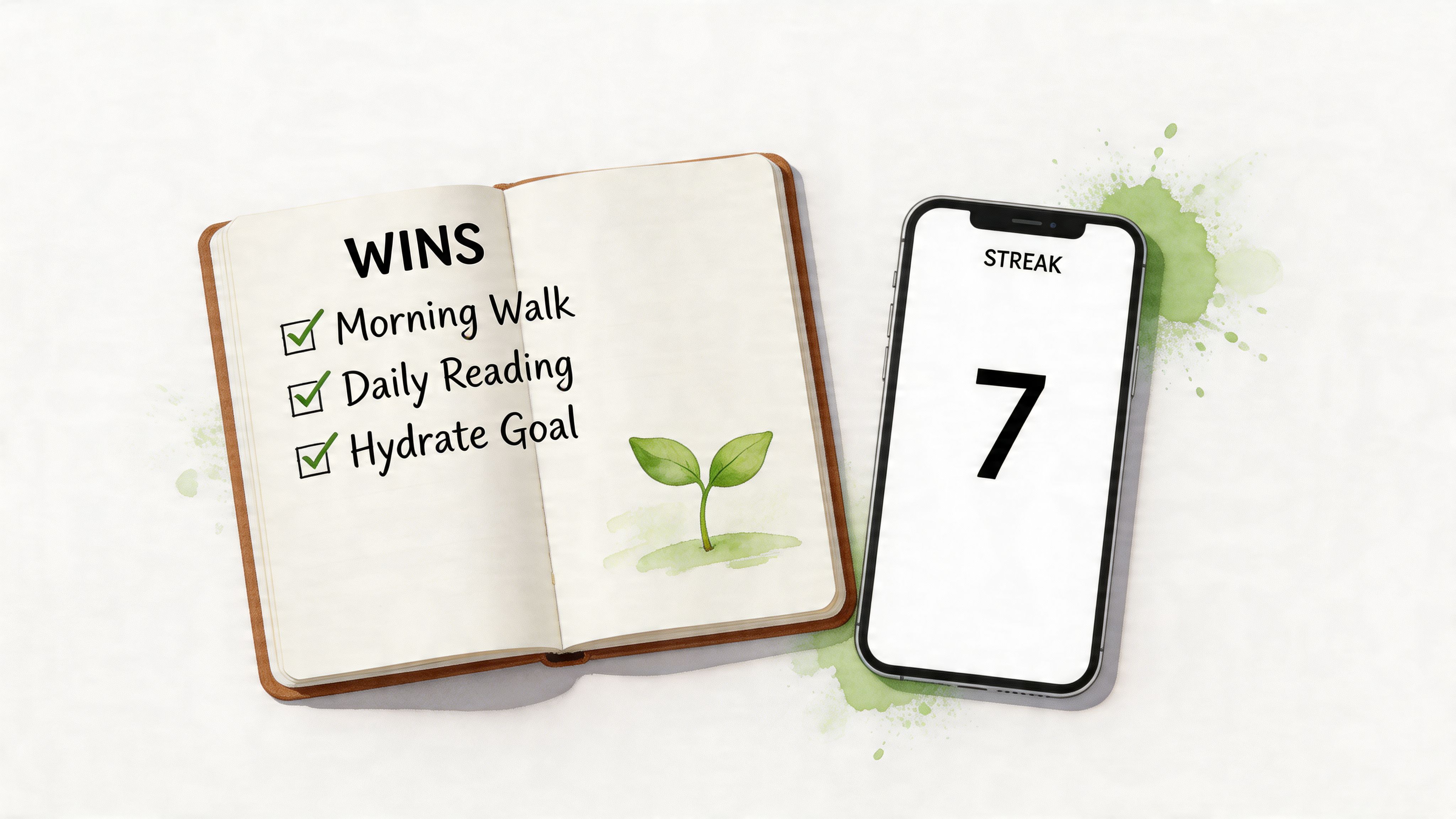
A useful entry might read, “I asked a thoughtful question in the meeting even though I felt nervous.” Then pair it with, “My perspective is valuable.” Or, “I took a walk instead of numbing out online.” Then pair it with, “I know how to care for myself.”
Tiny wins change the emotional tone
This practice is especially powerful when affirmations feel hard to believe. If “I’m confident” feels too far away, your evidence log gives you a bridge. You can say, “Today I acted with courage in one small way.” That’s often enough to shift from self-doubt to self-respect.
Try pulling examples from different areas of life:
- Work: I gave honest feedback with care.
- Relationships: I listened without trying to control the outcome.
- Health: I honored my energy instead of pushing past my limit.
Confidence often starts as remembered evidence, not felt certainty.
Make the review part count
Don’t only collect these entries. Re-read them. A weekly review helps you spot patterns your anxious brain may miss. You may notice that you keep showing up under pressure, speaking more clearly, or recovering faster from setbacks.
A streak-based app can effectively support the practice. The journal holds your proof. I Become can reinforce the matching affirmation through Speak, Listen, Read, or Write modes, especially on days when your inner critic is louder than your memory.
5. Letter Writing to Future Self
Some forms of journaling help with today’s emotions. This one helps you stay connected to the person you’re becoming. Writing to your future self creates emotional distance from the current moment, and that distance often brings clarity.
Choose a time frame. Three months is close enough to feel real. Six months works well for habit change. A year gives you room to describe bigger shifts in identity, work, relationships, or peace of mind. Then write a letter as if you’re sending encouragement forward.

Include what feels hard right now, what you hope will change, and what you want your future self to remember. You can also name the affirmations you’re practicing so the letter becomes a record of your inner work, not just your goals.
Two strong ways to use this method
The first option is a direct letter forward. You might write, “I hope you trust yourself more by then. I hope you’ve stopped apologizing for taking up space. I hope the morning routine we’re building has become second nature.”
The second option is to write from your future self back to you. That version can be surprisingly powerful because it lets you borrow confidence from the person you’re trying to grow into.
- Forward-looking letter: Name current struggles, desired change, and the values you want to live by.
- Future-self reply: Write as if growth has happened, and describe what helped most.
- Affirmation anchor: Include a few statements you want to keep practicing consistently.
Why this works so well for adults
Adults often journal only when something is wrong. A future-self letter makes room for hope without denying reality. It reminds you that your current season is not your final shape.
This method also pairs beautifully with an affirmation practice. If confidence, calm, or self-worth is your focus in I Become, put those same themes into the letter. When you eventually reread it, you’ll see not only what changed around you, but what changed inside you.
6. Affirmation Deep-Dive Journaling
Repeating an affirmation can help, but repeating it without reflection can also make it feel flat. Deep-dive journaling gives one affirmation enough space to become personal.
Pick a single statement for the week. Not five. One. Then write about it from different angles. Why does this affirmation matter right now? What part of me resists it? When do I most need it? What would it look like to live as if it were becoming true?
If the affirmation is “I am calm under pressure,” don’t stop at the sentence itself. Write about the situations that challenge your calm, the body sensations you notice, the stories you tell yourself when stress rises, and the moments when you’ve handled pressure better than expected.
Go where the resistance is
Resistance is useful information. If an affirmation makes you uncomfortable, that doesn’t mean it’s wrong. It often means it has touched something important.
For example, with “I deserve success,” your journal entry might uncover old messages about visibility, guilt about doing well, or fear that success will change how others relate to you. That’s the work. The affirmation becomes more believable when you understand why it felt difficult in the first place.
If you want a deeper look at why repeated statements can influence thought patterns over time, I Become’s article on the science of affirmations is a useful companion.
Reflection prompt: “What would change in my choices this week if I treated this affirmation as guidance instead of decoration?”
Use one affirmation across multiple modes
Digital support offers significant advantages. Journal about one affirmation reflectively, then practice that same line through different modes during the week. Read it in the morning. Listen to it on a walk. Speak it before a stressful event. Write it again at night.
That repetition has practical relevance because many adults already use AI and digital tools for idea generation and personal tasks. Brookings reports 57% of U.S. adults use generative AI for personal purposes, according to Brookings’ nationwide survey on how Americans are using AI. The useful takeaway is simple. Adults are already comfortable integrating digital tools into reflective routines, so journaling and affirmation practice don’t need to live in separate worlds.
7. Trigger Awareness and Reframe Journaling
When emotions spike fast, generic affirmations rarely land. You need something suited to the moment that keeps knocking you off center. Trigger awareness journaling helps you build that.
Write out a recent situation that activated you. Then break it into sequence: event, feeling, automatic thought, behavior, and preferred reframe. This sequence matters because most adults only notice the event and the emotion. The thought in the middle is usually what drives the spiral.
A real example might look like this: Event, critical feedback from a manager. Feeling, shame and defensiveness. Automatic thought, “I’m failing.” Behavior, overexplaining and ruminating all evening. Reframe, “Feedback helps me improve, and I’m still capable.”
Build affirmations for specific moments
This method gets stronger when you write affirmations for recurring triggers instead of broad life categories. Someone with social anxiety may need a different statement than someone who spirals after work criticism or conflict at home.
Useful examples include:
- For criticism: I can receive feedback without questioning my worth.
- For social tension: I’m allowed to be seen without performing perfection.
- For Monday stress: I can meet this day one step at a time.
Set these up where you’ll encounter them before the trigger usually happens. A morning notification, a Lock Screen widget, or a saved note can interrupt the usual chain reaction.
Keep the entry practical, not dramatic
The best trigger journaling is matter-of-fact. You’re mapping a pattern, not writing a courtroom case against yourself. Over time, you’ll start noticing the trigger earlier, sometimes even before the automatic thought fully takes over.
That’s the shift worth watching. Not “I never get triggered anymore,” but “I catch it sooner, and I have language ready when it happens.”
8. Values Alignment Reflection and Affirmation Creation
A lot of affirmations fail because they sound good but don’t belong to the person saying them. Values-based journaling fixes that by helping your statements come from what matters most to you, not from what sounds impressive online.
Start by naming three to five values you want your life to reflect. They might be honesty, steadiness, creativity, devotion, courage, compassion, freedom, or growth. Then write about what each value looks like in behavior. “I value authenticity” means very little until you define how authenticity shows up in your conversations, work, boundaries, and choices.
Let your values write the affirmation
Once your values are clear, affirmations become easier to trust. They stop sounding borrowed.
Examples:
- Authenticity: I express my true self with courage and care.
- Growth: I learn through challenge and keep moving forward.
- Connection: I build meaningful relationships by showing up honestly.
The most powerful affirmation is often the one that sounds like your values in first person.
This method is especially helpful when you feel torn between what you want and what others expect. Your journal can reveal whether a goal belongs to you or whether you’ve absorbed it from pressure, comparison, or habit.
Questions worth answering in writing
Use prompts like these when the page feels too open:
- Which values make me feel most like myself?
- Where am I living in alignment right now?
- Where am I betraying my own values to stay comfortable or approved of?
- What affirmation would help me act more in line with who I want to be?
I Become fits naturally here because you can use its Write mode to shape affirmations that feel like your own, then revisit them throughout the day. That personal fit matters more than using the most polished wording.
9. Progress Milestone Documentation and Celebration
Many adults are terrible at noticing progress while it’s happening. They move the goalpost, minimize their effort, and wait for a major breakthrough before allowing themselves to feel proud. That habit weakens motivation.
Progress milestone journaling changes the focus. Once a week, document what has shifted, both internally and externally. Maybe you spoke up faster. Maybe you recovered from a hard morning without losing the whole day. Maybe you rested without guilt. These count.
Celebrate the evidence of change
A milestone doesn’t need to be public to matter. Some of the most meaningful progress is invisible from the outside.
You might write:
- “I set a boundary without rehearsing it for hours.”
- “I noticed negative self-talk and redirected it sooner.”
- “I kept my promise to journal even when I wanted to skip it.”
This kind of reflection matters because many people abandon journaling when there’s no structure supporting consistency. One background article in the research set points to accountability as a major gap in static journaling advice. In practice, that means your review ritual matters. A streak, a reminder, a saved weekly check-in, or a repeated calendar prompt can all help you keep showing up.
Give progress a ritual
Celebration doesn’t have to be elaborate. Write a paragraph of acknowledgment. Share a small win with someone safe. Mark the moment with your favorite coffee, a walk, or a quiet pause. The point is to teach your mind to register growth instead of dismissing it.
If you use I Become, the streak counter can serve as a simple visual cue that your effort is accumulating. Pair that with your journal entry, and you create both an emotional record and a behavioral record of change.
10. Accountability and Commitment Journaling
Motivation is unreliable. A written commitment is steadier. Accountability journaling works because it asks you to decide in advance how you’ll return to the practice when life gets messy.
Write a commitment statement that answers a few direct questions. Why does this inner work matter to me right now? What exactly am I committing to? When will I practice? What usually gets in the way? How will I respond when I miss a day or lose momentum?
A strong commitment sounds clear and forgiving at the same time. For example: “I’m practicing confidence-focused affirmations daily because I’m tired of shrinking in rooms where I belong. I’ll use Read mode in the morning and Listen mode during my commute. If I miss a day, I’ll restart the next morning without making it mean something about my worth.”
Write commitments you can actually keep
Vague promises create guilt. Specific promises create traction. Don’t commit to a perfect routine you already know won’t fit your life.
Try statements like these:
- For consistency: I’ll journal for a few minutes after coffee on weekdays.
- For recovery: If I skip practice, I’ll return at the next available moment instead of waiting for Monday.
- For support: I’ll use I Become when my thoughts feel too noisy to redirect on my own.
This matters in the broader context of modern habits because adults increasingly rely on digital tools in everyday life. In a 2026 Crisis Text Line article about self-care prompts, 62% of texters with anxiety reported that journaling helps in difficult moments, according to Crisis Text Line’s piece on journal prompts for better self-care. Even without turning that into a rule for everyone, it reflects something practitioners see often. Writing can become a stabilizing anchor when emotions are moving fast.
Recommitment is part of the practice
Review your commitment regularly. Not to judge yourself, but to update the plan. Maybe your original routine was too ambitious. Maybe evenings don’t work and mornings do. Maybe speaking affirmations feels more natural than writing them. Adaptation is not failure. It’s maturity.
If you keep one principle, keep this one. Consistency beats intensity. Returning beats restarting from scratch.
10-Item Comparison of Adult Journal Prompts
| Practice | Complexity 🔄 | Resources ⚡ | Expected Outcomes ⭐ | Ideal Use Cases 💡 | Key Advantages 📊 |
|---|---|---|---|---|---|
| Gratitude and Affirmation Pairing | Low, daily 5–10 min | Minimal, journal + app | Increased positivity; reduced rumination | Quick daily ritual to deepen affirmations | Grounds affirmations in real gratitude; written progress record |
| Mindset Shift Documentation | Medium-High, 15–20 min, introspective | Moderate, structured format (3 columns), time | Reframed limiting beliefs; evidence-based affirmations | Tackling deep blocks and selecting focus areas | Personalized, CBT-aligned reframes; tracks thought evolution |
| Morning Intention Setting with Lock Screen Integration | Low, 2–3 min morning routine | Minimal, phone widget + brief journaling | Greater daily focus and accountability | Busy professionals needing on-the-go reminders | Seamless app integration; high likelihood of consistency |
| Confidence Building Through Evidence Logging | Medium, daily logging habit | Moderate, categorized tracking, searchable archive | Genuine confidence from accumulated wins | Overcoming self-doubt with concrete evidence | Tangible evidence database; pairs with streak features |
| Letter Writing to Future Self | Low-Medium, occasional sessions | Low, writing materials or digital service | Long-term commitment; perspective on growth | Long-range goal setting and reflection | Strong emotional resonance; measurable time-based check-ins |
| Affirmation Deep-Dive Journaling | Medium, weekly 15–20 min | Moderate, structured prompts, time | Deeper embodiment; clearer resistance points | Preventing rote repetition; integrating affirmations | Reveals obstacles and supports behavior change |
| Trigger Awareness and Reframe Journaling | Medium-High, mapping triggers, iterative | Moderate, time + therapeutic structure | Rapid-response affirmations; improved regulation | Frequent stressors or predictable trigger moments | Contextualized affirmations timed for real situations |
| Values Alignment Reflection and Affirmation Creation | Medium, deep values work | Moderate, reflection exercises, time | Authentic, intrinsically motivated affirmations | Aligning practice with identity and priorities | Ensures long-term motivation; value-consistent statements |
| Progress Milestone Documentation and Celebration | Low-Medium, weekly check-ins | Low, journal + simple rituals | Reinforced momentum; reward activation | Maintaining motivation and recognizing small wins | Makes progress visible; activates reward pathways |
| Accountability and Commitment Journaling | Medium, structured, ongoing reviews | Moderate, planning tools, calendar reminders | Sustained adherence; prepared for obstacles | Users needing structure to maintain consistency | Written accountability; pre-planned solutions and recommitments |
Start Your Journey, One Thought at a Time
Real change rarely begins with a dramatic breakthrough. More often, it begins with a notebook, a quiet minute, and one honest sentence. That’s why the best journal prompts adults use aren’t random questions pulled from a list. They’re methods that help you think more clearly, feel more honestly, and act more intentionally.
Some days you’ll need gratitude because your attention is stuck on what’s missing. Other days you’ll need evidence logging because your confidence is shaky. There will be seasons when trigger journaling helps you interrupt anxiety, and others when values reflection reminds you who you are beneath the noise. Different methods serve different moments. That’s a strength, not a sign that you’re inconsistent.
If you’re not sure where to begin, choose the one that matches your current need. If your inner critic is loud, start with mindset shift documentation or confidence evidence logs. If you feel scattered, try morning intention setting. If you’re craving a bigger sense of direction, write to your future self or build affirmations from your values. You don’t need to use all ten. You need one method you’ll go back to.
That’s also where digital support can make a real difference. A journal captures insight in the moment, but insight fades if nothing calls it back into your day. An affirmation app can help carry your reflection into real life. Instead of journaling something meaningful at 7 a.m. and forgetting it by 2 p.m., you can place that thought where you’ll see, hear, speak, or write it again.
I Become is especially well suited for that kind of integration. It isn’t trying to replace journaling. It complements it. You can use your journal to uncover the belief you most need, then use I Become to reinforce it through daily affirmations, Lock Screen widgets, and practice modes that match how you engage best. On one day, that might mean reading a calming statement before work. On another, it might mean speaking a confidence affirmation out loud before a meeting or writing a grounding phrase when your thoughts start to spiral.
Journaling works best when it becomes part of a living practice. Not a perfect one. A living one. A practice that adapts to your energy, your stress, your schedule, and your growth. Some entries will be deep. Some will be brief. Some will surprise you. Some will keep you steady. All of that counts.
You don’t need the perfect words to start. You don’t need to feel wise, healed, or ready. You just need a little willingness to meet yourself authentically on the page.
Your next chapter won’t write itself. But it can begin today, one thought at a time. Download I Become on the App Store, pair it with the journaling method that fits your season, and let your daily reflections become something more than passing thoughts. Let them become evidence of the person you’re becoming.
If you want gentle support turning reflection into a daily habit, try I Become. It’s a simple iOS affirmation app designed to help you rewire your thoughts with personalized affirmations, Lock Screen widgets, and four practice modes: Read, Speak, Listen, and Write. Use it alongside your journal to reinforce confidence, calm, and self-trust throughout the day.
Found this helpful? Share it with someone who might benefit.