
How to Stay Motivated at Work: A Compassionate Guide for 2026
Feeling drained? Learn how to stay motivated at work with gentle, effective strategies. Rekindle your drive with mindfulness and self-improvement tips.
Staying motivated isn't about brute force. You can’t just will yourself to be more productive. It’s a gentler process—one of reconnecting with your purpose, thoughtfully designing your days, and intentionally shifting your perspective. It’s about aligning what you do with what truly matters to you, one small step at a time.
The Quiet Crisis of Workplace Motivation

If that professional spark feels a little dim lately, you are in very good company. That familiar feeling of a heavy alarm clock, the Sunday evening dread—it’s a shared experience for so many of us. This isn't a personal failing. It’s a symptom of a much larger, quieter crisis happening in workplaces everywhere.
Realizing this is the first step toward giving yourself some grace. Motivation isn't an on/off switch. It’s a delicate ecosystem, easily influenced by outside pressures, monotonous tasks, and that little voice inside our heads. When the "why" behind our work gets fuzzy, even the simplest to-do list can feel like a mountain.
You Are Not the Problem
The data paints a surprisingly stark picture. A staggering 85% of employees across the globe are either not engaged or are actively disengaged from their jobs, according to a 2023 Gallup report. This isn't just a feeling; it has a real impact, contributing to a productivity loss estimated at an incredible $8.8 trillion globally. Dig into these employee motivation statistics, and you'll see that feeling adrift is actually the norm, not the exception.
This isn't meant to be discouraging. Just the opposite. It’s validation that what you’re feeling is real and part of a much bigger conversation. The answer isn't to just "work harder" or power through burnout. The real change comes from reclaiming your motivation from the inside out.
The most powerful shifts begin with small, consistent changes in your mindset. It's about remembering that you have the ability to gently guide your thoughts toward a more positive and empowered state.
The Power of Intention
The journey back to feeling motivated can start with a single, simple act: setting an intention for your day. Think of it as a quiet promise to yourself, a way to frame your day before the world starts making demands on it. You can't control every email, deadline, or meeting, but you absolutely can choose the energy you bring to the table.
This is about so much more than just getting through the workday. It's about fundamentally transforming your relationship with your career. Small, intentional practices can create a profound ripple effect, boosting not just your productivity but your overall sense of well-being.
Ready to start building a more encouraging inner dialogue? A great place to begin is with the I Become app for iOS. It’s a gentle way to practice daily affirmations, helping you rewire your mindset for clarity and confidence, one thought at a time. Download it from the App Store and set your first intention today.
Connect Your Work to What Truly Matters
Let's be honest, motivation isn't a switch you can just flip on. Forcing it never works. True, sustainable drive comes from a much deeper place—it sparks when your daily grind connects to something that actually matters to you. It's about finding your personal 'why'.
When your work feels out of sync with who you are, every single task can feel like a monumental effort. The secret to staying motivated is finding a way to bridge that gap, not with a huge leap, but with small, deliberate steps back to yourself.
This isn't about chasing the next promotion or a bigger paycheck, though those things are nice. It’s about pausing and asking yourself: what really lights me up here?
Find Meaning in the Everyday
Think about it. What are the moments at work that give you a genuine spark of satisfaction?
- Is it the feeling you get after finally mastering a tricky piece of software?
- The quiet pride in mentoring a junior teammate and watching them nail a presentation?
- Or maybe it’s the sense that you’re part of a project that could actually make a difference?
These pockets of meaning are already scattered throughout your workday, often hidden under a pile of routine tasks. Your job is to become a detective and seek them out. That tedious data entry project? Reframe it. You're not just plugging in numbers; you're laying the foundation for a report that will guide your team toward smarter decisions.
Every task, no matter how small it seems, can be a thread connecting you to a bigger purpose.
This isn't an overnight change, but a practice. One of the best ways I’ve found to build this muscle is through simple journaling. At the end of the day, just jot down one thing you did that felt significant or aligned with your values. It only takes a minute.
When you consciously link your daily tasks to your core values, your job stops being a list of obligations. It becomes a path for real growth and fulfillment.
Reinforce Your Purpose with Intention
Once you’ve started to identify your ‘why,’ you need to keep it front and center. Daily affirmations are an incredible tool for this—and no, this isn't about wishful thinking. It's about intentionally training your brain to focus on what empowers you.
For example, you could create a custom affirmation in the I Become app that says, "My work is a meaningful contribution to my growth" or "I find purpose in the skills I am building today."
Imagine seeing that pop up on your phone. It’s a gentle nudge, a powerful reminder that grounds you in your purpose throughout the day.
You don’t have to go all-in at once. Just start small. The goal is to consistently align what you do with who you are. Honestly, when you know why you're doing something, figuring out the how becomes so much easier.
Ready to start? You can begin this journey of reconnection by downloading I Become from the App Store and crafting your first purpose-driven affirmation.
Design Your Day for Sustainable Energy
Relying on sheer willpower to power through your workday is a recipe for burnout. It’s like trying to run a marathon on three hours of sleep—you might make it a few miles, but you’ll eventually hit a wall. A much smarter, more sustainable strategy is to design your day with your natural energy flow, not against it.
When you do this, motivation stops being something you have to chase and becomes a natural byproduct of a well-designed routine.
Think of your daily energy as a wave. It has natural peaks and valleys. Instead of fighting that tide, you can learn to ride it. This all starts with a simple, honest question: When do you really feel your best? For a lot of us, it’s that golden window in the morning. For others, creative lightning strikes in the afternoon. There’s no right answer, only your answer.
Master Your Energy with Time Blocking
Once you’ve identified your high-energy windows, you can start using one of the most powerful productivity tools I know: energy-based time blocking. The idea is beautifully simple. You schedule your most demanding, focus-heavy tasks for when you feel sharpest.
Then, you save the lower-energy stuff—like clearing out that scary inbox, organizing files, or handling administrative busywork—for your natural lulls. This tiny shift is a game-changer. It protects your best brainpower from being wasted on menial work and saves you from staring at a blank screen when it's time to tackle something that truly matters.
Trying to force productivity when your energy is gone is a direct path to exhaustion. When you design your day around your body's natural rhythms, you preserve your mental and emotional fuel, making motivation infinitely easier to come by.
This is all about connecting your daily actions back to a deeper sense of purpose. It’s not just about what you do, but why you’re doing it.
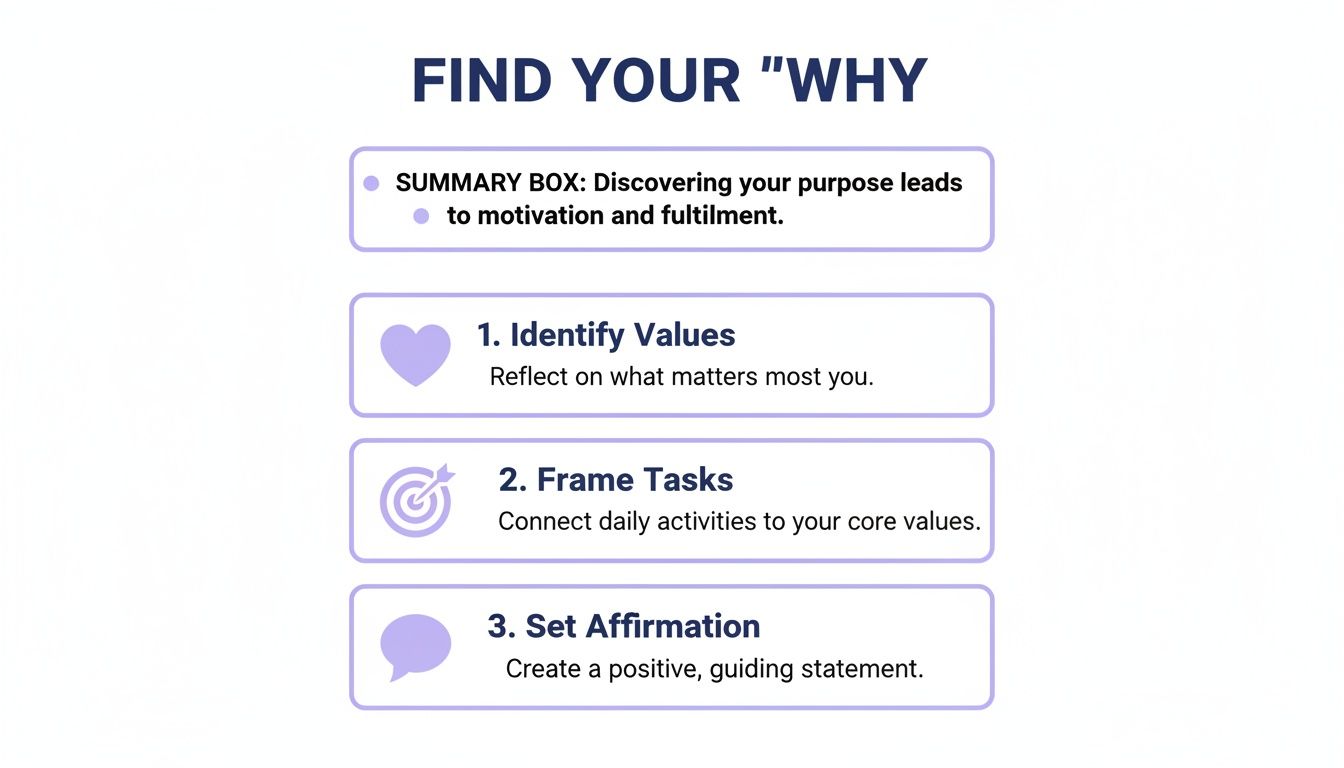
As the guide above shows, clarifying your core values and reframing how you see your tasks helps you tap into a much deeper well of energy than willpower alone ever could.
Mindful Workday Design vs The Burnout Cycle
So much of what we think of as "hard work" is actually just counterproductive. We've been conditioned to follow habits that drain our energy, leading to the all-too-familiar burnout cycle. A mindful approach flips this on its head, focusing on habits that sustain and replenish our drive.
The table below shows the difference between these two approaches. Which side feels more familiar to you?
| Habit | The Burnout Cycle (Drains Motivation) | Mindful Design (Sustains Motivation) |
|---|---|---|
| Task Planning | Tackling tasks as they appear, regardless of complexity or your energy level. | Matching high-focus tasks to peak energy windows and low-focus tasks to lulls. |
| Breaks | Working for hours without stopping or taking "breaks" to scroll social media. | Taking intentional 5-10 minute micro-breaks to stretch, breathe, or step away from the screen. |
| Transitions | Abruptly jumping from one project to another, or from work to home, feeling frazzled. | Using small rituals (like tidying your desk) to signal a mental shift and create closure. |
| Mindset | Pushing through exhaustion, believing more hours equals more output. | Listening to your body's cues and respecting the need for rest and recovery. |
Adopting the habits on the right isn't about working less; it’s about working smarter. It’s about creating a structure that supports you, rather than one you have to constantly fight against.
Don't Forget Micro-Breaks and Transition Rituals
Knowing how to stay motivated also means knowing when to stop. Pushing through hour after hour without a real pause doesn't make you more productive—it just makes you tired. The real secret is embracing micro-breaks and transition rituals.
A micro-break is a short, deliberate pause of 5-10 minutes completely away from your screen. This isn’t about trading one screen for another (put the phone down!). It's about letting your mind truly reset.
- Stand up and stretch by a window, focusing on your breathing.
- Put on one song—your absolute favorite—and just listen.
- Do nothing for five minutes. Just sit and let your mind wander without an agenda.
Transition rituals are just as vital. These are tiny routines that signal to your brain that it's time to shift gears—whether you're moving from a big client project to an internal meeting or, crucially, from work mode to home mode. Something as simple as tidying your desk and reviewing your to-do list for tomorrow can create a powerful sense of closure and peace.
Building a mindful routine is a practice, not a one-time fix. If you're looking for some ideas to get started, our free morning ritual builder can offer some great inspiration for building more intention into your day.
Ultimately, when you learn to manage your energy instead of just your time, you create a work life that actually supports you. When your day is designed with care, motivation is no longer a battle. It becomes a steady, quiet hum in the background of everything you do.
Celebrate Small Wins to Fuel Your Momentum
If you're looking for the single biggest secret to staying motivated, it isn't some grand, earth-shattering strategy. It's much simpler. It's progress. That quiet, powerful feeling of moving forward, even just a little bit, creates a positive feedback loop in our brain that makes us eager for more.
We've all been there—staring down a massive project that feels completely overwhelming. The sheer size of it can be paralyzing. The trick is to stop looking at the entire mountain and just focus on the very first stone you need to move.
This means breaking that intimidating goal into almost laughably small micro-goals. Forget adding "Complete Q3 Report" to your to-do list. Instead, break it down: "Gather sales data," "Create the first chart," and "Write the introduction paragraph." Each time you tick off one of these smaller tasks, you get a little jolt of accomplishment that proves you are moving forward.
Make Your Progress Impossible to Ignore
Seeing is believing, especially when it comes to motivation. You need to make your progress tangible, something you can actually see and feel.
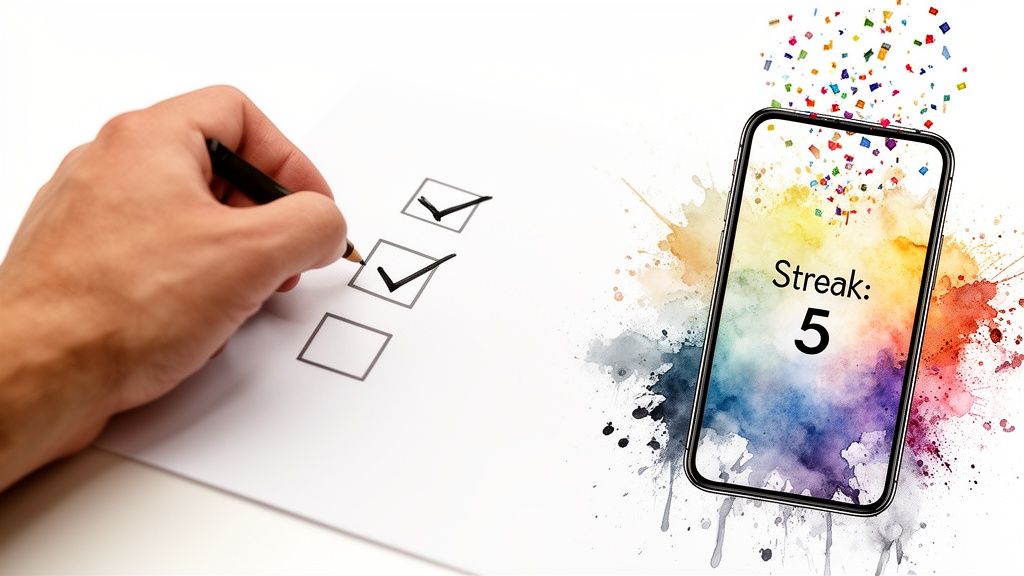
This can be as low-tech as a physical checklist on your desk or as modern as a dedicated habit-tracking app. The specific tool doesn't matter as much as the result: a clear, visual record of your consistency. It turns your effort from an abstract idea into concrete proof of your commitment.
"The single biggest motivator is progress in meaningful work; the single biggest demotivator is a setback." — Teresa Amabile & Steven Kramer
This feeling of advancement goes beyond just checking off tasks; it's fundamental to our overall job satisfaction. A 2023 ADP study on the global workforce found that while pay is important, career progression is a huge priority. In some regions, 27% of workers actually prioritized opportunities for growth over their salary. It's a core human need. Further analysis from Culture Amp in 2024 even named development the number one driver of motivation.
Build Momentum with a Daily Streak
One of the most powerful ways to visualize your progress is by building a streak. There's a special kind of magic in watching that number climb from one day to five, then to ten. It becomes undeniable proof that you're showing up for yourself, creating a gentle but firm sense of accountability.
This is where having a simple tool designed for mindful consistency can be a game-changer. You can start this whole process right now with a goal that feels almost too easy.
Download the I Become app from the App Store and set a simple intention: practice just one affirmation each day. Use the app’s built-in streak tracker to watch your consistency grow. This tiny daily action is the perfect first step toward rewiring your brain for sustainable motivation. If you want to dive deeper, check out our guide on building a powerful daily practice.
Rewire Your Inner Dialogue with Affirmations
Let's be honest. Your biggest motivation killer probably isn't your boss or that looming deadline. Most of the time, it's the quiet voice inside your own head—that nagging inner critic.
It's the voice that whispers, "I'm not good enough" or "I'm going to drop the ball on this one." Before you even start, that internal narrative can completely drain your drive. This is where the real battle for motivation is won or lost: inside your own mind. The good news? You have the power to change the conversation.
The Surprising Science of Shifting Your Mindset
This isn't about fluffy "positive thinking." It's a practice grounded in the incredible science of neuroplasticity—your brain's ability to physically change and form new connections.
When you intentionally repeat a new, supportive thought, you're literally carving out a new neural pathway. Think of it like walking through a field of tall grass. The first time is tough, but the more you walk the same path, the more defined it becomes. Eventually, that new, encouraging path is easier to travel than the old, negative one.
This practice builds an unshakable resilience and a deep well of confidence you can draw from when things get tough. It's like training a muscle; the more you work it, the stronger it gets. And the stronger you get, the quieter that inner critic becomes.
Of course, external factors matter. A 2024 global study from Culture Amp found that inspiring leadership is a top driver of employee motivation. But it also revealed a stark reality: 41% of "quiet quitters" point to a lack of positive culture and engagement. The takeaway is clear: while a great boss helps, we also need to become our own best source of inspiration.
Making Affirmations Work for You
The only affirmations that stick are the ones that feel authentic and speak directly to your struggles. Generic platitudes just won't cut it.
Here are a few starting points you can tweak to fit your own situation:
- When a project feels impossible: "I am resourceful and fully capable of navigating this challenge."
- When your to-do list is overwhelming: "I move through my day with calm and focus."
- When you're nervous about speaking up: "My voice is valuable, and my perspective matters."
- When imposter syndrome creeps in: "I belong here. My contributions are meaningful."
You don't have to believe the affirmation 100% when you first say it. That’s not the point. The goal is simply to make room for a new, more supportive thought to exist. The belief will follow with practice.
Imagine getting a gentle, encouraging thought on your phone's Lock Screen minutes before a big presentation. That’s the kind of timely nudge that can completely shift your state of mind from anxious to empowered. To see the research behind this, check out our article on the science of affirmations.
A Daily Practice That Fits Your Life
The best habits are the ones that bend to fit your life, not the other way around. With the I Become app, you can connect with your affirmations in whichever way feels most natural to you.
It offers four distinct practice modes:
- Read: Silently absorb the words during a quiet moment at your desk.
- Speak: Say them aloud in your car to give them power and energy.
- Listen: Let them wash over you during your commute or a morning walk.
- Write: Physically write them in a journal to deepen the mind-body connection.
By choosing the mode that fits your mood and your schedule, you're not just repeating words—you're actively rewiring your brain for confidence and motivation. Download I Become from the App Store and see for yourself how a simple daily practice can make a profound difference.
Your Quick-Start Guide to Renewed Motivation
Alright, we’ve covered a lot of ground—from finding your "why" to rewiring the way you think about your day. But theory is one thing; putting it into practice is what really counts.
This isn't about some massive, life-altering overhaul. That's a recipe for burnout. Instead, think of this as a simple, one-week experiment. Just seven days to gently and consistently re-engage your focus.
Here’s a small, practical prompt for each day. These are designed for busy professionals like you, and each one takes just a few minutes. Let’s begin.
Your First 7 Days to More Drive
This plan breaks down the big ideas we've talked about into tiny, manageable actions. Don't underestimate them. The goal is to build a little momentum, day by day, and the cumulative effect can be surprisingly powerful.
Day 1: Find One Small Win When your workday ends, pause. Look back and pinpoint just one thing you accomplished. Did you finally clear out 10 old emails? Did you help a colleague untangle a problem? Write it down. Acknowledge it. Let yourself feel that small but very real spark of progress.
Day 2: Set a Meaningful Intention Before you even open your laptop, take 60 seconds for yourself. Set a simple intention for the day. It could be something like, “I will approach my tasks with a calm focus,” or maybe, “I will stay curious and look for opportunities to learn.” This simple act frames your day with purpose before the world’s demands rush in.
Day 3: Have a 5-Minute Affirmation Session Pick one supportive thought that resonates with you. Maybe it's, "My work is a valuable contribution." Now, spend just five minutes with it. You can write it down a few times, say it aloud, or just sit with it quietly. Think of it as a moment of intentional self-encouragement.
Day 4: Schedule One Micro-Break Go into your calendar right now and block out ten minutes for a genuine break. This is non-negotiable screen-free time. Get up, stretch, look out a window, or just close your eyes and breathe. You need to give your brain these little pockets of air to reset.
Day 5: Reframe One Tedious Task Scan your to-do list for that one item that makes you groan. Got it? Now, challenge yourself to connect it to a bigger, more meaningful goal. Is that boring report actually providing the critical data your team needs to succeed? Shifting your perspective is a powerful way to shift your energy.
Day 6: Acknowledge Your Streak Pause and recognize this: you've shown up for yourself for six days straight. This isn't about being perfect; it's about the simple, quiet power of coming back to the practice each day. Give yourself credit for that consistency.
Day 7: Reflect and Appreciate Take a look back at your week. What did you notice? Which small action made the biggest difference in how you felt? Acknowledge the effort you've put in and appreciate your own commitment to feeling better at work.
Remember, sustained motivation isn't a finish line you cross. It's a daily practice, a gentle rhythm of reconnecting with yourself, your purpose, and your power to choose where you put your focus.
The path to staying motivated is built with small, consistent steps, not giant, exhausting leaps. Be patient with yourself. Some days will be easier than others, and that’s completely normal. The only goal is to keep showing up.
This guide is your starting point. To help you keep the momentum going, consider making I Become your compassionate companion on this journey. With daily affirmations, beautiful Lock Screen widgets, and multiple ways to practice, it’s designed to fit into your life and offer a bit of encouragement right when you need it.
Ready to start your practice? Download I Become from the App Store and begin gently rewiring your thoughts for a more motivated and fulfilling workday.
Found this helpful? Share it with someone who might benefit.