
How to Practice Gratitude Daily: A Simple Guide
Learn how to practice gratitude daily with simple morning rituals, micro-habits, and powerful prompts. A warm, practical guide to building a consistent habit.
Some days, gratitude sounds lovely in theory and impossible in real life. You wake up already behind, scroll too long, rush through breakfast, answer messages on the move, and by bedtime your brain feels too tired to reflect on anything deeper than “I made it.”
That's exactly why a daily gratitude practice needs to be simple. If it asks too much of you, it turns into one more task to avoid. If it fits inside moments you already have, it can support your mood, your attention, and the way you move through the day.
Learning how to practice gratitude daily doesn't mean becoming cheerful all the time. It means training your mind to notice what is steady, kind, comforting, helpful, or meaningful, even on imperfect days. Small moments count. In fact, they're often the ones that make the habit last.
Why Gratitude Feels Good and Is Good for You
When life feels noisy, gratitude gives your mind somewhere gentle to land. It takes your attention off autopilot for a moment and points it toward something real and supportive, like a friend who checked in, a meal that nourished you, or the relief of sitting down after a long day.
That shift isn't just sentimental. Gratitude has become a studied well-being practice, not just a nice idea. A large long-term analysis found that people with the highest gratitude scores had a 9% lower risk of dying over four years, and a meta-analysis found gratitude interventions were linked to 6.86% higher life satisfaction and a 5.8% boost in mental health, according to Harvard Health's summary of the research.

Gratitude is a practice, not a personality type
You do not need to be naturally optimistic to benefit from gratitude. You don't need a perfect morning routine, a beautiful journal, or a calm life.
You only need a brief pause and a little honesty.
Gratitude works best when it's grounded in what's actually true for you, not what sounds impressive on paper.
For one person, gratitude might be appreciation for supportive parents. For another, it might be clean sheets, a quiet train ride, or the fact that they made it through a difficult week. The practice is less about performing positivity and more about noticing what is already holding you up.
What people often get wrong
Many people assume gratitude has to feel profound every time. It doesn't. Some days it will feel warm and moving. Other days it will feel ordinary.
That's still valuable.
A simple daily rhythm often works better than waiting for inspiration. Try this mindset:
- Keep it short: A few minutes is enough.
- Keep it specific: Name actual moments, people, or comforts.
- Keep it repeatable: The best practice is the one you'll still do when you're busy.
If you've ever thought, “I know gratitude is good for me, but I don't know how to make it a real habit,” you're not failing. You're just ready for a more practical approach.
Your Morning and Evening Gratitude Rituals
A daily gratitude habit becomes much easier when it has a home. Morning and evening work well because they already carry a natural pause. You're either setting the tone for the day or gently closing it.
The CDC's How Right Now gratitude guidance recommends a regular gratitude practice and notes that consistent practice can improve well-being. Clinical studies summarized there also suggest that 2 to 4 weeks of practice can lead to detectable benefits like improved sleep and lower blood pressure.
A soft morning ritual
Your morning ritual doesn't need to be long. It only needs to happen before the day fully grabs your attention.
Try this while coffee brews, while you sit on the edge of your bed, or before you open email:
- Take one full breath: Let your shoulders drop.
- Name three things you're thankful for: Keep them concrete.
- Choose one thing you want to carry into the day: Calm, patience, support, energy, or trust.
Examples help. “I'm grateful for my blanket” is fine. “I'm grateful for the warmth of my blanket because I slept poorly and it helped me rest anyway” lands deeper.
If you want a little structure around this habit, a morning ritual builder can help you anchor the practice to things you already do, like making tea or checking your calendar.
Practical rule: If your ritual feels heavy, shrink it. A tiny ritual done often is stronger than an ambitious one you avoid.
An evening ritual that closes the day kindly
Evening gratitude works differently. Instead of preparing you for what's ahead, it helps your nervous system review the day with more balance.
You can do this in a notes app, in a notebook, or out loud while washing your face.
Try this short pattern:
- Recall three good things: They can be big or small.
- Add one sentence of why each mattered: This deepens the reflection.
- End with one kind thought toward yourself: Especially if the day was messy.
A few examples:
- The cashier smiled when I looked stressed. It reminded me people can be gentle.
- My lunch tasted good. I actually paused long enough to enjoy it.
- I finished one task I'd been avoiding. That gave me some relief.
If you miss a day
Nothing has gone wrong.
A gratitude practice isn't broken by inconsistency. It's built by returning. If mornings don't work, move it to bedtime. If daily feels too rigid, start with a few days each week and let the rhythm build from there.
The point isn't to create a perfect performance. It's to give yourself a reliable moment of perspective.
Weaving Gratitude into Your Busiest Days
Busy people often quit gratitude because they imagine it requires a quiet notebook, a fresh candle, and ten uninterrupted minutes. Most days don't look like that. Real life is more like traffic, deadlines, grocery lines, and reheated coffee.
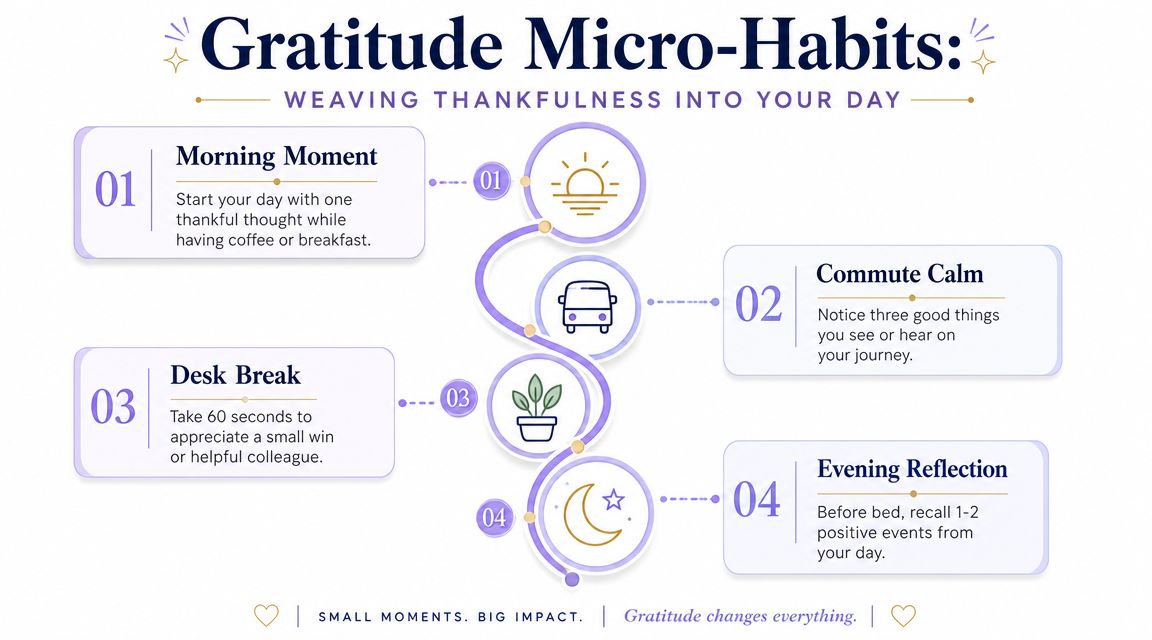
That's where micro-habits help. Instead of saving gratitude for a perfect moment, you attach it to moments that already exist.
Tiny anchors that work in motion
One Medical recommends trigger-based gratitude practices that fit daily routines, including prompts during a commute, a walk, or before bed, and even using a physical prompt like a gratitude rock to help the habit stick, as described in their guide to everyday gratitude practices.
That idea is wonderfully practical. You don't need more time. You need a cue.
Here's what that can look like in ordinary life:
- While waiting for coffee: Think of one thing making today easier.
- At a red light or on the train: Notice three things that are pleasant, helpful, or beautiful.
- When washing your hands: Thank your body for getting you through the day.
- When you touch your keys, bag, or pocket stone: Let that object remind you to name one good thing.
Gratitude snacks for the mind
A formal journal can still be useful, but there's something powerful about these tiny check-ins. They interrupt mental rushing. They also teach your brain that gratitude isn't separate from life. It lives inside life.
A useful gratitude prompt for busy days is simply this: “What is helping me right now?”
Maybe it's sunlight through the window. Maybe it's headphones, good shoes, a colleague who answered fast, or the friend who sent a voice note. These won't always feel dramatic. They don't need to.
If you want the habit to last, make it friction-free. Attach it to your commute. Attach it to brushing your teeth. Attach it to locking your phone at night. The simpler the trigger, the easier the return.
Gratitude Prompts That Actually Work
Blank-page resistance is real. You sit down meaning to reflect, and your mind offers the same three answers every time. Family. Coffee. Home. Those are all valid, but if your practice stays too general, it can start to feel flat.
Positive psychology guidance suggests gratitude becomes more effective when you list 3 to 5 concrete items and reflect on why they matter. Specificity creates stronger emotional activation than generic statements, as explained in this overview of gratitude exercises and techniques.
Why specific beats vague
Compare these two entries:
- I'm grateful for my friend.
- I'm grateful that my friend sent a two-line text this afternoon when I was overwhelmed, because it made me feel less alone.
The second one gives your mind something to hold. It carries texture, emotion, and meaning.
If you want more ideas to get past generic entries, these HolyJot journaling tips are a helpful prompt bank. You can also explore more reflective ideas in these journaling prompts for self-discovery when your usual answers feel stale.
Sample Gratitude Prompts for a Deeper Practice
| Prompt Category | Example Prompt |
|---|---|
| Daily comfort | What small comfort supported me today? |
| Relationships | Who made my day lighter, and what exactly did they do? |
| Personal strength | What quality in myself helped me handle something well? |
| Sensory detail | What did I see, hear, taste, or smell today that brought relief or pleasure? |
| Challenge and growth | What hard moment taught me something useful? |
| Home and routine | What object, space, or routine quietly helps me every day? |
| Body and energy | What did my body allow me to do today that I appreciate? |
| Work or study | What small win or useful support showed up in my responsibilities today? |
Prompts you can use tonight
Try a few of these and notice which ones open something genuine:
- For relationships: What kindness did I almost overlook today?
- For your environment: What in my space makes life easier or calmer?
- For difficult seasons: What has been hard lately, and what support still exists inside that difficulty?
- For self-trust: What did I do today that I'm proud of?
- For the ordinary: What routine moment would I miss if it disappeared tomorrow?
Specific gratitude doesn't have to sound poetic. It only has to be real.
When your entries get more detailed, your practice usually gets more alive. That's often the difference between a gratitude habit you abandon and one you actually want to return to.
Troubleshooting Your Gratitude Practice
Sometimes gratitude feels easy. Sometimes it feels forced, repetitive, or strangely irritating. That doesn't mean you're doing it wrong. It means you're human.
One of the biggest reasons people stop is that they believe gratitude should always feel uplifting. But some days you're sad, angry, numb, or exhausted. On those days, trying to leap straight into thankfulness can feel fake.
When gratitude feels like toxic positivity
Guidance on gratitude journaling warns against forcing the practice into toxic positivity. A better approach is to acknowledge your real emotions first, then notice what you still appreciate. If the practice feels stale, it can help to return to the same theme and look for new details, or reduce the frequency for a while, as noted in this article on starting a gratitude journal without forcing it.
That might sound like this:
- I'm disappointed today, and I'm also grateful my friend listened.
- I feel anxious, and I'm grateful I stepped outside for fresh air.
- I'm emotionally tired, and I'm grateful I fed myself anyway.
Both things can be true.
You don't have to deny pain to practice gratitude. You can tell the truth first.
When the practice gets boring
Repetition is another common barrier. If you keep writing the same things, your brain may stop engaging.
A few gentle fixes help:
- Change the lens: Focus only on people for a week. Then switch to sensory moments, lessons, or small comforts.
- Return to one theme: If you always write “home,” ask what about home mattered today. Quiet? Safety? Smell? Familiarity?
- Try less often: If daily feels dull, practice once a week for a while and make it more thoughtful.
When you forget entirely
Forgetfulness usually means the habit has no visible cue. Put your notebook on your pillow. Add a one-word reminder to your phone wallpaper. Pair gratitude with something fixed, like turning off your alarm or plugging in your charger.
You don't need to become a different person to keep this practice. You just need to make it easier to remember on ordinary days.
Making Gratitude a Habit That Lasts
The most sustainable gratitude habits are small enough to survive a full life. They don't depend on motivation. They depend on good placement.
That's why habit stacking works so well. You place gratitude directly after something you already do every day. After brushing your teeth, name one thing you appreciate. After pouring coffee, write three words in your notes app. After getting into bed, remember one moment that felt kind or grounding.

Make the habit easy to see and easy to repeat
Long-lasting habits usually have three qualities. They are visible, simple, and forgiving.
A visible habit has a cue. A simple habit feels almost too easy. A forgiving habit leaves room for imperfect weeks without collapsing.
If consistency is something you're actively working on in other areas too, this guide on mastering goal consistency offers practical ways to keep small routines going without relying on willpower alone.
Here are a few gratitude-friendly setups:
- Phone cue: Add a recurring reminder with a prompt like “One good thing.”
- Lock screen note: Use a short phrase that nudges attention toward appreciation.
- Bedside method: Keep a notebook and pen where you naturally end the day.
- Voice note version: If writing feels like friction, speak your gratitude out loud.
For more ideas on creating a routine you can keep, this guide to building a daily practice that fits real life is a useful place to start.
Use support, not pressure
You don't need a rigid system. You need one that welcomes you back. Some days your gratitude practice will be a thoughtful paragraph. Other days it will be a single sentence in the dark.
That still counts.
A short guided reflection can also help when you want a little company in the process:
The goal isn't to become someone who never struggles. The goal is to become someone who remembers, a little more often, that even busy and imperfect days can hold something worth noticing.
If you want gentle support while building a daily mindset practice, I Become is a lovely next step. The iOS app helps you rewire your thoughts through daily affirmations, Lock Screen widgets, reminders, and flexible practice modes like Read, Speak, Listen, and Write. If gratitude and affirmations both matter to you, download I Become from the App Store and make your daily reflection easier to return to, even on busy days.
Found this helpful? Share it with someone who might benefit.