
Your Guide to Emotional Abuse Healing and Rediscovering Yourself
Begin your emotional abuse healing with this compassionate guide. Discover how to reclaim your power, set boundaries, and build a life of peace and self-worth.
The first step toward healing from emotional abuse is often a quiet one. It’s the moment you finally give yourself permission to see the truth of your situation. Unlike a physical injury, the wounds are invisible, which can make you feel lost, confused, and even start to question your own sanity.
But let's be clear: acknowledging the hurt is the most powerful thing you can do on your personal growth journey. It’s the beginning of validating that what you went through was real, it was painful, and it was never your fault.
Recognizing the Invisible Scars of Emotional Abuse
Your journey to healing truly starts with this courageous act of recognition. It’s about learning to name the subtle, destructive patterns that have slowly chipped away at your sense of self. This isn't about pointing fingers or starting a fight. It's about creating a safe, mindful space, just for you, to see your experiences with clarity and compassion.
Emotional abuse is a master of disguise. It can hide in plain sight, masquerading as intense love, over-the-top concern, or even a “harmless” joke. This is precisely why it’s so disorienting. You might feel like you’re constantly walking on eggshells, replaying conversations in your head, or battling a persistent feeling of being fundamentally flawed.
Those feelings aren't a reflection of you. They are the predictable and painful result of manipulative behaviors.
Common Tactics of Emotional Abuse
Understanding these patterns helps you reclaim your power. They aren't just one-off bad moments; they are part of an intentional system of control.
Gaslighting: A deeply manipulative tactic designed to make you question your perception of reality. You hear things like, "That never happened," or "You're just being overly sensitive." Over time, this makes you feel like you can’t trust your own mind.
Constant Criticism and Devaluation: This is the relentless drumbeat of put-downs, name-calling, or being unfavorably compared to others. It’s designed to shred your self-esteem, leaving you feeling worthless. One minute you're their everything, the next you're nothing.
Isolation: Abusers often work to methodically cut you off from your support system—your friends, family, and even coworkers. They might manufacture drama or convince you that they are the only person who truly understands and cares for you, deepening your dependence on them.
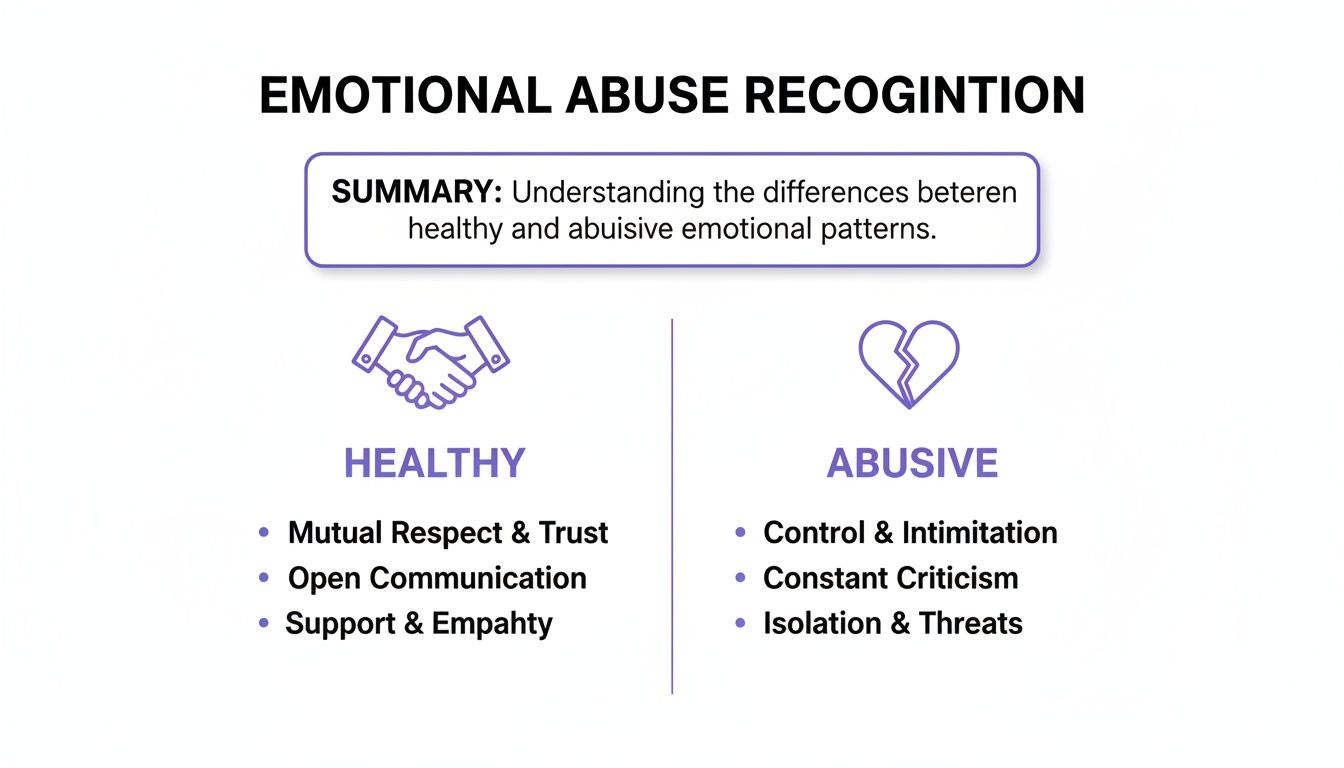
It's natural to confuse these destructive patterns with the normal ups and downs of a relationship. But there’s a fundamental difference between a healthy argument and a campaign of control.
This table can help you tell them apart.
Healthy Disagreement vs. Emotional Abuse
| Behavior | Healthy Disagreement | Emotional Abuse |
|---|---|---|
| Focus | On the issue at hand ("I'm upset you forgot.") | On the person's character ("You're so selfish and forgetful.") |
| Goal | To find a resolution and understand each other. | To win, dominate, and control the other person. |
| Feelings Afterward | A sense of resolution, even if difficult. You feel heard. | Feeling drained, confused, shamed, or scared. |
| Respect | Maintained throughout, even when disagreeing. | Disrespect, contempt, and scorn are common. |
| Accountability | Both people can apologize and take responsibility. | One person deflects all blame and never apologizes. |
Healthy conflict is a part of any relationship; it can even bring you closer. Emotional abuse, on the other hand, is a one-way street designed to diminish you.
The True Weight of Invisible Wounds
The scars of emotional abuse might be invisible, but their impact is devastatingly real. In fact, a landmark study found that the long-term psychological damage—like PTSD, depression, and anxiety—can be just as severe as, or even worse than, the effects of physical abuse. You can read more about the study's findings on these "thousand cuts" and see just how deep these wounds can go.
Healing begins the moment you name what happened. This isn’t about blame; it’s about breaking the silence that protects the abuse and finally reclaiming your own story.
If any of this feels painfully familiar, please hear this: you are not alone, and you are not imagining it. Seeing the truth of your experience is the first, most essential step toward getting your life back. This newfound awareness is the solid ground on which you will rebuild everything.
Taking Your First Steps Toward Safety and Clarity

The journey out of emotional abuse rarely starts with a dramatic, movie-style exit. More often, it begins with a quiet, internal shift—a decision to carve out a small pocket of safety for yourself. This isn't about confrontation. It’s about survival and gently, carefully, reclaiming your own space.
If you’re feeling overwhelmed by the thought of it, please know that's completely normal. Healing isn't one giant leap; it's a series of small, manageable steps. The goal right now is simply to give yourself enough room to breathe, think, and hear your own voice again. It’s about taking back your power in whatever way feels safe enough for you, right where you are.
Create Gentle Distance
The very first, most essential move is to create a little distance. This doesn't automatically mean you have to pack a bag and leave—that's not always safe or even possible. Emotional distance can be just as powerful, acting as your first line of defense.
What does that look like? It might be consciously choosing not to get pulled into another circular argument that you know will go nowhere. It could mean putting your phone on silent for an hour to get a break from a constant stream of manipulative texts or draining calls. This small act of separation gives your nervous system a desperately needed rest from being on high alert 24/7.
The Power of Documenting for Your Own Sanity
When you're deep in the fog of emotional abuse, it's easy to question your own reality. That’s why writing things down is so incredibly powerful. This isn't about building a legal case (though it could be useful for that later). It’s about validating your own experience. It’s proof for you that you aren’t "crazy," "making things up," or "being too sensitive."
Find a private, secure place—a password-protected note on your phone or a hidden journal. Write down what happened, the date, and most importantly, how it made you feel. When you look back over these entries, you’ll begin to see the patterns. That clarity is what cuts through the gaslighting and helps you trust yourself again. This log is for your eyes only, a testament to your truth.
The Strength in Sharing With Just One Person
Emotional abuse thrives in isolation. It’s designed to make you feel completely alone. Breaking that silence, even with just one trusted person, can feel like a monumental release of pressure. You don't need to tell the world; you just need to find one safe harbor.
Confiding in a trusted friend, family member, or therapist can lift an incredible weight. Hearing someone say, "I believe you," can be one of the most validating and strengthening experiences on your healing journey.
Choose someone you know, deep down, will listen without judgment and have your back. Saying the words out loud to another person makes it real, tangible. It reinforces your resolve and reminds you that you are not on this path alone.
Introduce Micro-Boundaries
Does the idea of setting a big, firm boundary make your heart pound? That's a common fear. So don't start there. Instead, begin with micro-boundaries. Think of them as small, personal acts of resistance that slowly build your boundary-setting muscle.
Here are a few real-world examples:
- Instead of giving an immediate "yes" or "no," say, "I need a minute to think about that."
- When a conversation turns demeaning, simply get up and leave the room. You don't have to announce it. Just go.
- Let a call go to voicemail, even if you know they expect you to pick up.
- Insist on taking a 30-minute walk by yourself, just to clear your head.
Each of these tiny acts sends a powerful message back to yourself: my needs matter. Every micro-boundary is a building block for your self-respect. As you get more comfortable, you can reinforce this inner strength by exploring affirmations for overcoming toxic relationships.
Beginning this process is a profound act of self-love. These first steps are about creating the space you need to see clearly and begin to trust yourself again. They are the solid ground upon which you will build a freer, more authentic life.
Building Your Daily Healing Toolkit
 Once you’ve carved out some initial safety for yourself, the real work of healing begins. It happens in the small moments of each day. This is where you start to mindfully gather the tools that will support your self-improvement, day in and day out.
This isn’t about making huge, sweeping changes overnight. It’s about building a simple, personal toolkit for your own emotional well-being—a collection of practices that can anchor you when you feel lost and gently guide you back to your own strength. Think of it as your first-aid kit for the heart.
Start with Mindful Anchoring Techniques
The echoes of past abuse can show up without warning, pulling you into an emotional flashback or a sudden wave of anxiety. In those moments, your nervous system feels hijacked. Mindful anchoring is the practice of bringing yourself back to the present, reminding your body and mind that you are safe right now.
One of the most powerful and immediate anchors is the 5-4-3-2-1 grounding exercise. It pulls your focus out of the mental storm and into the solid reality of your surroundings.
- 5: Look around and name five things you can actually see.
- 4: Notice four things you can physically feel—the texture of your shirt, your feet on the floor.
- 3: Listen for three distinct sounds, like a clock ticking or traffic outside.
- 2: Identify two different scents you can smell.
- 1: Name one thing you can taste, even if it's just the faint taste in your own mouth.
This simple act redirects your brain away from the trauma loop and reaffirms your safety in the here and now. It’s a beautifully portable tool you can use anywhere, anytime you feel overwhelmed.
Untangle Your Thoughts with Gentle Journaling
Emotional abuse is designed to create confusion and self-doubt, leaving your inner world feeling like a tangled mess. Journaling gives you a private, judgment-free space to gently pull on those threads and start making sense of your own feelings again.
You don’t have to write a novel. Just start with simple, focused prompts meant for healing.
Journaling Prompts for Clarity:
- What is one feeling I'm holding onto today? Where do I feel it in my body?
- Write a compassionate letter to your younger self about what they were going through.
- What is one small, kind thing I did today that was just for me?
- If my inner critic had a voice, what does it sound like? What is a kinder voice I can replace it with?
This is your space. It's not for anyone else to read. It's where you can process everything, validate your own emotions, and finally start to hear your own voice above the noise.
The impact of emotional harm is profound. Research shows that among domestic violence survivors, a staggering 95% endured emotional tactics, leading to higher rates of mental health disorders and long-term depression. This underscores why structured daily practices are so vital for recovery. You can discover more insights about these findings on PMC.
Rewire Your Inner Voice with Affirmations
A core tactic of emotional abuse is the slow, deliberate erosion of your self-worth. Over time, the abuser’s critical voice often becomes your own inner critic, replaying a constant script of "not good enough."
A consistent affirmation practice is a powerful way to fight back. It’s how you challenge that script and gently, intentionally, rewire your brain.
This isn't about "toxic positivity" or pretending the pain isn't there. It’s about consciously planting seeds of self-worth, compassion, and strength where seeds of doubt were sown. It’s about creating a new, supportive inner dialogue, one thought at a time.
Building this habit can feel tough at first, which is why a dedicated tool can make all the difference. An app like I Become is designed to make this practice feel effortless and encouraging. You can select affirmations that truly speak to your healing journey and have them appear on your phone as gentle reminders throughout the day.
Imagine using the different practice modes to actively build your new inner voice:
- Speak Mode: Reclaim your voice by saying truths like "I am worthy of respect" out loud.
- Write Mode: Internalize messages of strength by physically writing "My feelings are valid" over and over.
- Listen Mode: Let calming affirmations wash over you during moments of stress or anxiety.
This simple daily ritual becomes a compassionate act of self-parenting—giving yourself the encouragement you always deserved. For more ideas, you can also explore our guide on building a daily practice that actually sticks.
Your daily toolkit is your declaration that your well-being matters. By weaving these small, consistent practices into your life, you are actively taking part in your own healing, building a foundation of resilience, and taking back control of your inner world. Ready to start rewiring your thoughts? Download I Become from the App Store and choose your first affirmation today.
How Professional Support Can Accelerate Your Recovery
Reaching out for professional help is one of the most courageous things you can do on your healing journey. It’s a powerful way of telling yourself, and the world, that you are ready to invest in your own well-being and build a future that isn't defined by the past.
This isn’t about weakness; it’s about strategy. Think of therapy as having a seasoned guide join you on a difficult but essential expedition—someone who knows the terrain, can help you read the map, and will hold a safe space for you to navigate the complex emotions of healing from abuse.
Finding the Right Kind of Support
Just as your story is uniquely yours, the path to healing isn't one-size-fits-all. Different therapeutic methods are designed to address different aspects of trauma. Knowing a little about them can help you feel more empowered as you start your search.
You'll likely come across a few common approaches:
Cognitive Behavioral Therapy (CBT): This is all about untangling the lies that abuse makes you believe. Emotional abuse often hardwires negative thoughts like, "I'm not good enough" or "It was my fault." A CBT therapist helps you gently challenge these beliefs, examine the real evidence, and start replacing them with healthier, more compassionate truths about yourself.
Eye Movement Desensitization and Reprocessing (EMDR): This might sound a bit strange, but EMDR is incredibly effective for trauma. It’s designed to help your brain properly process and file away painful memories. Using gentle bilateral stimulation (like eye movements or tapping), it helps reduce the intense emotional charge of a memory, so you can remember what happened without feeling like you're reliving it.
While understanding the methods is helpful, the single most important element is the person you choose to work with.
What to Look for in a Therapist
Finding the right therapist is everything. You're looking for a partner in this process, and the "fit" has to feel right in your gut. You need to feel safe, seen, and deeply respected.
As you start your search or have initial consultations, pay close attention to how you feel in their presence. Can you imagine being truly vulnerable with this person?
A good therapist won’t hand you the answers. Instead, they act as a compassionate guide. They hold the flashlight for you, illuminating the path so you can reconnect with your own inner wisdom and find your way back to yourself.
When you're looking for someone to support your recovery from emotional abuse, try to find a professional who:
- Is trauma-informed and truly understands the dynamics of abuse.
- Makes you feel heard and validated from the very first conversation.
- You feel a genuine sense of warmth, trust, and rapport with.
Remember, it is absolutely okay to "shop around." Have a few consultation calls. This is your healing, and you deserve a guide who truly gets it.
Your First Sessions and Making Care Accessible
Those first few sessions are about building that foundation of trust. It’s a time for you to share your story at your own pace while the therapist listens, learns, and begins to collaborate with you on a plan. It’s your journey; you are always in the driver's seat.
If cost is a concern, please don't let it stop you. You have options. Many therapists offer a sliding-scale fee based on income. Also, look into community mental health centers and university training clinics. Online therapy platforms have also made professional support more accessible and affordable than ever before.
As you begin this work, you can create an incredible synergy by pairing it with your own daily self-care rituals. The new, empowering beliefs you cultivate in therapy can be strengthened every single day. Using an affirmation app like I Become is a simple way to weave the positive messages from your sessions into the fabric of your daily life, making your progress feel more solid and real.
Ready to take that next brave step? Download I Become from the App Store and start building that foundation of self-worth today.
Navigating Your Healing Journey and Rediscovering Yourself
Let's be honest from the start: healing from emotional abuse isn't a straight line. It’s a winding path with incredible highs, frustrating lows, and plenty of unexpected detours. The kindest thing you can do for yourself is to accept this reality right now.
Some days will feel amazing. You’ll feel strong, clear-headed, and full of hope. Then, out of nowhere, a song on the radio, a particular smell, or a passing comment can send a wave of grief or anger crashing over you. It can feel like you’ve been knocked ten steps back.
This isn’t a failure. It’s the natural, messy rhythm of recovery.
Understanding Emotional Triggers
Think of triggers as emotional landmines left behind by the trauma you endured. They are subconscious tripwires that instantly activate your nervous system’s fight-or-flight mode, even when you’re completely safe.
A trigger can be almost anything. It might be a specific tone of voice, the sight of a car that looks like theirs, or the familiar feeling of being dismissed or misunderstood. When a trigger hits, you might feel a sudden jolt of anxiety, a surge of irritability, or a deep, pulling sadness that makes you want to hide from the world.
The goal isn't to fight these feelings off. Instead, try to meet them with gentle curiosity. The moment you feel that shift, pause and just name what’s happening. "I'm being triggered right now. This is a memory, not my current reality."
This one small act of mindfulness creates a tiny but powerful space between the feeling and your reaction. It’s in that space that you begin to reclaim your control.
Self-Compassion Is Your Greatest Ally
On the days when you feel exhausted, stuck, or just plain over it, self-compassion is the most powerful tool you have. So often, the abuser's critical voice becomes our own inner narrator, whispering that we should be "healed by now." This is the voice you must learn to gently, but firmly, challenge.
When you stumble, speak to yourself the way you would to a dear friend who is hurting.
Instead of, “Why am I still so upset about this?” try reframing it. “It makes perfect sense that I’m feeling this way. I survived something incredibly difficult, and it’s okay to still be healing from it.” This simple shift in your inner dialogue is absolutely fundamental to your recovery.
Healing from emotional abuse is not a passive process of waiting for time to pass. It requires active, compassionate intervention and the right tools.
The research on this is striking. One study on survivors of intimate partner violence found that after two years, only 14% felt fully recovered. Even a decade later, that number only rose to 22%, and this was among people who had accessed support services. This tells us that simply waiting for time to heal all wounds isn't enough. Proactive healing is what truly makes the difference. You can learn more about why active recovery is so crucial from the research findings.
Rediscovering Who You Are Now
Emotional abuse shrinks your world. It often forces you to mute your own opinions, give up hobbies you once loved, and tiptoe around another person's moods. One of the most beautiful and exciting parts of healing is the journey of rediscovering and reclaiming you.
This is where you move from just surviving to genuinely thriving. It’s about more than just picking up old hobbies again; it’s about intentionally building a life that feels authentic to your soul, not one designed to please or appease someone else.
Reconnect with Lost Passions: What did you love to do before this all happened? Maybe it was painting, hiking through the woods, dancing in your kitchen, or getting lost in a good book. Start small. You don't need to commit to hours—just 15 minutes a day doing something that is purely for you.
Build New, Healthy Connections: As you heal, you'll find yourself drawn to friendships built on mutual respect and genuine care. Pay attention to how it feels to be around people who really listen, celebrate your wins, and offer support without strings attached. This is your new standard for relationships.
Explore Your Own Values: For a long time, your life may have revolved around someone else's world. Now is your time. Ask yourself: What really matters to me? What do I want my life to stand for? Journaling is an incredible tool for bringing clarity to these big questions.
This is your chance to build a life that finally feels like home. As you explore the person you are becoming, you might find our collection of self-discovery affirmations to be a powerful companion.
This journey of rediscovery is tender, and you deserve support as you take these new steps. Affirmations are a wonderful way to reinforce your new reality. Using an app like I Become can help you plant seeds of self-trust and confidence every single day. By practicing affirmations like, "I am free to be my authentic self" or "I am creating a life I love," you are actively rewiring your brain for happiness and self-worth.
Ready to start this exciting chapter? Download I Become from the App Store and begin the beautiful work of rediscovering you.
Your Promise to a Brighter, Freer Future
When you truly commit to healing from emotional abuse, what you’re really doing is making a profound promise to your future self. It’s a quiet vow that you will find peace, a deep-seated commitment to reclaiming the worthiness that was always yours, and a courageous step into a life defined by your own freedom, not by someone else's fear.
Every small act of self-preservation is a brick laid on the foundation of that promise. When you hold a boundary, even if your voice shakes. When you catch a critical inner voice and replace it with a kind word. These are not small things; they are you, honoring the person you are becoming.
The goal isn't to pretend the past didn't happen. It’s to build a future so full of light, joy, and your own voice that the old shadows simply lose their power. You are so much more capable of this than you might feel right now. And you deserve every bit of the peace you're working toward.
Healing isn’t some finish line you cross one day. It’s the daily, often messy, practice of choosing yourself over and over again. Every single step, no matter how small it feels, is a victory creating momentum toward the beautiful life that is waiting for you.
One of the most compassionate ways to begin this practice is with daily affirmations. This isn't about just repeating empty phrases; it’s a gentle, structured way to start rewriting the painful scripts left behind by abuse. It's how you build a solid foundation of self-love, starting right now, from the ground up.
Take that first brave step today. You can download I Become from the App Store and just find one single affirmation that resonates. Let that one thought be your anchor. Let it be the daily reminder that a brighter, freer future isn't just possible—it’s what you are actively creating in this very moment. Your future self is already thanking you.
The Big Questions That Come Up in Healing
As you start to find your footing on this path, you're going to have questions. Big ones. That’s not just normal; it’s a sign that you’re becoming more aware and invested in your own healing. Let’s walk through some of the questions we hear most often from people on their self-improvement journey.
How Do I Know If This Is Actually Working?
This is the number one question. Real healing isn’t a switch you flip; it’s a slow dawn. You’ll know it’s working not because the bad feelings disappear, but because your relationship with them changes.
You’ll start to see it in small, quiet victories. Maybe you find yourself setting a tiny boundary—like not answering a text right away—and you don't immediately spiral into guilt. Or a painful memory surfaces, but it feels less like a tidal wave and more like a ripple. You might even catch yourself laughing, genuinely, at something silly. That’s it. That’s healing in action.
The opposite of this is suppression. That often feels like a constant state of bracing for impact, a low-humming anxiety you can’t quite shake. If you feel like you're just "white-knuckling" your way through each day, it's a signal that some of those buried feelings need a safe place to land.
Can We Fix the Relationship?
This is a heavy, complicated question, and the honest answer is that it's incredibly rare. For a relationship to have any chance of recovering, the person who was abusive must take 100% accountability for their actions—no excuses, no blaming. They also need to commit to serious, long-term professional help to unpack and change their behavior. This is a massive undertaking.
Your priority, though, has to be you. Your healing journey needs its own sacred space, with a support system that has nothing to do with the relationship. Trying to heal inside the very environment that hurt you is like trying to dry off in the middle of a rainstorm. It’s nearly impossible.
So, How Long Is This Going to Take?
We wish we could give you a clear timeline, but healing doesn't work that way. It's not a race with a finish line. The time it takes depends on so many things—the nature of the abuse, the support you have, and the tools you learn along the way.
Instead of asking, "Am I done yet?" try to celebrate the small, consistent ways you show up for yourself. The goal here is progress, not perfection. Every time you redirect a negative thought or hold firm on a boundary, you are taking a powerful step forward.
What if I Can't Afford Therapy Right Now?
Therapy is a phenomenal tool, but it’s not the only one in the toolbox. If one-on-one therapy is out of reach for now, please don’t feel like you’re stuck. There are so many other ways to find support.
- Look into community resources: Many community mental health centers, universities, or training institutes offer counseling on a sliding scale based on your income.
- Find a support group: Being in a room (even a virtual one) with people who just get it is powerfully validating. You can find groups online or in your local area.
- Build your own foundation: You can start right now, from home, with things that are free or low-cost. Journaling, practicing mindfulness, and creating a daily affirmation habit are not small things—they are the bedrock of self-support.
A gentle, consistent practice can be the anchor you need. The I Become app was created to help you do just that—gently rewire old thought patterns and build a new foundation of self-worth, one day at a time. Download I Become from the App Store and start with a simple, compassionate tool that’s there for you, every step of the way.
Found this helpful? Share it with someone who might benefit.