
Unlock Daily Habits for Success: Your 2026 Guide
Discover 10 practical daily habits for success. Adopt simple steps like affirmations & better sleep to build the life you want. Start your journey for 2026 now!

Your Journey to Success Starts One Day at a Time
Do you ever feel like you’re capable of more, but the path forward seems unclear? You know you want to feel calmer, sharper, more disciplined, more confident. But most days seem to disappear into notifications, obligations, fatigue, and a quiet frustration that you’re not using your full potential.
That feeling is more common than often acknowledged. Research published in Psychology & Health found that 66.34% of daily behaviors are habitually instigated, with 87.6% of habits being habitually executed once initiated. In other words, a huge part of daily life runs on autopilot. That can feel discouraging if your current routines aren’t serving you. It can also be indeed encouraging, because lasting change doesn’t require reinventing yourself from scratch.
Success isn’t built through one dramatic breakthrough. It’s built in the quiet moments of your day. It’s built when you pause before reacting, when you move your body even briefly, when you choose a better thought, when you return to the habit again after missing a day.
These daily habits for success aren’t meant to turn you into a machine. They’re meant to help you become more like yourself at your best. You’ll find practical steps here, real trade-offs, and simple adoption plans for 7, 14, and 30 days, so you can build momentum without overwhelm.
Pick one habit first. Let it become real in your actual life. Then add the next.
1. Daily Affirmations and Positive Self-Talk
The way you speak to yourself sets the ceiling for how you work, lead, recover, and try again. If your inner voice is harsh, even strong effort feels heavy. If your inner voice is grounded and supportive, challenges still feel hard, but they stop feeling personal.
Affirmations work best when they’re believable, specific, and repeated often enough that they stop sounding like a script and start sounding like your voice. This is due to many behaviors already running through established habit loops. The challenge isn’t always starting a new identity. It’s redirecting an old pattern.
Why it works
A lot of people fail with affirmations because they choose statements that feel fake. “I am unstoppable” won’t land if your nervous system is screaming otherwise. Better choices sound like, “I can handle this conversation calmly,” or “I’m becoming someone who follows through.”
Practical rule: Choose affirmations that feel stretching, not absurd.
I Become is especially useful here because it doesn’t force one practice style. Some days you may want to read an affirmation to yourself. Other days, speaking it aloud or writing it helps it sink in faster. If you want a deeper look at how repetition and self-talk support mindset change, the science of affirmations guide from I Become is a strong place to start.
7, 14, and 30-day adoption plan
- First 7 days: Pick 2 or 3 affirmations tied to one real area of life, such as confidence at work or emotional steadiness.
- By day 14: Use the same affirmations at the same cue point each day, such as brushing your teeth or opening your laptop.
- By day 30: Edit any statement that still feels flat. Keep what feels emotionally true and remove what sounds performative.
What doesn’t work is treating affirmations like magic words. What does work is pairing them with repetition, context, and emotion. Use the I Become widget on your lock screen so the practice appears inside your day instead of waiting for perfect motivation.
2. Morning Routine and Intentional Awakening
The alarm goes off. Your hand reaches for the phone. Ten minutes later, your mind is already crowded with other people’s priorities. That is how many days get lost before they properly begin.
A useful morning routine interrupts that pattern. It gives you a small pocket of control before work, messages, family needs, and unfinished thoughts start competing for attention. The goal is not an impressive ritual. The goal is a repeatable start that steadies your mind and reduces decision fatigue.

Why it works
Intentional waking works because your first few choices often shape the tone of the next several hours. If the morning begins with noise, urgency, and reaction, it is harder to recover focus later. If it begins with a few chosen actions, you start from a steadier baseline.
I have seen the same trade-off repeatedly. People build routines that look disciplined on paper, then quit because the routine asks too much on ordinary days. A better approach is smaller and more durable. Light. Water. A few breaths. One written priority. That is enough to change the feel of a morning.
Research from the Sleep Foundation also supports the value of a consistent wake time as part of healthy sleep habits, which affects energy, mood, and focus during the day, as explained in their guide to why consistency matters for sleep.
What works in real life
Keep the structure simple enough that you can do it on a rushed Tuesday, not just on a calm Sunday.
A practical routine usually includes four parts:
- Wake with one clear cue: open the curtains, drink water, or sit up and place both feet on the floor before touching your phone.
- Get your body online: do one or two minutes of stretching, walking, or shoulder rolls.
- Set your mental direction: open I Become before email or social media so your first input is selected on purpose.
- Choose the day’s focus: name one priority or one way you want to show up, such as calm, decisive, or patient.
That last piece matters more than people expect. A morning routine is not only about energy. It is about direction.
7, 14, and 30-day adoption plan
- Days 1 to 7: Build a routine that takes five minutes or less. Pick one wake cue, one physical action, and one mental reset.
- Days 8 to 14: Keep the same order every day. Add I Become as the first app you open so the habit has a consistent trigger.
- Days 15 to 30: Review what creates friction. Remove any step you skip often and keep the pieces that make mornings feel calmer and clearer.
Common pitfalls
The first mistake is copying someone else’s ideal morning. A parent with young kids, a student with an early commute, and a founder with late-night work hours need different routines.
The second is making the routine too long.
The third is treating one missed morning like failure. Missed days happen. Return to the first step at the next wake-up instead of trying to rebuild the whole system at once.
A strong morning routine lowers friction and gives you a stable starting point. It should help you begin the day with more clarity, not more pressure.
3. Consistent Meditation and Mindfulness Practice
Meditation isn’t about becoming blank, serene, or detached from life. It’s practice for noticing what’s happening inside you before it runs the show. That’s why it pairs so well with other daily habits for success. It gives you a small gap between stimulus and response.
Many people quit because they assume they’re bad at it. They sit down, notice ten thousand thoughts, and conclude it isn’t working. That’s backward. Noticing the thoughts is the practice.

Why it works better than forcing positivity
If affirmations plant a thought, mindfulness helps clear the soil. Without some quiet awareness, positive self-talk can bounce off a stressed mind. With even a short mindfulness ritual, people often find they can receive supportive thoughts with less internal resistance.
Use I Become’s Listen mode as a bridge if silent meditation feels too abrupt. Listening to affirmations with full attention can become its own mindfulness ritual.
7, 14, and 30-day adoption plan
- Days 1 to 7: Sit for a short session and focus on your breath or body sensations.
- Days 8 to 14: Keep the same time each day. Consistency matters more than duration.
- Days 15 to 30: Pair the session with a stressful transition point, such as before work, after class, or before sleep.
What doesn’t work is waiting for a quiet mind. What works is training one. If breath meditation irritates you, try a body scan, a walking meditation, or a listening-based practice. The method matters less than your willingness to return.
4. Goal Setting and Daily Intention Planning
Goals matter, but they often fail people when they stay too large, too vague, or too distant from daily action. “Build a better life” isn’t a plan. “Send the proposal, take the walk, review expenses, practice my affirmations” is a plan.
There’s also a gap in a lot of success content. People are told what to do, but not how to make it stick when motivation fades. The implementation-intention problem is real. One analysis highlighted that existing advice often underexplains the mechanism of consistency and noted that 80% of wealthy people pursue goals obsessively. Obsession alone still isn’t enough if your goals never get translated into a repeatable daily structure.
Make your intentions small enough to act on
A useful daily intention answers one question: what must happen today for me to feel aligned, even if the day gets messy?
That usually means choosing three meaningful actions, not fifteen. When people overload their list, they don’t become more disciplined. They become avoidant.
If you want your goals to feel more grounded and values-based, I’d also recommend I Become’s article on living with intention.
7, 14, and 30-day adoption plan
- Week 1: Write down one main intention each morning.
- Week 2: Add two support actions that make the intention concrete.
- By day 30: Review your evenings and notice which intentions changed your behavior.
Goals should reduce decision fatigue. If your planning system creates more mental noise, simplify it.
A student might write, “Today I study with calm focus,” then define the action as one library session, one chapter review, and one phone-free hour. A manager might choose, “Today I lead with clarity,” then prepare one difficult conversation and one focused work block. That’s how goals stop being abstract.
5. Physical Exercise and Movement
You planned a focused day. Then your body never fully wakes up, your attention drifts, and by midafternoon even simple tasks feel heavier than they should. That pattern is common, and regular movement is one of the cleanest ways to interrupt it.
Exercise supports success because it changes the quality of your energy, not just your fitness. A short walk can settle mental noise. Strength training can build the kind of self-trust that comes from keeping a promise to yourself. Mobility work can pull you out of the stiff, shut-down state that long hours at a desk create.
You do not need an ambitious training plan. You need a repeatable one.
Here’s a useful workout if you want a simple place to start.
Why it works in real life
Movement improves this habit loop in a practical way. You feel better in your body, which makes it easier to stay present. You stay more present, which improves the odds that you follow through on the rest of your day.
The trade-off is real. If you choose workouts that are too long, too intense, or too inconvenient for your current season, exercise starts competing with your life instead of supporting it. The better standard is consistency with enough challenge to feel progress.
A good baseline is simple:
- Pick a form of movement you do not dread: Walking, lifting, yoga, cycling, dance, and short home sessions all work.
- Match the session to the day: High-energy days can handle more intensity. Tired or crowded days may call for ten minutes and done.
- Attach it to identity: Use an affirmation in I Become before you train, such as “I honor my body through consistent action.”
- Track what gets in the way: If you keep skipping movement, use a few journaling prompts for self-reflection to spot the obstacle. Time, fatigue, perfectionism, and poor timing each need a different fix.
7, 14, and 30-day adoption plan
Days 1 to 7: Move every day for a short, fixed minimum. Ten minutes is enough. The goal is to remove negotiation.
Days 8 to 14: Give movement a home in your schedule. Same time, same cue, or same trigger after another habit. At this point, the routine starts feeling easier.
Days 15 to 30: Add light structure. For example, walk on Monday, Wednesday, and Friday, and do strength or mobility on Tuesday and Thursday. Log the habit in I Become so you can see streaks, notice missed days quickly, and return without guilt.
Common pitfalls
The first pitfall is treating soreness as proof of success. It is not. A session you can repeat tomorrow is more useful than one heroic workout that knocks you out for three days.
The second is picking exercise based on who you used to be. I have seen people try to restart with the routine they had in college, before kids, or before a demanding job. Build for your current life.
The third is waiting to feel motivated. Motivation is unreliable. A prepared plan, laid-out clothes, and a small minimum are what keep this habit alive.
Exercise should leave you steadier, clearer, and more capable of doing the work that matters. If your routine regularly drains you, scale it down until it fits.
6. Journaling and Reflective Writing
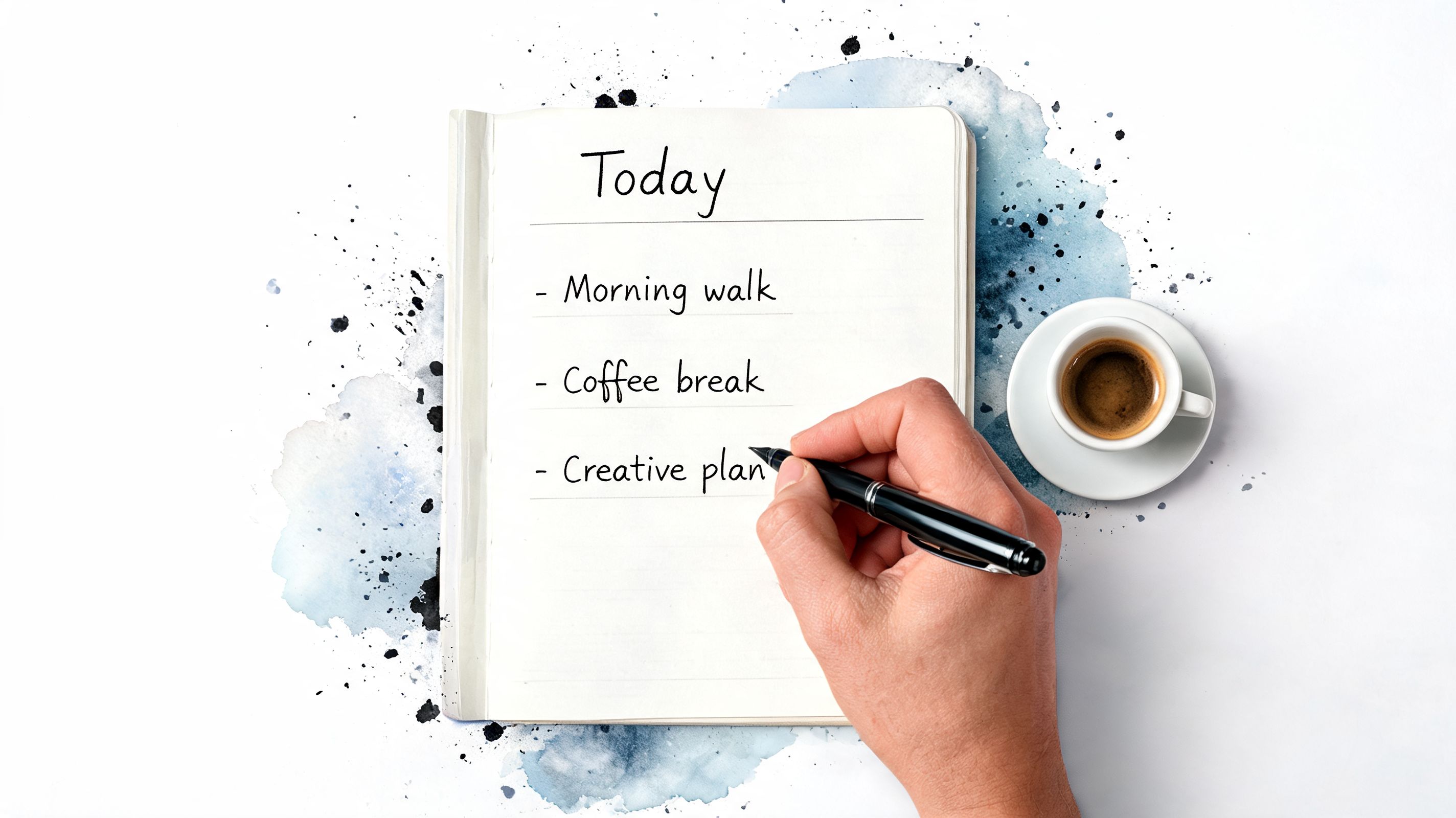
Journaling is one of the fastest ways to hear what you’re thinking. Thoughts that feel huge and tangled in your head often become workable once they’re on paper. That’s why reflective writing supports success so well. It turns vague inner noise into material you can use.
This habit also works beautifully with affirmations. If an affirmation says, “I trust myself,” journaling lets you ask, “Where do I already do that?” or “What keeps interrupting that trust?” Insight grows from that tension.
A simple structure that doesn’t feel like homework
Forget the idea that journaling needs polished paragraphs. The most useful pages are often messy. You’re not producing literature. You’re producing clarity.
Try this sequence:
- Start with a feeling: Name what’s present without editing it.
- Add one truth: Write what you know, even if it’s small.
- Finish with a direction: End with one next step.
If you want prompts that make this easier, I Become has a thoughtful collection of journaling prompts for self-reflection.
7, 14, and 30-day adoption plan
Write for a few minutes each day during the first week. In week two, connect one entry to an affirmation you’re practicing. By day 30, review earlier pages and look for repeated triggers, recurring strengths, and evidence of growth.
Some days journaling gives you insight. Other days it simply keeps you honest. Both are valuable.
What doesn’t work is waiting until you feel inspired. Journaling is most helpful when you use it on ordinary days too.
7. Continuous Learning and Skill Development
Success gets fragile when it depends only on motivation. It becomes sturdier when you build capability. That’s what daily learning does. It keeps you expanding, adapting, and staying mentally alive.
This doesn’t mean turning every spare minute into productivity theater. It means choosing one area where more skill would create more freedom. For a student, that might be writing or statistics. For a manager, conflict resolution. For a creator, storytelling or editing.
Learn narrowly, apply quickly
The people who grow fastest usually aren’t consuming random inspiration all day. They’re studying one useful thing and testing it in real life. A podcast on communication is nice. Practicing one better question in your next meeting is better.
A few grounded ways to build this habit:
- Pick one lane: Don’t study five unrelated topics at once.
- Use dead time well: Commutes, walks, and setup time are ideal for audio learning.
- Tie learning to identity: Pair study with an affirmation like “I can learn complex things steadily.”
7, 14, and 30-day adoption plan
For seven days, spend a small block of time on one skill. For the next two weeks, capture one takeaway after each session. By day 30, ask what changed in your behavior, not just what content you finished.
Busy lives need compact habits. Personalization, in this context, matters. One review of success advice noted that many routines are too prescriptive and fail to account for chronotypes, life stage, and irregular schedules, a gap discussed in this University of Washington Professional & Continuing Education article. Your learning habit should fit your real day, not an idealized one.
8. Sleep Optimization and Rest Priority
You meant to go to bed at 10:30. At 11:45, you are still answering one last message, scanning headlines, and telling yourself tomorrow will somehow be different. Then the alarm goes off, and the habits that looked simple on paper feel expensive. Patience is lower. Focus is scattered. Good intentions lose to convenience.
Sleep is not a reward for finishing the day perfectly. It is one of the conditions that makes steady effort possible. I have seen people blame themselves for inconsistency when the underlying problem was that they were trying to build discipline on top of exhaustion. Better rest does not fix everything, but it makes every other habit easier to keep.
Why it works
Sleep supports judgment, emotional control, memory, and recovery. Those are the systems behind follow-through. If your evenings are chaotic, your mornings usually become reactive. If your sleep is short or broken for several nights in a row, small stressors start to feel bigger than they are.
The trade-off is real. Protecting sleep often means ending the workday before you feel fully done, leaving a text unanswered until morning, or accepting that late-night entertainment has a cost. That is not rigid. It is honest.
What to do in real life
Start with a repeatable shutdown routine, not a perfect bedtime. A simple sequence trains the body to expect rest.
- Set a clear cutoff: Pick a time when work, problem-solving, and stimulating content stop.
- Lower the input: Dim lights, put the phone across the room, and avoid carrying tomorrow into bed.
- Empty your mind onto paper: Write down tomorrow’s top one to three tasks so your brain can stop rehearsing them.
- Use I Become as your evening cue: Play a short set of calming affirmations or sleep-focused audio at the same time each night to make the transition easier and more consistent.
7, 14, and 30-day adoption plan
Days 1 to 7: Choose one anchor only. Keep the same wake time or use the same 15-minute wind-down routine each night.
Days 8 to 14: Add one friction reducer. Charge your phone outside the bedroom, set out sleepwear, or write tomorrow’s priorities before you brush your teeth.
Days 15 to 30: Protect sleep on the nights that usually slip. For many people, that means Sunday, one midweek night, and Friday. Use I Become during your wind-down so the cue becomes automatic instead of something you have to negotiate with yourself about.
Common pitfalls
Perfectionism ruins this habit fast. One late night does not mean the week is lost.
Another common mistake is trying to fix sleep by forcing an early bedtime while keeping the same stimulating evening routine. That usually leads to lying in bed wide awake and feeling frustrated. Change the hour before sleep first. The bedtime often follows.
Sleep improves through small, repeated signals. Guard it like something that affects tomorrow, because it does.
9. Gratitude Practice and Appreciation Cultivation
Gratitude can sound soft until you try living without it. Then you notice how quickly the mind defaults to lack, irritation, comparison, and threat-scanning. A gratitude practice interrupts that pattern.
This doesn’t mean denying pain or pretending everything is fine. It means making sure difficulty doesn’t become the only lens you use. Gratitude widens perception. It helps you notice support, progress, beauty, effort, and grace that stress tends to hide.
Make it concrete or it won’t last
Generic gratitude fades fast. Specific gratitude changes your attention. “I’m grateful for my life” is nice. “I’m grateful my friend checked in when I was overwhelmed” lands more profoundly.
Gratitude works best when it names something real, recent, and emotionally felt.
Try weaving it into your day in simple ways. Write three specific gratitudes at night. Speak one during breakfast. Pair a gratitude reflection with an I Become affirmation about enoughness, trust, or calm.
7, 14, and 30-day adoption plan
- Days 1 to 7: List three specific things each day.
- Days 8 to 14: Add one hard thing that taught you something.
- Days 15 to 30: Express appreciation to another person at least a few times during the week.
What doesn’t work is treating gratitude like a forced positivity drill. What works is honest appreciation. Some days your list may be profound. Some days it may be “warm coffee, a finished task, and ten quiet minutes.” That still counts.
10. Boundary Setting and Time Management
Many people don’t lack motivation. They lack protection. Their best intentions get swallowed by reactive work, constant messaging, unclear expectations, and the habit of saying yes too quickly.
Boundary setting is one of the most practical daily habits for success because it creates room for every other habit to survive. If your mornings are open to everyone else’s urgency, your priorities won’t stay yours for long.
Protect the hours that shape you
This isn’t about becoming rigid or unavailable. It’s about deciding what deserves uninterrupted space. A person who blocks time for exercise, planning, focused work, or rest usually isn’t being selfish. They’re being structurally responsible.
On the work side, data discipline can support better decisions. According to McKinsey & Company, organizations that prioritize data in daily strategies are 23 times more likely to acquire customers, 6 times more likely to retain them, and 19 times more likely to achieve profitability. In personal life, the principle is similar. What you track and protect gets managed better than what you vaguely hope to do.
7, 14, and 30-day adoption plan
- Week 1: Protect one priority block each day.
- Week 2: Turn off nonessential notifications during that block.
- By day 30: Review where your energy is leaking and tighten one boundary that keeps getting ignored.
A few examples help:
- For professionals: Schedule your most important task before meetings begin.
- For students: Create one phone-free study block and one recovery block.
- For everyone: Use I Become notifications intentionally, not constantly, so the app supports your rhythm instead of adding noise.
10-Point Daily Habits Comparison
| Habit | Implementation 🔄 (complexity) | Resources & Time ⚡ (requirements) | Expected outcomes 📊 (impact) | Ideal use cases 💡 | Key advantages ⭐ |
|---|---|---|---|---|---|
| Daily Affirmations and Positive Self-Talk | Low, simple repetition habit; minimal learning curve | Very low time (5–10 min); apps or self-written statements | Improved confidence, reduced anxiety; incremental belief change | Quick mood reset, morning transitions, adjunct to therapy | Low-cost, portable, immediate mood lift |
| Morning Routine and Intentional Awakening | Moderate, requires planning and consistency | 15–60 min daily; space for multiple practices | Higher daily productivity, less decision fatigue, better focus | Professionals seeking consistent energy and structure | Sets tone for day; compounds other habits |
| Consistent Meditation and Mindfulness Practice | Moderate, learning curve for technique and consistency | 10–20+ min; quiet space or guided apps | Reduced stress, improved attention and emotional regulation | Stress management, focus improvement, performance prep | Strong neurobiological evidence; durable benefits |
| Goal Setting and Daily Intention Planning | Moderate, needs clear frameworks (e.g., SMART) | 5–20 min daily; journal or app for tracking | Clearer priorities, measurable progress, increased motivation | Project work, career planning, productivity systems | Aligns daily actions with long-term goals; measurable |
| Physical Exercise and Movement | Variable, technique matters; scalable intensity | 10–60 min; optional equipment or bodyweight routines | Better mood, energy, cognition, sleep, and resilience | Energy boost, stress reduction, confidence-building | High physiological ROI; supports mental habits |
| Journaling and Reflective Writing | Low–Moderate, simple format, needs privacy | 5–20 min; notebook or digital app | Greater self-awareness, emotional processing, problem solving | Emotional processing, habit tracking, creative work | Tangible record of progress; low cost |
| Continuous Learning and Skill Development | Moderate, requires focus and curation | 15–30+ min; courses, books, podcasts or mentors | Increased competence, career opportunities, growth mindset | Career advancement, reskilling, intellectual engagement | Long-term ROI; fosters adaptability |
| Sleep Optimization and Rest Priority | Moderate, requires environmental and schedule changes | 7–9 hours nightly target; environment tweaks, routines | Enhanced cognition, mood, immune function; amplifies other habits | Foundation for all performance-focused routines | Foundational benefit; multiplies effectiveness of habits |
| Gratitude Practice and Appreciation Cultivation | Low, simple habit, easy to start | 5–15 min; journaling or reflection | Increased well‑being, improved relationships, resilience | Mood stabilization, evening wind-down, relationship work | High emotional return for minimal effort |
| Boundary Setting and Time Management | Moderate–High, social and behavioral adjustments | Planning tools, calendar blocks, clear communication | Reduced burnout, protected focus time, sustainable productivity | Busy professionals, remote workers, creatives | Protects time for high-impact habits; prevents overload |
Becoming Your Best Self, One Habit at a Time
Success gets romanticized in ways that make it feel distant. It gets packaged as a dramatic reinvention, a perfect routine, or a level of discipline that only a few people seem to possess. Real life is quieter than that. Real change usually starts with one decision repeated long enough to become familiar.
That’s why daily habits for success matter so much. They don’t ask you to become someone else overnight. They ask you to practice becoming more consistent with the person you already want to be. One calmer morning. One clearer boundary. One walk instead of another skipped promise. One page of reflection. One better thought repeated until it feels natural.
You also don’t need all ten habits at once. In fact, trying to force all of them into your life immediately is one of the fastest ways to fail. Start with the habit that would make the biggest difference right now. If your mind feels noisy, begin with affirmations or mindfulness. If your days feel chaotic, begin with a morning routine or daily planning. If your energy is low, start with movement or sleep.
Be patient with the awkward stage. Every meaningful habit has one. The first few days often feel mechanical. The second week can feel inconvenient. That doesn’t mean the habit is wrong. It usually means the habit is still new. Keep adjusting the shape until it fits your life without losing its purpose.
One finding worth remembering is that daily behavior is often more automatic than we realize. That can sound limiting, but it’s hopeful. It means you don’t need endless motivation to change your life. You need supportive cues, repeatable actions, and enough self-compassion to keep going when the process feels imperfect.
I’ve found that people do better when they stop trying to dominate themselves into success and start building a daily environment that helps them succeed gently. That’s a very different energy. Less force. More follow-through.
If you want a simple companion for that process, I Become can help. It brings affirmations into the places where habits are built: your morning, your lock screen, your commute, your reflective moments before bed. With Read, Speak, Listen, and Write modes, it makes mindset practice flexible enough for real life. That flexibility matters, because sustainable success rarely comes from rigid perfection. It comes from showing up again and again in ways your life can hold.
Choose one habit. Begin today. Let small wins count. They’re often the beginning of everything.
If you want gentle support while building these daily habits for success, download I Become from the App Store. It helps you practice personalized affirmations through Read, Speak, Listen, and Write modes, with widgets and reminders that fit naturally into busy days. It’s a simple way to build more confidence, clarity, and consistency, one thought at a time.
Found this helpful? Share it with someone who might benefit.