
Change Your Mindset Meaning: Shift Your Perspective
Discover the true change your mindset meaning. Learn how to shift from a fixed to growth mindset using simple, daily habits to transform your life.
Some days, the phrase “change your mindset” sounds inspiring. Other days, it sounds exhausting.
You might be doing your best and still feel stuck in the same loop. A hard conversation keeps replaying in your head. One mistake at work turns into “I'm not good enough.” A healthy habit lasts a few days, then disappears the moment life gets busy. When that happens, it's easy to think the problem is your personality.
Usually, it isn't.
Most of the time, what people mean by change your mindset meaning is much simpler and kinder than “become a different person.” It means learning to notice the mental lens you use, then practicing a new way of seeing, responding, and talking to yourself. That process is gradual. It's trainable. And for beginners, it becomes much easier when you connect the science of repetition with small daily practices you can stick with.
What It Really Means to Change Your Mindset
A mindset is the set of beliefs and assumptions you bring into everyday life. It shapes how you interpret feedback, stress, uncertainty, and even success. Two people can face the same event and walk away with completely different stories about what it means.
If you send a message and don't get a reply, one mindset says, “I must have done something wrong.” Another says, “They may be busy. I'll follow up later.” The situation is the same. The interpretation changes.
That's why change your mindset meaning isn't just “think happy thoughts.” It means shifting the interpretation you habitually make. It means moving from automatic, often harsh conclusions toward thoughts that are more accurate, supportive, and useful.
The lens, not the whole identity
Many readers get confused here. They hear “change your mindset” and assume it means replacing their whole personality overnight.
It doesn't.
Think of mindset as a lens, not your core self. If the lens has become foggy with fear, self-criticism, or hopelessness, your job isn't to shame yourself for having it. Your job is to clean it gently and consistently.
Changing your mindset isn't denying what hurts. It's learning not to let one thought define your whole reality.
That distinction matters. A healthier mindset doesn't say, “Nothing is wrong.” It says, “Something is hard, and I can still choose my next response.”
What this can look like day to day
You don't need a dramatic life event to begin. Small shifts count.
- After a mistake: Instead of “I always ruin things,” try “I don't like this outcome, but I can learn from it.”
- During stress: Instead of “I can't handle this,” try “I can handle the next step.”
- When growth feels slow: Instead of “I'm failing,” try “I'm practicing.”
If you want a related practical read, this guide on how to develop a growth mindset pairs well with what you're learning here.
A mindset shift begins when you stop treating every thought as a fact. That's the opening. Everything else grows from there.
The Surprising Science Behind a New Mindset
A new mindset starts in a very physical place. Your brain changes in response to what you repeat.
If you've spent years rehearsing thoughts like “I'm behind,” “I always mess this up,” or “nothing ever changes,” those thoughts can begin to feel automatic. Not because they are true, but because they have been practiced. The encouraging part is that practice works both ways. New patterns can also become more familiar with time.
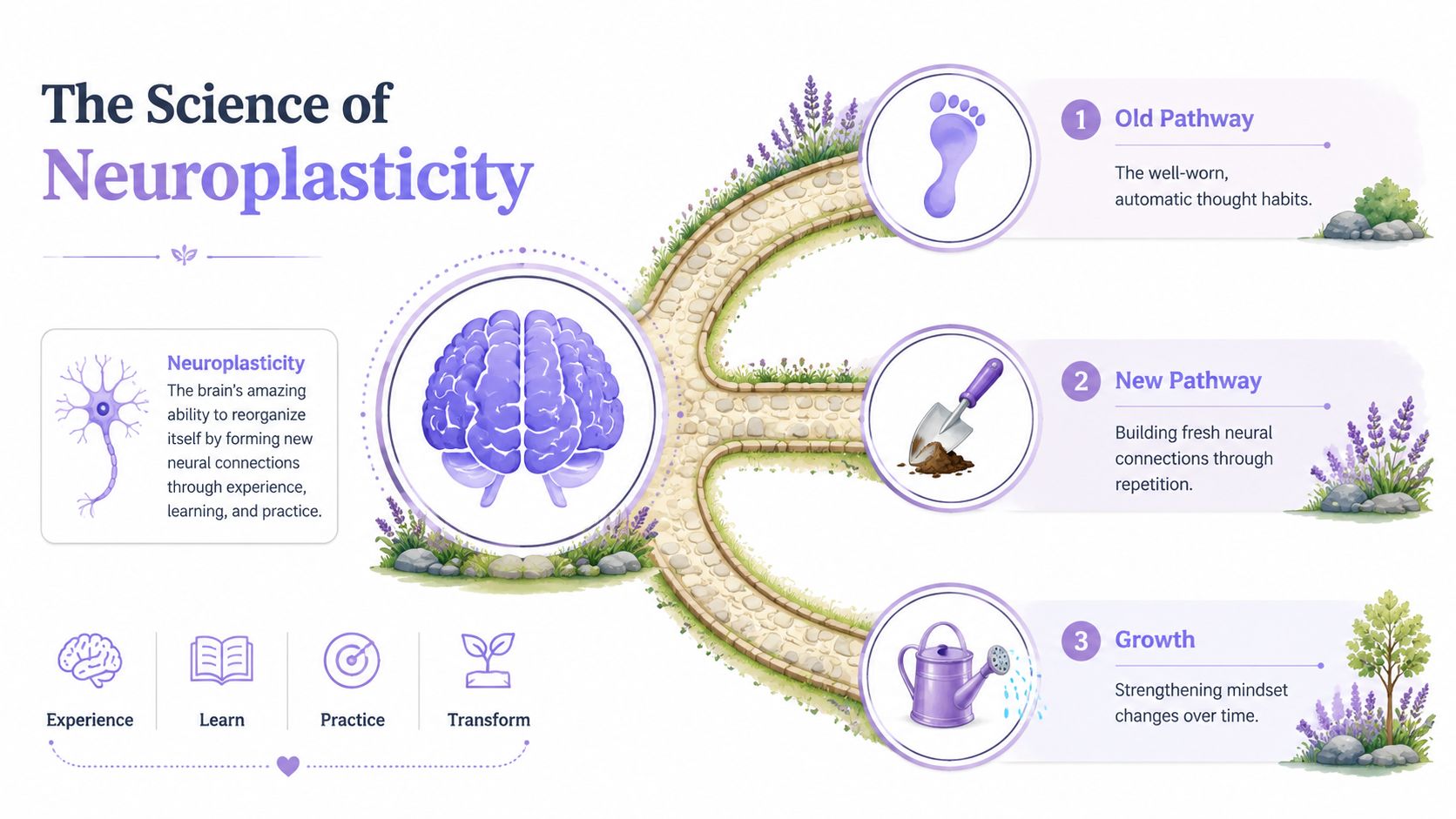
Neuroplasticity in plain language
Neuroplasticity is the brain's ability to adapt through repeated experience. A simple way to understand it is to picture a trail through grass. The route you walk often becomes easier to follow. A route you stop using begins to fade. Thought patterns can work in a similar way.
That does not mean one positive sentence rewires your brain overnight. It means repetition matters. Attention matters. Context matters too.
This often confuses beginners, especially around affirmations. An affirmation is not a magic spell, and it is not useful because you forced yourself to say something cheerful. It becomes useful when it helps interrupt an old mental loop and gives your brain a healthier sentence to rehearse. Used that way, affirmations can support the same learning process your brain already uses every day. This guide to the science behind affirmations and repetition explains that mechanism in more detail.
Why repetition changes more than motivation
A burst of inspiration can help you begin. It usually does not carry the whole change.
What changes a mindset more reliably is repeated exposure to a different thought, especially when that thought is tied to a real moment in your day. Reading one grounding statement in the morning, pausing to reframe a fear before a meeting, or ending the day with a kinder interpretation of what happened gives your brain something specific to practice.
This is one reason a simple app can be surprisingly helpful. It places the new thought in front of you at the exact times your old pattern usually appears. That turns mindset work from a vague intention into a daily cue-response habit. In other words, the app is not doing the change for you. It is helping you practice often enough for the change to stick.
Helpful rule: Practice the new thought before it feels natural. Familiarity often comes after repetition, not before.
The psychology behind the practice
Mindset change is also grounded in established psychology. Stanford's summary of mindset research notes that Aaron T. Beck's early work in cognitive therapy focused on how changing distorted thought patterns can influence emotion and behavior.
That history matters because it gives a practical frame for daily mindset work. You notice a thought. You question whether it is accurate or helpful. You replace it with something steadier and more true. Then you repeat.
Small moments count here. A new mindset is rarely built in one dramatic breakthrough. It is built the way a path is formed, one step in the same direction, again and again.
What a Mindset Shift Looks Like in Real Life
You are halfway through a workday. A manager leaves a short note on your draft: “Needs revision.” Your chest tightens. In a few seconds, your mind can turn that moment into a verdict about who you are, or into a piece of feedback you can use.
That is what a mindset shift looks like in real life. It shows up in ordinary moments, especially the ones that sting.

Side by side in everyday situations
| Situation | Fixed pattern | Growth-oriented pattern |
|---|---|---|
| You get critical feedback | “This proves I'm bad at this.” | “This feels uncomfortable, and I can learn from it.” |
| You make a mistake | “I always mess up.” | “I made an error. I can correct it.” |
| Someone else succeeds | “I'm falling behind.” | “Their progress says nothing about my value.” |
| A new skill feels hard | “Maybe I'm not meant for this.” | “New skills often feel awkward before they click.” |
The shift is not about pretending everything is fine. It is about giving your mind a more accurate job. Instead of acting like a judge handing down a final sentence, it begins to work more like a coach offering useful information.
That change can feel small at first. Small is enough.
What changes first
For many people, the first visible change is the sentence they say to themselves after something hard happens.
The feeling may still arrive. You may still feel embarrassed, disappointed, or tense. What starts to soften is the extra layer of interpretation. The mind stops turning one event into an identity.
- Old loop: “I failed, so I am a failure.”
- New loop: “This attempt failed. I can learn from it.”
That difference matters because identity statements stick. They tell the brain, “This is who I am.” A more flexible response tells the brain, “This is something I experienced.” One closes the door. The other leaves it open.
How the shift becomes visible
You may notice a mindset change in quiet ways before you notice it in big outcomes.
You recover faster after criticism. You pause before assuming the worst. You hear the old thought, but you do not follow it as quickly. If you have been practicing affirmations or reframes, this is often the stage where they start to work like trail markers on a familiar path. They do not erase stress. They help you return to steadier ground sooner.
This is also where daily tools can help bridge science and practice. Neuroplasticity means the brain changes through repeated experience. An affirmation app gives that repetition a home in ordinary life. A short statement at the moment you usually spiral can interrupt the old loop and support a different one. Over time, repetition helps the new response feel less forced and more available.
If you want examples of how these loops form and how to interrupt them, this guide on changing negative thought patterns can help you spot them more clearly.
Repetition is what makes it real
A mindset shift rarely arrives as one dramatic breakthrough. It usually develops the way a footpath forms in grass. Walk the same route often enough, and the trail becomes easier to follow.
The old thought may still appear. That does not mean you are doing it wrong. Progress often looks like this: the thought shows up, you notice it, you answer it with something kinder and more grounded, and then you choose your next action from that place.
That is real change. Quiet, repeated, and trainable.
Four Concrete Strategies to Change Your Mindset
Mindset change gets easier when it stops being a vague goal and becomes a repeatable practice. You don't need a complicated routine. You need a few tools you can return to when your mind slips into old patterns.

Start with mindful awareness
Before you can change a thought, you need to notice it.
Mindful awareness means observing what your mind is saying without instantly agreeing with it. If you catch yourself thinking, “I'm behind,” pause before turning that thought into a story about your worth.
A simple check-in can help:
- What happened
- What did my mind say about it
- Is that thought helping me respond well
This is gentle work. The point isn't to police every thought. The point is to become less fused with them.
Reframe, don't sugarcoat
Cognitive reframing means replacing a distorted thought with one that is more balanced and useful. This does not mean pretending everything is wonderful.
If your mind says, “I'll never get better at this,” a reframe could be, “I'm not where I want to be yet, but I can keep practicing.”
Notice the difference. The new thought is believable. That matters. A reframe works best when it feels honest enough for your nervous system to accept.
If you struggle with recurring mental loops, this guide on how to change negative thought patterns offers more examples you can adapt.
Attach the practice to daily life
A mindset habit sticks better when it's linked to something you already do.
Try pairing a short practice with an existing routine:
- After brushing your teeth: say one grounding statement
- When you open your laptop: take one steady breath and choose a focus thought
- Before sleep: write one sentence that reframes the hardest part of your day
This makes the habit easier to remember because it borrows stability from a routine that already exists.
A short guided visual can help make this feel more concrete.
Use affirmations as repetition tools
Affirmations help most when you treat them as repetition mechanisms, not magic phrases.
A useful affirmation is specific enough to anchor you and gentle enough to repeat consistently. Instead of choosing a statement that feels too far away, aim for one that stretches you without making you shut down.
Examples:
- I can meet this moment with steadiness.
- I'm learning a new way to speak to myself.
- I can feel discomfort without turning against myself.
- Progress is built through practice.
One practical option is I Become, an iOS affirmation app that delivers personalized affirmations through notifications and Lock Screen widgets, with Read, Speak, Listen, and Write practice modes. Tools like this can help turn mindset work into a daily cue-based habit rather than something you only remember when you're already overwhelmed.
The deeper point is simple. The more often a supportive thought meets a real moment in your day, the more likely it is to become available when you need it.
Common Pitfalls on Your Mindset Journey
The hardest part of mindset work often isn't getting started. It's staying steady when the process feels slower and messier than expected.
Many people begin with sincere effort, then assume something is wrong when old thoughts come back. Usually, nothing is wrong. You're just meeting the normal reality of change.

Expecting instant results
One major trap is believing a mindset shift should happen quickly. Hitendra Wadhwa's discussion of changing your mindset notes that mindset shifts are often slow and linked to identity, and that effects are often modest and work best when paired with concrete behavior systems rather than affirmations alone.
That's an important reset. If your inner world doesn't transform after a few days, that doesn't mean the practice failed. It usually means you're in the middle of the process.
All or nothing thinking
Another common pitfall is deciding that one difficult day erases all progress.
You miss a journal entry. You forget your affirmation. You react in an old way during a stressful moment. Then the mind says, “See? I'm back at the beginning.”
You aren't.
Growth is not a clean line. A healthier response sounds more like this:
Missing a day doesn't break the pattern. Quitting because you missed a day does.
Returning matters more than performing perfectly.
Confusing mindset work with emotional suppression
Some people hear “change your mindset” and think they need to stop feeling sad, angry, overwhelmed, or afraid. That creates another problem. They start judging themselves for having human emotions.
A resilient mindset makes room for emotion. It doesn't erase it.
You can say, “This is painful,” and still practice a better response. You can admit, “I feel anxious,” and still choose not to let anxiety narrate your whole future.
When positivity becomes unhelpful
There's also a difference between healthy encouragement and dismissive positivity. If someone is dealing with burnout, grief, caregiving strain, or financial pressure, “just be positive” can feel alienating.
Strong mindset work isn't about pretending external pressures don't exist. It's about reducing self-defeating mental habits so you can meet reality with more clarity, compassion, and agency.
Your Path to Lasting Change
A lasting mindset shift usually looks quieter than people expect. It's the pause before you criticize yourself. It's the new sentence you choose after a setback. It's the moment you remember that one hard day doesn't define your direction.
That's why the most useful understanding of change your mindset meaning is not “be more positive at all costs.” It's learning how to build a steadier relationship with your own thoughts. Over time, that can support more resilience, calmer decisions, and a kinder inner voice.
A grounded mindset also leaves room for reality. As Headspace's reflection on scarcity and abundance suggests, a resilient mindset isn't about denying stress such as job insecurity or cost-of-living pressure. It's about increasing your sense of agency while still acknowledging constraints.
That's a compassionate goal. You don't need to become endlessly upbeat. You need practices that help you respond with a little more choice and a little less automatic fear.
Start small. Pick one cue in your day. Pair it with one thought you want to strengthen. Repeat it long enough that it begins to feel familiar.
That's how change grows.
Frequently Asked Questions About Mindset Change
Can you change your mindset overnight
Usually, no. You can have a meaningful insight in one day, but lasting mindset change tends to come from repetition over time. A breakthrough can open the door. Daily practice helps you keep walking through it.
If you want a useful first expectation, aim for consistency over intensity. A few minutes practiced regularly is often more realistic than waiting for the perfect long session.
Is mindset change just pretending to be happy
No. Healthy mindset work is not forced happiness.
It's more accurate to say that you're learning to question unhelpful interpretations. You might still feel disappointed, stressed, or discouraged. The shift is that you stop turning every feeling into a fixed identity statement like “I'm broken” or “Nothing will ever improve.”
That's very different from pretending everything is fine.
What's the best first step for a beginner
Start by noticing one recurring thought that drains you.
Write it down exactly as it appears in your mind. Then create a gentler, more balanced version you can practice instead. Keep it simple enough to use in real moments.
For example:
- “I'm terrible at this” becomes “I'm still learning this”
- “I always fail” becomes “This attempt didn't go how I wanted”
- “I can't handle today” becomes “I can handle the next step”
One thought is enough to begin.
Do affirmations actually help
They can help when you use them consistently and realistically. The key is repetition. An affirmation works less like a wish and more like a rehearsal. You're giving your mind a sentence to return to often enough that it becomes easier to access under stress.
The most helpful affirmations are believable, relevant to your real life, and repeated in specific contexts, such as mornings, commutes, or stressful transitions.
What if I keep slipping back into old patterns
That's normal.
Old patterns were practiced many times, often for years. It makes sense that they still appear. Progress doesn't mean the old thought never shows up again. Progress means you notice it sooner, believe it less, and recover faster when it pulls at you.
Be patient with that part. It's part of the work, not proof that you're failing.
If you want a simple way to make this practice part of daily life, I Become offers an easy starting point on iPhone. You can use personalized affirmations, Lock Screen widgets, and Read, Speak, Listen, and Write modes to bring supportive repetition into the moments where mindset shifts happen. Download it from the App Store and take one small step today.
Found this helpful? Share it with someone who might benefit.