
Abundance and Prosperity: A Guide to Your Richest Life
Unlock abundance and prosperity with a new mindset. Learn the science, overcome blocks, and use daily practices to attract wealth in all areas of your life.
Some days, abundance and prosperity can feel like words that belong to someone else.
You might be doing all the “right” things. You work hard. You try to stay responsible. You keep promising yourself that once you earn more, save more, heal more, or finally get your life organized, then you’ll feel secure. But the feeling never fully lands. There’s always another bill, another comparison, another quiet fear that you’re behind.
That feeling is more common than often acknowledged.
A lot of people confuse a season of strain with a permanent identity. They start to believe, “I’m bad with money,” “Success is for other people,” or “There’s never enough for me.” Over time, those thoughts stop sounding like thoughts and start sounding like truth. That’s where a lack-based life begins. Not only in the bank account, but in the nervous system, the self-talk, and the way you interpret every setback.
Abundance asks you to question that story.
It doesn’t ask you to deny difficulty. It doesn’t ask you to pretend stress is joy. It asks something gentler and stronger. It asks whether your current perspective is the only possible one. It asks whether you can begin to relate to your life as something that can grow, expand, and support you more fully than it does today.
You don’t need to become a different person overnight. You need a new relationship with what’s already possible.
Prosperity grows from that shift. It shows up in practical ways, like wiser decisions, steadier emotions, healthier boundaries, and a greater sense of enough. It also shows up in subtler ways, like feeling less threatened by other people’s success and more willing to act on your own hopes.
If you’ve been curious about abundance and prosperity but unsure where to start, you’re in the right place. The key is to understand both the inner side and the outer side. The mindset and the practice. The why and the how.
Your Invitation to a More Abundant Life
A woman sits at her kitchen table after work, scrolling through photos of someone else’s promotion, someone else’s vacation, someone else’s bright new chapter. Her own day was full of effort. Meetings, errands, mental load, small acts of survival. Yet by evening, all she can think is, “Why does it feel like everyone else is moving forward except me?”
That moment has very little to do with laziness or failure. It often comes from living in constant reaction mode.
When life becomes a stream of problems to manage, your mind narrows. It stops scanning for possibility and starts scanning for danger. You notice what’s missing. You compare. You brace. You make choices from urgency instead of trust. Even good things can feel fragile.
This is why abundance and prosperity begin long before a visible result appears.
When lack becomes a habit
A lack mindset can sneak in:
- You discount your progress even when you’ve come far.
- You treat rest like a reward you haven’t earned yet.
- You assume good things are scarce and must be fought over.
- You mistake temporary circumstances for a final verdict on your life.
None of this means you’re broken. It means you’re human, and your mind has learned to protect you by focusing on what feels unresolved.
Gentle reframe: Protection and expansion are not the same thing. A mind trained only to protect will miss doors that are already opening.
Abundance is the practice of widening your attention again. It helps you notice resources, support, growth, creativity, and opportunity, even while you’re still working through real limitations. Prosperity is what often follows when that inner stance shapes your actions consistently.
A different way to begin
Think of this less like “manifesting riches” and more like learning a new posture toward life.
A tight fist can’t receive much. An open hand can work, give, and receive.
That’s the invitation. Not magical thinking. Not pressure to be positive all the time. Just a willingness to loosen the grip of fear and build habits that support a fuller life.
Understanding Abundance vs Prosperity
People often use these words as if they mean the same thing. They’re connected, but they aren’t identical.
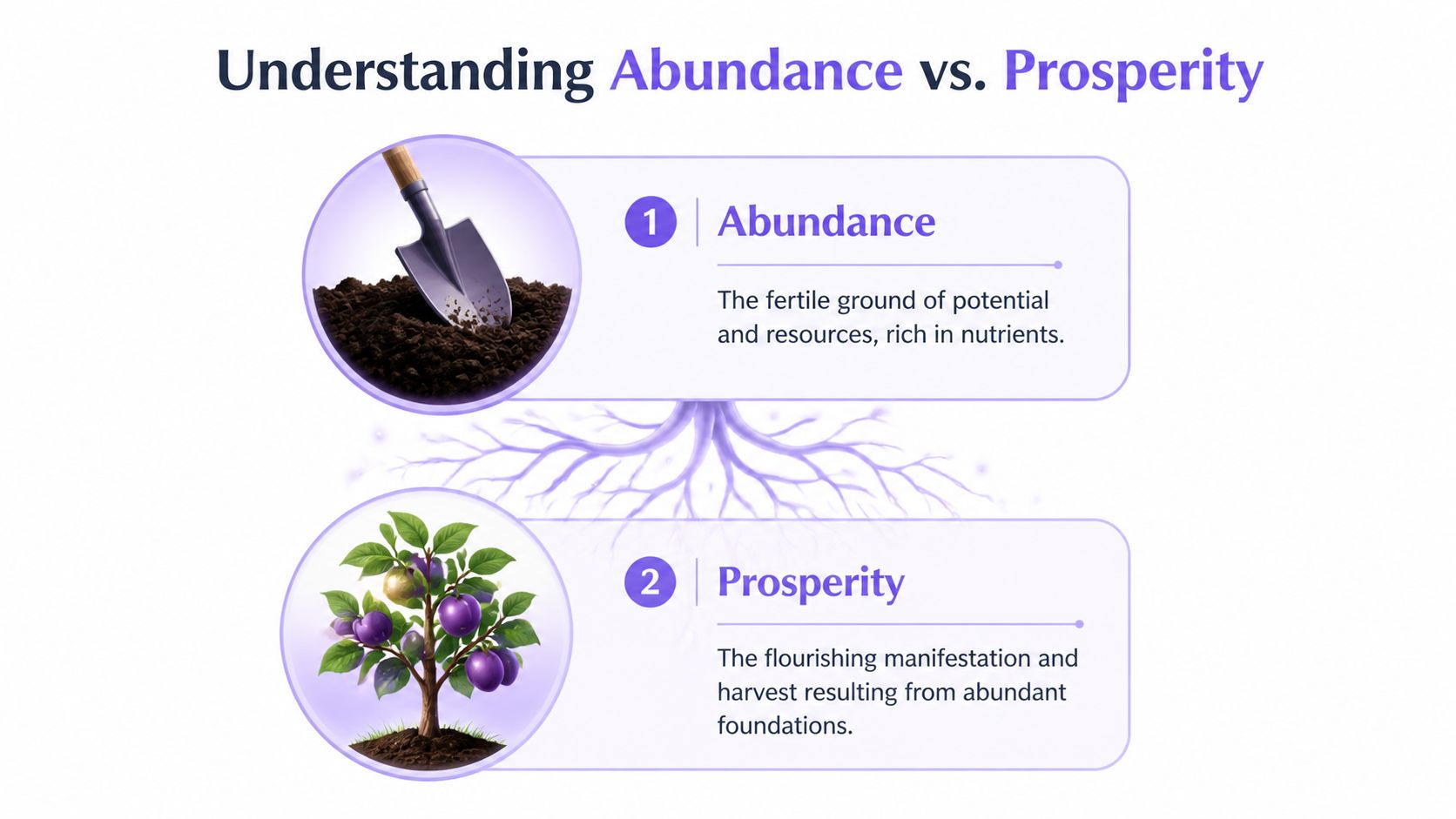
A simple way to understand abundance and prosperity is to picture a garden. Abundance is the soil. Prosperity is the harvest.
If the soil is dry, depleted, and neglected, the harvest will be inconsistent. If the soil is nourished, rooted, and alive, growth has somewhere to begin. In human terms, abundance is your inner relationship with enoughness, worthiness, possibility, and trust. Prosperity is the outward expression of that relationship in your money, health, work, time, relationships, and peace of mind.
Abundance starts inside
Abundance is not the same as excess.
You can own a lot and still live in fear. You can have a modest season and still think, choose, and respond from sufficiency. That’s why some people sabotage opportunities the moment they arrive. Their external life starts growing faster than their internal capacity to receive.
A grounded abundance mindset sounds like this:
- I can grow my capacity
- Someone else’s success doesn’t reduce my chances
- I am allowed to want more
- I can make decisions from clarity instead of panic
These beliefs create emotional room. And emotional room changes behavior.
Prosperity shows up in lived reality
Prosperity is tangible. It includes resources, yes, but also freedom, stability, and the sense that your effort creates meaningful return.
One useful way to think about prosperity is through time price, which asks how many hours of work it takes to buy a standard basket of goods. According to the American Abundance Index analysis, from March 2006 to December 2025, the hours of work needed to buy that basket fell 12.16 percent. That means the average worker’s real purchasing power improved, even after accounting for inflation.
That matters because prosperity isn’t only about how much money comes in. It’s also about how much life energy you have to trade for what you need.
| Term | Simple meaning | Everyday example |
|---|---|---|
| Abundance | Inner sense of enough and possibility | You stop making choices only from fear |
| Prosperity | Outer expression of well-being and access | Your work buys more freedom, security, or ease |
Why the difference matters
If you chase prosperity without building abundance, you may hit goals and still feel deprived. If you nurture abundance without acting in the tangible world, you may feel inspired but remain stuck.
Healthy growth needs both. You care for the soil, and you tend the crop.
The Science Behind an Abundant Mindset
You open your banking app, see a number that feels too small, and your body tightens before you’ve even finished your morning tea. In that moment, “abundance” can sound like a pretty word with no practical use. But mindset work is not about pretending problems do not exist. It is about training your mind so you can respond with steadier judgment, better choices, and more room to act.
Your brain learns from repetition. A thought you practice often becomes easier to access, much like a footpath that becomes clearer each time you walk it. If your mind repeatedly rehearses danger, shortage, and failure, those patterns become familiar. If you repeatedly practice thoughts tied to possibility, learning, and support, those pathways become easier to use under stress.
A scarcity mindset narrows attention. It pulls focus toward what might go wrong and makes the future feel smaller than it is. An abundant mindset widens attention. It helps you notice options, resources, and next steps that panic often hides.

Your mind follows repeated instructions
This helps explain why affirmations can support real change when they are grounded, believable, and repeated consistently. Researchers studying self-affirmation have found that these practices can reduce defensiveness, support self-regulation, and strengthen receptivity to positive behavior change. Neuroimaging research has also shown that self-affirmation engages brain regions involved in self-related processing and valuation, which helps explain why repeated inner language can shape later choices.
That does not make affirmations magic. They do not replace budgeting, skill-building, or wise planning. They improve the mental setting in which those actions happen. This shift in mindset is significant because a person who often thinks, “I can learn to handle money well,” is more likely to pause, plan, and follow through than someone who keeps repeating, “I ruin everything.”
If you want a closer look at the research, the science of affirmations gives a clear explanation of how repeated self-talk can influence behavior over time.
Prosperity involves more than income
This is also where people often get confused. They assume abundance thinking is only about earning more money. Money can improve options, safety, and access, but prosperity is broader than that. It includes agency, trust, emotional steadiness, supportive relationships, and the feeling that your life has room to grow.
Researchers who study prosperity across countries have found that well-being includes psychological and social dimensions alongside material ones. In plain terms, a fuller life is not built from income alone. Freedom, meaning, and connection shape how prosperity feels in daily experience.
That idea helps bridge the “why” and the “how” of this work. The psychology matters because your inner state affects how you earn, spend, ask, receive, recover, and persist. Daily practice matters because repeated small actions teach the nervous system that growth can feel safe.
Scarcity and abundance in daily life
These mindsets show up in ordinary moments:
Scarcity says
“If someone else succeeds, there is less for me.”
“I need complete certainty before I begin.”
“One mistake means I am back at zero.”Abundance says
“Another person’s success can expand what I believe is possible.”
“I can begin with imperfect clarity.”
“Setbacks can teach me something useful.”
Practical rule: Repeat the thoughts you want available when stress gets loud.
Why repetition works better than intensity
Many beginners expect one powerful breakthrough to change everything. The mind usually changes more subtly than that. You notice a softer reaction to a bill. You ask for help sooner. You stop assuming every delay means failure.
That is how an abundant mindset grows.
It works like strengthening a muscle with steady, manageable reps. One repetition does not look dramatic. Weeks of practice change what feels natural. That is why daily tools matter so much. A simple, repeatable practice can help turn insight into habit, which is what makes inner change visible in your decisions, your energy, and eventually your results.
Identifying Your Hidden Blocks to Prosperity
Most blocks to prosperity don’t announce themselves clearly. They hide inside normal-sounding thoughts.
“I shouldn’t want too much.”
“If I do well, people will judge me.”
“Money changes people.”
“I’m already behind, so what’s the point?”
These are not facts. They are often inherited narratives. You may have picked them up from family tension, cultural messaging, painful experiences, or years of watching other people struggle. Once absorbed, they shape what feels safe.
Four common hidden narratives
Some blocks are especially common among thoughtful, caring people:
Worthiness wounds
You may believe abundance must be earned through exhaustion, not received with openness.Fear of outgrowing others
A part of you may worry that success will create distance in relationships you value.Imposter thinking
When good things start arriving, your mind may insist you’re fooling everyone.Comparison habits
You compare your real, unfinished life to someone else’s polished highlight reel.
These patterns can keep you emotionally loyal to struggle, even while you consciously say you want more.
A wider view of what’s possible
One helpful antidote is to challenge the belief that abundance is disappearing or reserved for a shrinking few.
According to World Data Lab projections summarized by the World Economic Forum, if current trends continue, the world’s prosperous population, defined as people living on $25 or more per day, is projected to outnumber the non-prosperous for the first time in history in 2049. That is a projection, not a guarantee, but it offers a powerful counter-story. Growth is possible at scale.
Your old belief may say, “There isn’t enough.” Reality may be more expansive than that belief allows.
Questions that reveal the real block
When you feel resistance around abundance and prosperity, pause and ask:
- What feels unsafe about having more?
- Who taught me this belief, directly or indirectly?
- What do I fear people would think if I became more prosperous?
- What might change if I stopped treating struggle as proof of virtue?
You don’t need to answer perfectly. You only need honesty.
Often the block isn’t greed, laziness, or lack of discipline. It’s grief, guilt, fear, or a nervous system that learned to expect disappointment. When you meet that with compassion, the block softens. And once it softens, new action becomes possible.
Daily Practices to Cultivate Abundance
A new mindset becomes believable when it shows up in ordinary moments. In the minute before you open your banking app. In the breath you take before replying to an email. In the way you speak to yourself after a setback.
That is why daily practice matters. You are teaching your mind and body a new pattern, the same way a gardener waters a plant a little at a time instead of flooding it once and hoping for the best.

You do not need a perfect routine. You need a few practices gentle enough to repeat when life is full. That is how the "why" of abundance becomes the "how."
Practice one with affirmations
Affirmations are most useful when they feel steady, grounded, and slightly expansive. If a sentence feels wildly untrue, your mind will argue with it. If it feels too small, it will not move you. A good affirmation sits in the middle. It gives your attention a better place to rest.
Try reading these slowly, out loud if possible:
- I am open to receiving support, opportunities, and growth.
- I trust myself to create a stable and meaningful life.
- There is enough room for me to succeed in my own way.
- I release the habit of expecting less for myself.
- I am becoming someone who handles prosperity with wisdom.
- My work, energy, and creativity can create real value.
- I welcome abundance without guilt.
Pick one or two that create a small shift in your body. Maybe your shoulders drop. Maybe your breathing softens. That is enough.
If you want help making this repeatable, building a daily practice usually starts by making the habit easier to return to.
Practice two with journaling
Journaling gives hidden beliefs a place to come into view. Spoken thoughts move quickly. Writing slows them down, which makes patterns easier to notice.
Write by hand if you can. Pen and paper work like a slower mirror.
Try prompts like these:
- If I knew I could not fail, what would I allow myself to pursue?
- What belief about money, success, or worth am I ready to outgrow?
- Where in my life do I already have more than I give myself credit for?
- What would prosperity feel like in my body, not just on paper?
- What small act today would match the person I’m becoming?
Do not aim for polished writing. Aim for truth.
Write the sentence you normally avoid. That’s often where the most important work begins.
Practice three with visualization
Visualization helps your nervous system rehearse a different experience. Many people know what they want in theory, but their body still expects pressure, scarcity, or disappointment. A short mental rehearsal can make a calmer response feel more familiar.
Try this short script:
- Sit comfortably and take a few slow breaths.
- Picture yourself six months or a year from now, living with more steadiness.
- Notice small details. Your posture. Your morning routine. The way you check your bank account, answer emails, or make decisions.
- See yourself acting without the old panic.
- Let your body register the feeling of calm capability.
A short guided clip can help you settle into the practice:
Prosperity grows through more than income
As noted earlier, research on well-being points to a wider picture than money alone. Income can support stability, but people also feel more alive and satisfied when they experience freedom, connection, and generosity. That matters for abundance work because it keeps your practice from becoming narrow or performative.
In everyday life, prosperity often looks like this. More choice. Less fear. More willingness to receive help and share what you have.
A simple weekly rhythm can help:
| Day focus | Tiny action |
|---|---|
| Morning reset | Read one affirmation three times |
| Midday pause | Ask, “What would abundance choose here?” |
| Evening reflection | Journal for a few minutes |
| Weekly review | Notice any thought that feels softer or stronger |
Keep it light. Repetition builds trust.
Build Your Abundance Habit with the I Become App
Individuals don’t struggle because they lack insight. They struggle because insight fades by Tuesday.
You might read a meaningful article, feel inspired for a day, and then get pulled back into old thought loops by work stress, notifications, and ordinary life. That’s why consistency matters more than intensity. A gentle practice you repeat will do more for abundance and prosperity than a dramatic reset you abandon.
I Become is designed for exactly that kind of consistency.
A simple way to turn intention into routine
The app helps you keep affirmations present instead of accidental. You can choose focus areas that match your current season, then work with daily statements in ways that fit how you learn best.
Its four practice modes make the habit feel personal:
- Read when you want a calm, quick reset
- Speak when you want to hear confidence in your own voice
- Listen when you’re walking, commuting, or winding down
- Write when you want deeper reflection and reinforcement
That variety matters. Some days you need stillness. Some days you need repetition. Some days you need a practice that meets you where your energy is.
Making abundance visible all day
One of the hardest parts of mindset work is remembering it in the exact moment you need it.
That’s where widgets and notifications help. Instead of waiting until a perfect self-care window appears, you let the practice come to you. A sentence on your Lock Screen can interrupt an old spiral before it gathers force. A timely notification can remind you that you have another option besides criticism or fear.
If you want a full look at how the app supports habit-building, the I Become features page walks through the experience clearly.
A practical setup that works
A beginner-friendly rhythm might look like this:
- Choose a small theme such as worthiness, calm, financial confidence, or receiving.
- Save a short list of affirmations you can repeat without resistance.
- Use one mode in the morning and another in the evening.
- Turn on gentle reminders so the practice stays visible.
- Track your streak as encouragement, not pressure.
The goal isn’t perfection. It’s familiarity. You’re teaching your mind a new home.
If you’re ready to make abundance and prosperity a daily practice instead of a vague intention, download I Become from the App Store. It’s a simple, encouraging iOS app that helps you build an affirmation habit through daily prompts, widgets, and Read, Speak, Listen, and Write modes, so your mindset work can become steady, personal, and real.
Found this helpful? Share it with someone who might benefit.